Thank you for visiting SNEWPapers!
Sign up free
Story
December 6, 1868
The New Orleans Crescent
New Orleans, Orleans County, Louisiana
What is this article about?
Speculative essay on historical and future migrations driven by overpopulation, improved navigation, and industrialization, focusing on Europe and China potentially flooding the New World with emigrants, leading to profound social changes.
Clipping
OCR Quality
98%
Excellent
Full Text
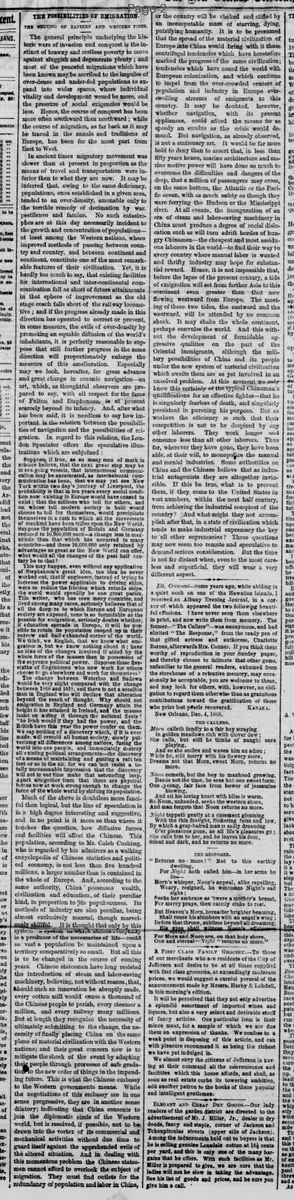
THE POSSIBILITIES OF EMIGRATION.
THE MEETING OF EASTERN AND WESTERN TIDES
The general principle underlying the historic wars of invasion and conquest is the instinct of brawny and restless poverty to move against sluggish and degenerate plenty; and most of the peaceful migrations which have been known may be ascribed to the impulse of over-dense and under-fed populations to expand into wider spaces, where individual vitality and development would be more, and the pressure of social exigencies would be less. Hence, the course of conquest has been more often southward than northward; while the course of migration, as far back as it may be traced in the annals and traditions of Europe, has been for the most part from East to West.
In ancient times migratory movement was slower than at present in proportion as the means of travel and transportation were inferior then to what they are now. It may be inferred that, owing to the same deficiency, populations, once established in a given area, tended to an over-density, amenable only to the terrible remedy of decimation by war, pestilence and famine. No such catastrophes are at this day necessarily incident to the growth and concentration of populations—at least among the Western nations, where improved methods of passing between country and country, and between continent and continent, constitute one of the most remarkable features of their civilization. Yet, it is hardly too much to say, that existing facilities for international and inter-continental communication fall as short of future attainments in that sphere of improvement as the old stage coach falls short of the railway locomotive; and if the progress already made in this direction has operated to correct or prevent, in some measure, the evils of over-density by promoting an equable diffusion of the world's inhabitants, it is perfectly reasonable to suppose that still further progress in the same direction will proportionately enlarge the measure of this amelioration. Especially may we look, hereafter, for great advance and great change in oceanic navigation—an art, which, as thoughtful observers are prepared to say, with all respect for the fame of Fulton and Stephenson, is at present scarcely beyond its infancy. And, after what has been said, it is needless to say how important is the relation between the possibilities of navigation and the possibilities of migration. In regard to this relation, the London Spectator offers the speculative illustrations which are subjoined:
Suppose, if true, as so many men of mark in science believe, that the next great step may be in sea-going vessels, that international communication may be accelerated, as international communication has been, that we may yet see New York within two days' journey of Liverpool, the probability is that in ten years every social condition now existing in Europe would have ceased to exist; that the millions who toil for others, and on whose toil modern society is built would choose to toil for themselves, would precipitate themselves in a rush to which all the movements of mankind have been trifles upon the New World. Suppose the population of Britain and Germany reduced to 10,000,000 each—a change less in magnitude than that which has occurred in many countries—and these 10,000,000 only retained by advantages as great as the New World can offer. What would all the changes of the past half century be to that?
This may happen, even without any application of Stephenson's great idea, the idea he never worked out, that if engineers, instead of trying to increase the power applicable to driving ships, were to reduce the friction which retards ships, the world would speedily be one great parish. This writer, who has seen many countries, and lived among many races, seriously believes that of all the dangers to which Europe and European society are exposed, none is so formidable as the passion for emigration, seriously doubts whether, if education spreads in Europe, it will be possible to retain its population cooped up in their narrow and half-exhausted corner of the world. We think, we English, that we know what emigration is, but we know nothing about it; have no idea of the changes involved if aided by the whole force of the masses then in possession of the supreme political power. Suppose those five-sixths of Englishmen who now work for others choose to go elsewhere and work for themselves? The change between Waterloo and Sadowa would be very slight compared with the change between 1868 and 1815, and there is not a sensible man in England who will declare that alteration beyond the reach of thought. Why should not emigration in England and Germany attain the height it has attained in Ireland, and the masses insist on aiding it through the national fleets? The Irish would if they had the power, and the British have this year the power conferred on them. We say nothing of a discovery which, if it is ever made, will remodel all human society, slowly pulverizing all differences among nations, fusing the world into one people, and immediately destroy all existing political arrangements—the discovery of a means of maintaining and guiding a raft ten feet or so in the air, for we cannot resist a totally unreasonable impression that the discovery will not in our time make that astounding leap. Apart altogether from that there are physical forces now at work strong enough to change the face of the whole world by shifting its population.
Much of the above is doubtless more fanciful than logical, but the line of speculation is in a high degree interesting and suggestive, and in no point is it more so than where it touches the question, how diffusive forces and facilities will affect the Chinese. This population, according to Mr. Caleb Cushing, who is regarded by his admirers as a walking encyclopedia of Chinese statistics and political economy, is not less than five hundred millions, a larger number than is contained in the whole of Europe. And, according to the same authority, China possesses wealth, civilization and education, of their peculiar kind, in proportion to its populousness. Its methods of industry are also peculiar, being almost exclusively manual, though marvellously skillful. It is thought that only by this system—a system in which almost everybody is a producer of the necessaries of life—could so vast a population be maintained upon a territory comparatively so small. But all this is to be changed in the course of coming years. Chinese statesmen have long resisted the introduction of steam and labor-saving machinery, believing, not without reason, that, should such an innovation be abruptly made, every cotton mill would cause a thousand of the Chinese people to perish, every steamer a million, and every railway many millions. But at length they recognize the necessity of ultimately submitting to the change, the necessity of finally placing China on the same plane of material civilization with the Western nations; and their great concern now is to mitigate the shock of the event by adapting their people through processes of safe gradation to the new order of things in the impending future. This is what the Chinese embassy to the Western governments means. While the negotiations of this embassy are in one sense progressive, they are in another sense dilatory; indicating that China consents to join the diplomatic circle of the Western world, but is resolved, if possible, not to be drawn into the vortex of its commercial and mechanical activities without due time to guard itself against the apprehended evils of the altered situation. And in dealing with this momentous problem the Chinese statesmen cannot afford to overlook the subject of migration. They must find outlets for the redundancy of population and labor in China, or the country will be choked and stifled by an incomputable mass of starving, dying, putrifying humanity. It is to be presumed that the spread of the material civilization of Europe into China would bring with it those centrifugal tendencies which have heretofore marked the progress of the same civilization: tendencies which have zoned the world with European colonization, and which continue to impel from the over-crowded centers of population and industry in Europe ever-swelling streams of emigrants to this country. It may be doubted, however whether navigation, with its present appliances, could afford the means for as speedy an exodus as the crisis would demand. But navigation, as already observed, is not a stationary art. It would be far more bold to deny than to assert that, in less than fifty years hence, marine architecture and marine motive power will have done so much to overcome the difficulties and dangers of the deep, that a million of passengers may cross, on the same bottom, the Atlantic or the Pacific ocean, with as much safety as though they were ferrying the Hudson or the Mississippi river. At all events, the inauguration of an era of steam and labor-saving machinery in China must produce a degree of social dislocation such as will turn adrift hordes of hungry Chinamen—the cheapest and most assiduous laborers in the world—to find their way to every country where manual labor is wanted and thrifty industry may hope for substantial reward. Hence, it is not impossible that, before the lapse of the present century, a tide of emigration will set from farther Asia to this continent even greater than that now flowing westward from Europe. The meeting of these two tides, the eastward and the westward, will be attended by no common shock. It may shake the whole continent, perhaps convulse the world. And this without the development of formidable aggressive qualities on the part of the Oriental immigrants, although the military possibilities of China and its people under the new system of material civilization which awaits them are as yet involved in an unsolved problem. At this moment we only know this certainly of the typical Chinaman's qualifications for an effective fighter—that he is singularly fearless of death, and singularly persistent in pursuing his purpose. But as workers the efficiency is such that their competition is not to be despised by any other laborers. They work longer and consume less than all other laborers. Thus far, wherever they have gone, they have been able, at their will, to monopolize the manual and menial industries. Some authorities on China and the Chinese believe that as industrial antagonists they are altogether invincible. If this be true, what is to prevent them, if they come to the United States in vast numbers, within the next half century, from achieving the industrial conquest of the country? And what might they not accomplish after that, in a state of civilization which tends to make industrial supremacy the key to all other supremacies? These questions may now seem too remote and speculative to demand serious consideration. But the time is not far distant when, even to the most careless and superficial, they will wear a very different aspect.
THE MEETING OF EASTERN AND WESTERN TIDES
The general principle underlying the historic wars of invasion and conquest is the instinct of brawny and restless poverty to move against sluggish and degenerate plenty; and most of the peaceful migrations which have been known may be ascribed to the impulse of over-dense and under-fed populations to expand into wider spaces, where individual vitality and development would be more, and the pressure of social exigencies would be less. Hence, the course of conquest has been more often southward than northward; while the course of migration, as far back as it may be traced in the annals and traditions of Europe, has been for the most part from East to West.
In ancient times migratory movement was slower than at present in proportion as the means of travel and transportation were inferior then to what they are now. It may be inferred that, owing to the same deficiency, populations, once established in a given area, tended to an over-density, amenable only to the terrible remedy of decimation by war, pestilence and famine. No such catastrophes are at this day necessarily incident to the growth and concentration of populations—at least among the Western nations, where improved methods of passing between country and country, and between continent and continent, constitute one of the most remarkable features of their civilization. Yet, it is hardly too much to say, that existing facilities for international and inter-continental communication fall as short of future attainments in that sphere of improvement as the old stage coach falls short of the railway locomotive; and if the progress already made in this direction has operated to correct or prevent, in some measure, the evils of over-density by promoting an equable diffusion of the world's inhabitants, it is perfectly reasonable to suppose that still further progress in the same direction will proportionately enlarge the measure of this amelioration. Especially may we look, hereafter, for great advance and great change in oceanic navigation—an art, which, as thoughtful observers are prepared to say, with all respect for the fame of Fulton and Stephenson, is at present scarcely beyond its infancy. And, after what has been said, it is needless to say how important is the relation between the possibilities of navigation and the possibilities of migration. In regard to this relation, the London Spectator offers the speculative illustrations which are subjoined:
Suppose, if true, as so many men of mark in science believe, that the next great step may be in sea-going vessels, that international communication may be accelerated, as international communication has been, that we may yet see New York within two days' journey of Liverpool, the probability is that in ten years every social condition now existing in Europe would have ceased to exist; that the millions who toil for others, and on whose toil modern society is built would choose to toil for themselves, would precipitate themselves in a rush to which all the movements of mankind have been trifles upon the New World. Suppose the population of Britain and Germany reduced to 10,000,000 each—a change less in magnitude than that which has occurred in many countries—and these 10,000,000 only retained by advantages as great as the New World can offer. What would all the changes of the past half century be to that?
This may happen, even without any application of Stephenson's great idea, the idea he never worked out, that if engineers, instead of trying to increase the power applicable to driving ships, were to reduce the friction which retards ships, the world would speedily be one great parish. This writer, who has seen many countries, and lived among many races, seriously believes that of all the dangers to which Europe and European society are exposed, none is so formidable as the passion for emigration, seriously doubts whether, if education spreads in Europe, it will be possible to retain its population cooped up in their narrow and half-exhausted corner of the world. We think, we English, that we know what emigration is, but we know nothing about it; have no idea of the changes involved if aided by the whole force of the masses then in possession of the supreme political power. Suppose those five-sixths of Englishmen who now work for others choose to go elsewhere and work for themselves? The change between Waterloo and Sadowa would be very slight compared with the change between 1868 and 1815, and there is not a sensible man in England who will declare that alteration beyond the reach of thought. Why should not emigration in England and Germany attain the height it has attained in Ireland, and the masses insist on aiding it through the national fleets? The Irish would if they had the power, and the British have this year the power conferred on them. We say nothing of a discovery which, if it is ever made, will remodel all human society, slowly pulverizing all differences among nations, fusing the world into one people, and immediately destroy all existing political arrangements—the discovery of a means of maintaining and guiding a raft ten feet or so in the air, for we cannot resist a totally unreasonable impression that the discovery will not in our time make that astounding leap. Apart altogether from that there are physical forces now at work strong enough to change the face of the whole world by shifting its population.
Much of the above is doubtless more fanciful than logical, but the line of speculation is in a high degree interesting and suggestive, and in no point is it more so than where it touches the question, how diffusive forces and facilities will affect the Chinese. This population, according to Mr. Caleb Cushing, who is regarded by his admirers as a walking encyclopedia of Chinese statistics and political economy, is not less than five hundred millions, a larger number than is contained in the whole of Europe. And, according to the same authority, China possesses wealth, civilization and education, of their peculiar kind, in proportion to its populousness. Its methods of industry are also peculiar, being almost exclusively manual, though marvellously skillful. It is thought that only by this system—a system in which almost everybody is a producer of the necessaries of life—could so vast a population be maintained upon a territory comparatively so small. But all this is to be changed in the course of coming years. Chinese statesmen have long resisted the introduction of steam and labor-saving machinery, believing, not without reason, that, should such an innovation be abruptly made, every cotton mill would cause a thousand of the Chinese people to perish, every steamer a million, and every railway many millions. But at length they recognize the necessity of ultimately submitting to the change, the necessity of finally placing China on the same plane of material civilization with the Western nations; and their great concern now is to mitigate the shock of the event by adapting their people through processes of safe gradation to the new order of things in the impending future. This is what the Chinese embassy to the Western governments means. While the negotiations of this embassy are in one sense progressive, they are in another sense dilatory; indicating that China consents to join the diplomatic circle of the Western world, but is resolved, if possible, not to be drawn into the vortex of its commercial and mechanical activities without due time to guard itself against the apprehended evils of the altered situation. And in dealing with this momentous problem the Chinese statesmen cannot afford to overlook the subject of migration. They must find outlets for the redundancy of population and labor in China, or the country will be choked and stifled by an incomputable mass of starving, dying, putrifying humanity. It is to be presumed that the spread of the material civilization of Europe into China would bring with it those centrifugal tendencies which have heretofore marked the progress of the same civilization: tendencies which have zoned the world with European colonization, and which continue to impel from the over-crowded centers of population and industry in Europe ever-swelling streams of emigrants to this country. It may be doubted, however whether navigation, with its present appliances, could afford the means for as speedy an exodus as the crisis would demand. But navigation, as already observed, is not a stationary art. It would be far more bold to deny than to assert that, in less than fifty years hence, marine architecture and marine motive power will have done so much to overcome the difficulties and dangers of the deep, that a million of passengers may cross, on the same bottom, the Atlantic or the Pacific ocean, with as much safety as though they were ferrying the Hudson or the Mississippi river. At all events, the inauguration of an era of steam and labor-saving machinery in China must produce a degree of social dislocation such as will turn adrift hordes of hungry Chinamen—the cheapest and most assiduous laborers in the world—to find their way to every country where manual labor is wanted and thrifty industry may hope for substantial reward. Hence, it is not impossible that, before the lapse of the present century, a tide of emigration will set from farther Asia to this continent even greater than that now flowing westward from Europe. The meeting of these two tides, the eastward and the westward, will be attended by no common shock. It may shake the whole continent, perhaps convulse the world. And this without the development of formidable aggressive qualities on the part of the Oriental immigrants, although the military possibilities of China and its people under the new system of material civilization which awaits them are as yet involved in an unsolved problem. At this moment we only know this certainly of the typical Chinaman's qualifications for an effective fighter—that he is singularly fearless of death, and singularly persistent in pursuing his purpose. But as workers the efficiency is such that their competition is not to be despised by any other laborers. They work longer and consume less than all other laborers. Thus far, wherever they have gone, they have been able, at their will, to monopolize the manual and menial industries. Some authorities on China and the Chinese believe that as industrial antagonists they are altogether invincible. If this be true, what is to prevent them, if they come to the United States in vast numbers, within the next half century, from achieving the industrial conquest of the country? And what might they not accomplish after that, in a state of civilization which tends to make industrial supremacy the key to all other supremacies? These questions may now seem too remote and speculative to demand serious consideration. But the time is not far distant when, even to the most careless and superficial, they will wear a very different aspect.
What sub-type of article is it?
Historical Event
Journey
Curiosity
What themes does it cover?
Exploration
Misfortune
Survival
What keywords are associated?
Emigration
Migration
Overpopulation
Navigation
China
Europe
Industrialization
Social Change
What entities or persons were involved?
Caleb Cushing
Where did it happen?
Europe, China, New World
Story Details
Key Persons
Caleb Cushing
Location
Europe, China, New World
Story Details
Essay explores historical migrations from east to west due to overpopulation, speculates on future mass emigrations from Europe and China enabled by advanced navigation and industrialization, predicting profound global social and economic disruptions from clashing tides of emigrants.