Thank you for visiting SNEWPapers!
Sign up free
Rhode Island Republican
Newport, Newport County, Rhode Island
What is this article about?
A letter to Mr. Farnsworth defends Governor Arthur Fenner against accusations of blocking payments for depreciation claims to officers and soldiers of Revolutionary War regiments under Colonels Elliott, Topham, and Crary. It argues that post-1788 allowances by Rhode Island would not be reimbursed by the U.S., burdening the state, and highlights inaction under prior Governor William Greene.
Merged-components note: Merging the split sections of the 'SERIOUS CONSIDERATIONS!' letter to the editor across pages 2 and 3, as the content continues seamlessly from one to the next. Relabeling the second part from editorial to letter_to_editor to match the overall content.
Clippings
1 of 2
OCR Quality
Full Text
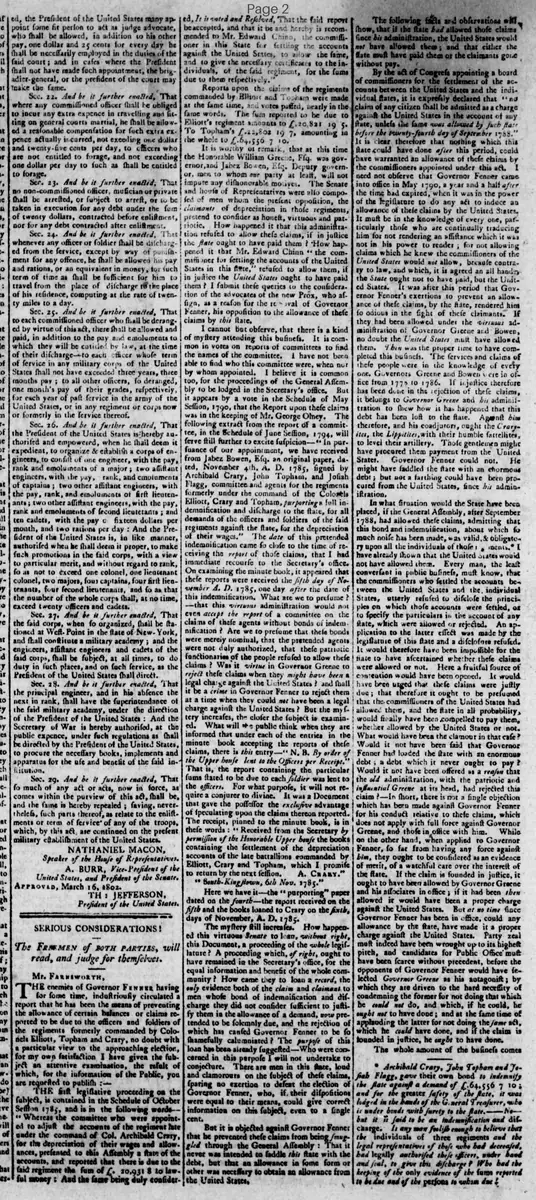
The FREEMEN of BOTH PARTIES, Will read, and judge for themselves.
Mr. Farnsworth,
THE enemies of Governor Fenner having for some time, industriously circulated a report that he has been the means of preventing the allowance of certain balances or claims reported to be due to the officers and soldiers of the regiments formerly commanded by Colonels Elliott, Topham and Crary, no doubt with a particular view to the approaching election, for my own satisfaction I have given the subject an attentive examination, the result of which, for the information of the Public, you are requested to publish:-
The said legislative proceeding on the subject, is contained in the Schedule of October Session 1785, and is in the following words--
"Whereas the committee who were appointed to adjust the accounts of the regiment late under the command of Col. Archibald Crary, for the depreciation of their wages and allowances, presented to this Assembly a state of the accounts, and reported that there is due to the said regiment the sum of L. 20,931 8s. to lawful money: And the same being duly considered, It is voted and Resolved, That the said report be accepted, and that it be and hereby is recommended to Mr. Edward Chinn, the commissioner in this State for settling the accounts against the United States, to allow the same, and to give the necessary certificates to the individuals, of the said regiment, or the sums due to them respectively."
Reports upon the claims of the regiments commanded by Elliott and Topham were made at the same time, and votes passed, nearly in the same words. The sum reported to be due to Elliott's regiment amounts to L.20,821 19s. 5d. To Topham's L.22,802 19s. 7d. amounting in the whole to L.64,556 7s. 10d.
It is worthy of remark, that at this time the Honorable William Greene, Esq. was governor, and Jabez Bowen, Esq. Deputy governor, men to whom one party at least, will not impute any dishonorable motives. The Senate and house of Representatives were also composed of men whom the present opposition, the claimants of depreciation in those regiments, pretend to consider as honest, virtuous and patriotic. How happened it that this administration refused to allow these claims, if in justice the state ought to have paid them? How happened it that Mr. Edward Chinn "the commissioner for settling the accounts of the United States in this state," refused to allow them, if in justice the United States ought to have paid them? I submit these queries to the consideration of the advocates of the new Prox, who assign, as a reason for the removal of Governor Fenner, his opposition to the allowance of these claims by this state.
I cannot but observe, that there is a kind of mystery attending this business. It is common in votes on reports of committees to find the names of the committee. I have not been able to find who this committee were, nor by whom appointed. I believe it is common too, for the proceedings of the General Assembly to be lodged in the Secretary's office. But it appears by a vote in the Schedule of May Session, 1790, that the Report upon these claims was in the keeping of Mr. George Olney. The following extract from the report of a committee, in the Schedule of June Session, 1794, will serve still further to excite suspicion--"In pursuance of our appointment, we have received from Jabez Bowen, Esq. an original paper, dated, November 4th. A. D. 1785, signed by Archibald Crary, John Topham, and Josiah Flagg, committee and agents for the regiments formerly under the command of the Colonels Elliott, Crary and Topham, purporting as follows in indemnification and discharge to the state, for all demands of the officers and soldiers of the said regiments against the state, for the depreciation of their wages." The date of this pretended indemnification came so close to the time of receiving the report of those claims, that I had immediate recourse to the Secretary's office. On examining the minute book, it appeared that these reports were received the fifth day of November A. D. 1785, one day after the date of this indemnification. What are we to presume? -that this virtuous administration would not even accept the report of a committee on the claims of these agents without bonds of indemnification? Are we to presume that these bonds were merely nominal, that the pretended agents were not duly authorized, that these patriotic functionaries of the people refused to allow these claims? Was it virtue in Governor Greene to reject these claims when they might have been a legal charge against the United States? and shall it be a crime in Governor Fenner to reject them at a time when they could never have been a legal charge against the United States? But the mystery increases, the closer the object is examined. What will the public think when they are informed that under each of the entries in the minute book accepting the reports of these claims, there is this entry--"N. B. By order of the Upper house lent to the Officers per Receipt." That is, the report containing the particular sums stated to be due to each soldier was lent to the officers. For what purpose, it will not require a conjurer to divine. It was a Document that gave the possessor the exclusive advantage of speculating upon the claims thereon reported. The receipt, pinned to the minute book, is in these words: "Received from the Secretary by permission of the Honorable Upper house the books containing the settlement of the depreciation accounts of the late battalions commanded by Elliott, Crary and Topham, which I promise to return by the next session. A. Crary." "South-Kingstown, 6th Nov. 1785."
Here we have it--the "purporting" paper dated on the fourth--the report received on the fifth and the books loaned to Crary on the sixth, days of November, A. D. 1785.
The mystery still increases. How happened this virtuous Senate to loan, without right, this Document, a proceeding of the whole legislature? A proceeding which, of right, ought to have remained in the Secretary's office, for the equal information and benefit of the whole community? How came they to loan a record, the only evidence both of the claim and claimant to men whose bond of indemnification and discharge they did not consider sufficient to justify them in the allowance of a demand, now pretended to be solemnly due, and the rejection of which has caused Governor Fenner to be so shamefully calumniated? The purpose of this loan has been already suggested--Who were concerned in this purpose I will not undertake to conjecture. There are men in this state, loud and clamorous on the subject of these claims, sparing no exertion to defeat the election of Governor Fenner, who, if their dispositions were equal to their means, could give correct information on this subject, even to a single cent.
But it is objected against Governor Fenner that he prevented these claims from being brought through the General Assembly: That it never was intended to saddle this state with the debt, but that an allowance in some form or other was necessary to obtain an allowance from the United States.
The following facts and observations will show, that if the state had allowed those claims since his administration, the United States would not have allowed them; and that either the state must have paid them or the claimants gone without pay.
By the act of Congress appointing a board of commissioners for the settlement of the accounts between the United States and the individual states, it is expressly declared that "no claim of any citizen shall be admitted as a charge against the United States in the account of any state, unless the same was allowed by such state before the twenty-fourth day of September 1788." It is clear therefore that nothing which this state could have done since this period, could have warranted an allowance of these claims by the commissioners appointed under this act. I need not observe that Governor Fenner came into office in May 1790, a year and a half after the time had expired, when it was in the power of the legislature to do any act to induce an allowance of these claims by the United States. It must be in the knowledge of every one, particularly those who are continually traducing him for not rendering an assistance which it was not in his power to render; for not allowing claims which he knew the commissioners of the United States would not allow, because contrary to law, and which, it is agreed on all hands the State ought not to have paid, but the United States. It was after this period that Governor Fenner's exertions to prevent an allowance of these claims, by the state, rendered him so odious in the sight of these claimants. If they had been allowed under the virtuous administration of Governor Greene and Bowen, no doubt the United States must have allowed them. Then was the proper time to have completed this business. The services and claims of these people were in the knowledge of every one. Governors Greene and Bowen were in office from 1775 to 1786. If injustice therefore has been done in the rejection of these claims, it belongs to Governor Greene and his administration to show how it has happened that this debt has been lost to the state. Against him therefore, and his coadjutors, ought the Crary-ites, the Lippittites, with their humble attendants, to level their artillery. Those gentlemen might have procured them payment from the United States. Governor Fenner could not. He might have saddled the state with an enormous debt; but not a farthing could have been procured from the United States, since his administration.
In what situation would the State have been placed, if the General Assembly, after September 1788, had allowed these claims, admitting that this bond and indemnification, about which so much noise has been made, was valid & obligatory upon all the individuals of those regiments.* I have already shown that the United States would not have allowed them. Every man, the least conversant in public business, must know, that the commissioners who settled the accounts between the United States and the individual States, utterly refused to disclose the principles on which those accounts were settled, or to specify the particulars in the account of any state, which were allowed or rejected. An application to the latter effect was made by the legislature of this state and a disclosure refused. It would therefore have been impossible for the state to have ascertained whether these claims were allowed or not. Here a fruitful source of contestation would have been opened. It would have been urged that these claims were justly due; that therefore it ought to be presumed that the commissioners of the United States had allowed them, and the state in all probability, would finally have been compelled to pay them, whether allowed by the United States or not. What would have been the clamour in that case? Would it not have been said that Governor Fenner had loaded the state with an enormous debt; a debt which it never ought to pay? Would it not have been offered as a reason that the old administration, with the patriotic and influential Greene at its head, had rejected this claim?--In short, there is not a single objection which has been made against Governor Fenner for his conduct relative to these claims, which does not apply with full force against Governor Greene, and those in office with him. While on the other hand, when applied to Governor Fenner, so far from having any force against him, they ought to be considered as an evidence of merit, of a watchful care over the interest of the state. If the claim is founded in justice, it ought to have been allowed by Governor Greene and his associates in office; if it had been then allowed it would have been a proper charge against the United States. But at no time since Governor Fenner has been in office, could any allowance by the state, have made it a proper charge against the United States. Party zeal must indeed have been wrought up to its highest pitch, and candidates for Public Office must have been scarce without precedent, before the opponents of Governor Fenner would have elected Governor Greene as his antagonist; by which they are driven to the hard necessity of condemning the former for not doing that which he could not do, and which, if he could, he ought not to have done; and at the same time of applauding the latter for not doing the same act, which he could have done, and if the claim is founded in justice, he ought to have done.
The whole amount of the business comes to this--Archibald Crary, John Topham and Josiah Flagg, gave their own bond to indemnify the State against a demand of L.64,556 7s. 10d.: and for the greater safety of the State, it was lodged in the hands of the General Treasurer, who is under bonds with surety to the State.--Nevertheless it is said to be an indemnification and discharge: Is any man foolish enough to believe that the individuals of three regiments and the legal representatives of those who had deceased, had legally authorized these officers, under hand and seal, to give this discharge? Who had the keeping of the only evidence of the sums reported to be due and of the persons to whom due!
to this point:--Governor Greene and Governor Bowen had it in their power, at the time the committee reported in 178 to have assumed the payment of these balances, and then they would have been a legal charge against the United States; the officers and soldiers would have got their pay, and the amount of the balances would have passed to the credit of this state; which, in the whole, principal and interest, would amount at this day, to about four hundred and fifty thousand dollars! which is a clear loss to the state. This sum would readily have been allowed by the commissioners who adjusted the accounts between the United States and the individual states, had Governor Greene (and those in office in the state at the time the committee reported) agreed that the state should have assumed the payment of these balances.
ARTHUR FENNER came in Governor May 1790. The question respecting the state's assuming the payment of these balances, came before the Senate. Governor Fenner opposed the passage of the bill, on account of the law of Congress passed August 1 1790 (vol. 1, page 244) where it is enacted in the following words, "Nor shall the claim of any citizen be admitted as a charge against the United States in the account of any state unless the same was allowed by such state before the 24th day of September 1788."
If then, Governor Fenner had given his assent to this bill, and it had passed the Senate, it would have increased the state debt about four hundred and fifty thousand dollars, for services rendered to the United States. As well might he attempt the payment of the debts of other States as these balances, since Congress had solemnly declared they would not pay the amount of them. But by Governor Fenner's wisdom and good conduct in this business, as a Chief Magistrate, he has freed the state from a debt of not less than four hundred and fifty thousand dollars, which the citizens would now have been groaning under; and the very Speculators in Crary's balances would now have been laughing at your distresses. And for this, Fellow Citizens, Governor Fenner is to be turned out of office.
Fellow-Citizens, are you to be deceived by the speculators, the enemies of your liberties? No, you are not:--Then unite; rally round the standard of freedom, and act like men; and not sacrifice your liberties at the shrine of tyranny and oppression, and leave your posterity to linger out a wretched existence, through your folly and wickedness, in being misled by artful and designing men; but go to town meeting, and give your support for ARTHUR FENNER, as your Governor, a patriot of '75, and a friend to the people and the rights of man; but an enemy to speculators and jockeys.
FAIR PLAY.
What sub-type of article is it?
What themes does it cover?
What keywords are associated?
What entities or persons were involved?
Letter to Editor Details
Author
Fair Play
Recipient
Mr. Farnsworth
Main Argument
governor fenner rightly opposed allowing depreciation claims for revolutionary war regiments after 1788, as u.s. law barred reimbursement, preventing a massive state debt; prior governor greene failed to act when it could have been charged to the u.s.
Notable Details