Thank you for visiting SNEWPapers!
Sign up free
Lynchburg Virginian
Lynchburg, Virginia
What is this article about?
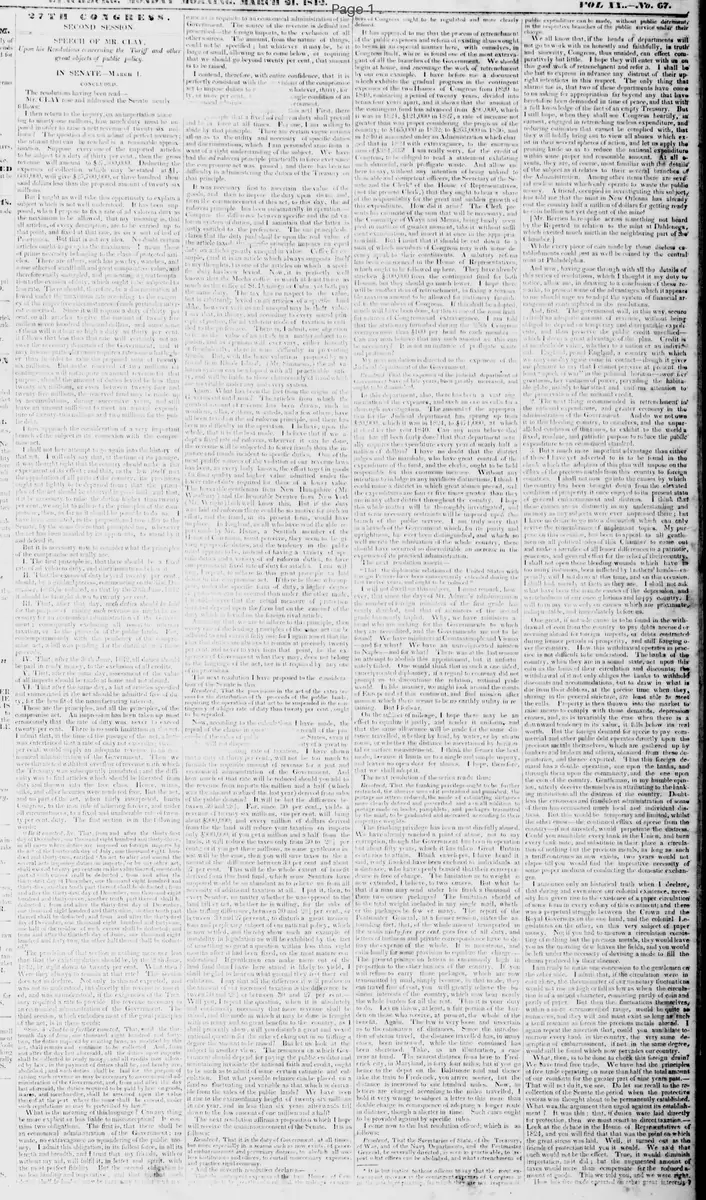
Conclusion of Henry Clay's March 1, 1842, U.S. Senate speech on tariff resolutions, defending the 1833 Compromise Act, proposing 30% ad valorem duties for revenue, government retrenchment, and protection for American industry amid economic distress.
Merged-components note: Continuation of Mr. Clay's speech on tariff and policy across pages 1 and 2, based on sequential reading order and content flow.
Clippings
1 of 2
OCR Quality
Full Text
SPEECH OF MR. CLAY.
Upon his Resolutions concerning the Tariff and other
goal objects of public policy.
IN SENATE—MARCH 1.
CONCLUDED.
The resolutions having been read—
Mr. CLAY rose and addressed the Senate nearly as follows:
I then return to the inquiry. On an importation amounting to ninety-one millions, how much duty must be imposed under to raise a nett revenue of twenty-six millions? The question does not admit of perfect accuracy;
the utmost that can be reached is a reasonable approxima-
tion. Suppose every one of the imported articles
to be subject to a duty of thirty per cent., then the gross
revenue will amount to $27,300,000. Deducting the
expenses of collection which may be stated at $1,500,000, will give $25,800,000, or three hundred thou-
sand dollars less than the proposed amount of twenty-six
millions.
But I might as well take this opportunity to explain a
subject which is not well understood. It has been sup-
posed, when I propose to fix a rate of ad valorem duty as
the maximum to be allowed, that my meaning is, that
all articles, of every description, are to be carried up to
that point, and fixed at that rate, as on a sort of bed of
Procrustes. But that is not my idea. No doubt certain
articles ought to go up to the maximum—mean these
of prime necessity belonging to the class of protected art-
cles. There are others, such as jewelry, watches, and
some others of small bulk and great comparative value, and
therefore easily smuggled, and presenting a strong tempta-
tion to the evasion of duty, which ought in my view to
be rated. There should, therefore, be a discretion al-
lowed under the maximum rate according to the
various circumstances of each particular article—
most needed. Such it will require a duty of thirty per-
cent on all articles to raise the amount of the twenty-seven
million seven hundred thousand and odd dollars, and such as the
articles which had duty at thirty per cent
at that rate will easily answer the necessary demands of the Government, and it
may in supposition particular circumstances require what higher
than in order to raise the proposed sum of twenty-
six millions. But as the rates of two millions is
continuance will make up the revenue to that
amount I calculate by the aid I can be by it than
twenty-six millions, or even between twenty-four and
twenty-six millions, the surplus may be made up by accumulations during successive years, and still
leave an amount sufficient to meet an annual expendi-
ture of nearly thirty-two millions for the public
service.
I now approach the consideration of a very important
branch of the subject in its connection with the com-
promise act.
I shall not here attempt to go into the history of
that act. I will only say that, at the time it was passed,
it was the work which the country should make an experiment of. Its effects had that, in the lay itself in
the explanation of all parties in every variety. It is proper
much not highly to be rejoiced from; that the prophecies of that act should be realized in largest extent and that.
it it be necessary to raise the duties higher than twenty
per cent., you ought to be able to the pledge that com-
promise, as far as it shall be possible to do so. I
face I can claim, in the people to the
Senate, by the same as that prompted me, wherever
the act has been assailed by its opponents, to stand by it
and defend it.
But it is necessary now to consider what the principle
of the compromise act really are.
1. The first principle is, that there should be a fixed
rate of ad valorem duty, and no discrimination.
II. That the excess of duty over twenty per cent
should, by gradual process, commencing in the first Dec., be reduced, so that by the 30th June, all
duties should be brought down to twenty per cent.
III. That, at that day, such duties should be laid
for the purpose of raising such revenue as might be
necessary for the ordinary expenses and payments of the Govern-
ment; consequently excluding all protection or to the proceeds of the public land sales.
Contemporaneously with the passage of the compromise act, a bill was passed for the distribution of the proceeds of the public lands.
IV. That, after the 30th June, 1842 all duties should
be paid in ready money, to the exclusion of all credit.
V. That, after the same day, assessment of the value
of all imports should be made at home and not abroad.
VI. That after the same day, a list of articles specified
and enumerated in the act should be admitted free of duty,
for the benefit of the manufacturing interest.
These are the principles, and all the principles, of the
compromise act. An impression has been taken up most
erroneously that the rate of duty was never to exceed
twenty per cent. There is no such limitation in the act.
I admit that, at the time of the passage of the act a hope
was entertained that a rate of duty not exceeding
20 per cent. would supply an adequate revenue to an
economical administration of the Government. Then we
were threatened with that overflow of revenue with which
the Treasury was subsequently inundated: and the difficulty was to find articles which should be liberated from
duty and thrown into the free list. Hence, wines,
stocks, and other luxuries were rendered free. But the act,
and no part of the act, when fairly interpreted, furnishes
any pledge, on the part of its friends, to the iron rule of adhering forever, and under
all circumstances, to a fixed and unalterable rate of twenty
per cent, duty. The first section is in the following
words:
"Be it enacted, &c. That from and after the thirty-first
day of December, eighteen hundred and thirty-three,
in all cases where duties are imposed on foreign imports by
this act or the fourteenth day of July, one thousand eight hundred and forty-two, entitled 'An act to alter and amend the
several acts imposing duties on imports' or by any other act,
shall exceed twenty per centum on the value thereof, one-tenth
part of such excess shall be deducted, from and after the
thirty-first day of December, one thousand eight hundred and
thirty-five another tenth part thereof shall be deducted, from
and after the thirty-first day of December, one thousand eight
hundred and thirty-seven, another tenth part thereof shall be
deducted, from and after the thirty-first day of December,
one thousand eight hundred and thirty-nine, another tenth part
thereof shall be deducted; and from and after the thirty-first
day of December,
one thousand eight hundred and forty-one,
one half of the residue of such excess shall be deducted and
from and after the thirtieth day of June, one thousand eight
hundred and forty-two the other half thereof shall be deducted
&c."
The provision of that section is nothing more nor less
than that the existing duties should be, by the 30th June,
1842 brought down to twenty per cent. What then
Were they always to remain at that rate? The section
does not say so. Not only is this not so stated, but it
was not so understood, but directly the reverse was understood, in the exigencies of the Treasury required a rate to provide the revenue necessary to
an economical administration of the Government. In the
third section, which embodies most of the great principles
of the act, is in these words:
"Sec. 3. And be it further enacted, That until the thir-
teenth day of June, one thousand eight hundred and forty-
two, the duties imposed by existing laws, as modified by this
act, shall remain and continue to be collected. And, from
and after the day last aforesaid, all the duties upon imports
shall be collected in ready money and all credits now allowed
by law, in the payment of duties shall be, and hereby are,
abolished, and such duties shall be laid for the purpose of
raising such revenue as may be necessary to an economical ad-
ministration of the Government, and, from and after the day
last aforesaid, the duties required to be paid by law on goods,
wares, and merchandise, shall be assessed upon the value
thereof at the port where the same shall be entered, under
such regulations as may be prescribed by law."
What is the meaning of this language? Can any thing
be more explicit or less liable to misconception? It contains two obligations. The first is, that there shall be
an economical administration of the Government: no
waste, no extravagance no squandering of the public money. I admit this obligation, in its fullest force, in all its
length and breadth, and I trust that my friends, with or
without my aid, will fulfil it, in letter and spirit, with
the most perfect fidelity. But the second obligation is
no less binding and imperative and that is, that we raise
such revenue
as is requisite to an economical administration of the
Government. The source of the revenue is defined and
prescribed—the foreign imports, to the exclusion of all
other sources. The amount, from the nature of things,
could not be specified; but whatever it may be, be it
large or small, allowing us to come below, or requiring
that we should go beyond twenty per cent., that amount
is to be raised.
I contend, therefore, with entire confidence, that it is
perfectly consistent with the provisions of the compromise
act to impose duties to whatever, thirty, for-
ty, or more per cent
upon the condition of an economical
Government.
This act? First, there
pl di ut a fixed ad valorem duty shall prevail
and be in force at all times. For one, I am willing to
abide by that principle. There are certain vague notions
all at as to the utility and necessity of specific duties
and discriminations, which I am persuaded arise from a
want of a right understanding of the subject. We have
had the ad valorem principle practically in force ever since
the compromise act was passed, and there has been no
difficulty in administering the duties of the Treasury on
that principle.
It was necessary first to ascertain the value of the
goods, and then to impose the duty upon them: and,
from the commencement of this act, to this day, the ad
valorem principle has been substantially in operation.
Compare the difference between specific and the ad va-
lorem system of duties, and I maintain that the latter is
usually entitled to the preference. The ad valorem principle
declares that the duty paid shall be upon the real value of
the article taxed instead principle imposes equal
duty on articles greatly unequal in value. The free
example, (and it is an article which always suggests itself
to my thoughts,) is one of the articles on which a specific
duty has been levied. Now, it is perfectly well
known that the Mocha coffee is worth at least three times as
much as the Rio, or St. Domingo or Cuba, yet both pay
the same duty. The tax has no respect to the value.
but is arbitrary; levied on all articles of a given kind
alike, however various and unequal may be their value.
Is not, in theory, and according to every sound prin-
ciple of justice, the ad valorem preferable to the specific? There is, I admit, one objection
to the former the valuation of articles is a matter subject to
dispute, and opinions will ever vary, either more or less
widely. In rude state of society, there is no difficulty in valuing
famous but in the high salubrious proposed by my
friend in Rhode Island, (Mr. Simmons,) the ad va-
lorem system can be applied with all practicable ease,
and will be liable to the chances of casualty made under
any and every system.
Again, What has been the fact from the origin of the
Government until now The articles from which the
greatest amount of revenue has been drawn, such as
woollens, linens, cottons, worsteds, and a few others, have
all been taxed on the ad valorem principle, and there has
been no difficulty in the operation. I believe, upon the
whole, that this is the best mode. I believe that if we adopt a fixed rate ad valorem, whatever it may be done,
the revenue will be subjected to fewer frauds than the injustice and frauds incident to specific duties. One of the
most prolific sources of the violation of our revenue laws
has been, as every lady knows, the effort to get in goods
of a finer quality and higher value admitted under the
lower rate of duty required for those of a lower value.
The honorable gentleman from New Hampshire (Mr.
Webster) and the honorable Senator from New York
(Mr. Wright) well know this. But if the duty
was laid ad valorem there would be no motive for such an
attempt, and the fraud, in its present form, would have
to cease. In England, as all who have read the able report
of Mr. Huskisson, a Scottish member of the
House of Commons, will perceive, they seem to be getting
vague repealed duties, and the tendency in the parlia-
ment is, instead of having a variety of specific
duties and a variety of ad valorem duties, to have
one uniform fixed rate of duty for all articles that will
raise to the desired amount of revenue.
While the compromise act. In the re ba the who ap-
auer the see the to ha of duty. a higher dere
gn e eared than under the other mode.
Would it at the actual measure of injustice
of deol up on the form but on the amount of the
duty which I vie don the foreign rival article.
My that we are to adhere to the principle then
esey cith I dn I neipled the me act can
altered to stood canied fully out for I again assert that the
is the duty always remain at precisely twenty
It at a and to ever to vary from that point, be the ex-
Lot Government what they may, does not belong
to the language of the act, nor is it required by any one
of its principles.
The next resolution I have proposed to the considera-
tion of the Senate is this:
Resolved, That the provisions in the act of the extra session for the distribution of the proceeds of the public lands,
requiring the operation of that act to be suspended in the contingency of a higher rate of duty than twenty per cent, ought
to be repealed.
Now, according to the calculations I have made, the
repeal of the clause in question
recall of the pro-
calithesalsdpth
e States, even
will not di apn
ity of a great m
ag rate o trvation. I have shown
the sta daty at thirty per cent, will not be too much to
furnish the requisite amount of revenue for a just and
economical administration of the Government. And
how much of that rate will be reduced should you add to
the revenue from imports the million and a half (which
was the amount realized the last year) derived from sales
of the public domain? It will be but the difference be-
tween 30 and 28. For, since 30 per cent. yields a
revenue of twenty-six millions, one per cent. will bring
about $866,000; and every million of dollars derived
from the land will reduce your taxation on imports
only $866,000 if you get a million and a half from the
lands, it will reduce the taxes only from 30 to 28 per
cent.; or if you get three millions, as some gentlemen in-
sist will be the case, then you will save taxes in the a-
moaunt of the difference between 30 per cent and about
28 per cent. This will be the whole extent of benefit
derived from this land fund, which some Senators have
supposed would be so abundant as to relieve us from all
necessity of additional taxation at all. I put it, then, to
every Senator, no matter whether he was opposed to the
land bill or not, whether he is willing, for the sake of
this trifling difference, between 30 and 28 per cent, or
between 30 and 27 per cent., to disturb a great national
question and perplexing subject of our national policy, which
is now settled, and thereby show such an example of
instability in legislation as will be exhibited by the act of
unsettling a great question within less than eight
months after it had been fixed, on the most mature con-
sideration? If gentlemen can make more out of the
land fund than I have here stated it likely to yield, I
shall be glad to hear on what ground they rest their recal-
calculations, I say that all the difference it will produce in
the she ont ifi r mereased taxatien is the difference be-
tween 30 and 27 or between 30 and 28 per cent.-
Will you, I repeat the question, when it is absolutely
and confessedly necessary that more revenue shall be
raised, and the mode in which it may be done is fraught
with so many and so great benefits to the country, as I
shall presently show, will you disturb a great and vexed
national question for the sake of eking out in so trifling a
degree the amount to be raised? But let us look at the
subject in another view. The resources on which Government
should depend for paying the public creditor and
maintaining inviolate the national faith and credit, ought
to be such as to admit of some certain estimate and calculation. But what possible reliance can be placed on a
fund so fluctuating and variable as that which is derived
from the sales of the public lands? We have seen
it rise to the extraordinary height of twenty-six millions
in one year, and in less than six years afterwards fall
down to the low amount of one million and a half.
The next resolution affirms a proposition which I hope
will receive the unanimous consent of the Senate. It is as
follows:
Resolved, That it is the duty of Government, at all times,
but more especially in a season such as now exists, of general
embarrassment and pecuniary distress, to abolish all useless
institutions and offices, to curtail unnecessary expenses,
and practice rigid economy.
And the seventh resolution declares—
That the pay and emoluments of the mem-
bers of Congress ought to be regulated and more clearly
defined.
It has appeared to me that the process of retrenchment
of the public expenses and reform of existing abuses ought
to begin in an especial manner here, with ourselves, in
Congress itself, where is found one of the most extrava-
gant of all the branches of the Government. We should
begin at home, and encourage the work of retrenchment
by our own example. I have before me a document
which exhibits the gradual progress in the contingent
expenses of the two Houses of Congress from 1820 to
1840, embracing a period of twenty years, divided into
periods four years apart, and it shows that the amount of
the contingent fund has advanced from $60,000, which
it was in 1821, $121,000 in 1827, a rate of increase not
greater than was proper considering the progress of the
country, to $165,000 in 1832; to $263,000 in 1836, and
in 1840 it amounted under an Administration which charged that in 1825 with extravagance, to the enormous
sum of $500,000. I am really sorry, for the credit of
Congress, to be obliged to read a statement exhibiting
such shameful, such profligate waste. And allow me
here to say, without any intention of being unkind to
those able and competent officers, the Secretary of the Senate and the Clerks of the House of Representatives,
(not the present Clerk,) that they ought to bear a share
of the responsibility for the great and sudden growth of
this expenditure. How did it arise? The Clerk pre-
sents his estimate of the sum that will be necessary, and
the Committee of Ways and Means, being busily occupied in matters of greater moment, take it without sufficient
examination, and insert it at once in the appropriation
bill. But I insist that it should be cut down to a
sum of which members of Congress may with some decency
ask to their constituents. A salutary reform
has been introduced in the House of Representatives,
which ought to be followed up here. They have already
stricken $100,000 from the contingent fund for both
Houses, but they should go much lower. I hope there
will be another item of retrenchment, to fixing a per-
sonal maximum amount to be allowed for stationery furnished
to the members of Congress. I think that shall be adopted
much more because done, this is one of the most fruit-
ful sources of Congressional extravagance. I am told
that the stationery furnished during the 26th Congress
averaged more than $100 per head to each member.
Can any man believe that any such amount as this can
be necessary? It is not an attempt to promote the
and fusion?
My a resolution is directed to the expenses of the
Judicial department of the Government.
Resolved That the expenses of the political department of
Government has of late years, been greatly increased, and
ought be diminished.
In this department, also, there has been a vast aug-
mentation of the expenses, and such an increase as calls for a
thorough investigation. The amount of the appropria-
tions for the Judicial department has sprung up from
$46,000, which it was in 1816, to $1,710,000, at which
it did in the year 1840. Can any man believe that
this is all legitimately done? that that department actu-
ally requires the expenditure every year of nearly half a
million of dollars? I have no doubt that the district
judges and the marshals, who have great control of the
expenditure of the fund, and the clerks, ought to be held
responsible for this enormous increase. Without any
intention to indulge in any invidious distinctions, I think
I could name a district in which great abuses prevail, and
the expenditures are four or five times greater than they
are in any other district throughout the country. I hope
this matter will be thoroughly investigated, and
that some necessary restraints will be placed upon the
train of the public service. I am truly sorry that
in a branch of the Government which, for its purity and
uprightness, has ever been distinguished, and which so
well merits the admiration of the whole country, there
should have occurred so discreditable an increase in the
expenses of its practical administration.
The next resolution asserts—
"That the diplomatic relations of the United States with
foreign powers have been unnecessarily extended during the
last twelve years and ought to be reduced."
I will not dwell on this subject. I must remark, how-
ever, that since the days of Mr. Adams's presidency
the number of foreign ministers of the first grade has
really doubled, and that of ministers of the second
grade less nearly tripled. Why, we have ministers at
Madrid who are seeking for the Governments to which
they are accredited, and the Governments are not to be
found! We have ministers at Constantinople and Vienna
—and for what? We have an unreciprocated mission
to Naples—and for what? There was at the last session
an attempt to abolish this appointment, but it unfortu-
nately failed. One would think that in such a one-sided,
unreciprocated diplomacy, if a regard to economy did not
prompt us to discontinue the relation, national pride
would. In like manner, we might look around the coasts
of Europe and this continent, and find mission after
mission which there seems to be no earthly utility in re-
taining. But I forbear.
On the subject of mileage, I hope there may be an
effort to equalize it justly, and render it uniform, and
that the same allowance will be made for the same dis-
tance travelled, whether by land, by water, or by steam
route, or whether the distance be ascertained by heri-
zontal or surface measurement. I think the former the best
mode, because it limits us to a single and simple inquiry,
and leaves no open door for abuse. I hope, therefore,
that we shall adopt it.
The next resolution of the series reads thus:
Resolved, That the franking privilege ought to be further
restricted, the abusive uses of it restrained and punished, the
postage on letters reduced, the mode of estimating distances
more clearly defined and prescribed and a small addition to
postage made on books, pamphlets, and packages transmitted
by the mail, to be graduated and increased according to their
respective weights.
The franking privilege has been most direfully abused.
We have already reached a point of abuse, not to say
corruption, though the Government has been in operation
but about fifty years, which it has taken Great Britain
centuries to attain. Blank envelopes, I have heard it
said, ready franked have been enclosed to individuals at
a distance, who have complacently learned that their correspondence is free of charge. The limitation as to weight is
now extended, I believe, to two ounces. But what be
that if a man may send under his frank a thousand of
these two ounce packages? The limitation should of
course be to the total weight included in any single mail, whether
the packages be few or many. The report of the
Postmaster General, at a former session, states the as-
tounding fact, that, of the whole amount transported in
the mails ninety-five per cent. goes free of all duty, and
letters of business and private correspondence have to defray the expense of the whole. It is monstrous, and
calls loudly for some provision to equalize the charge.
The present postage on letters is enormously high in
proportion to the other business of the country. If you
will refuse to carry those packages, which are now
transmitted by mail, simply because, in that mode, they
can travel free of cost, you will greatly relieve the busi-
ness interests of the country, which now bear nearly
the whole burden for all the rest. This it is your duty
to do. Let us throw, at least, a fair portion of the bur-
den on those who receive, at present, the whole of the
benefit. Again. The law is very loose and uncertain
as to the estimation of distances. Since the introduction of steam travel, the distance travelled has, in many
cases, been increased, while the time consumed has
been shortened. Take, as an illustration, a case
near at hand. The nearest distance from here to Fred-
erick city, in Maryland, is forty-four miles; but if you go
hence to the depot on the Baltimore road and thence
take the train to Frederick, you arrive sooner, but the
distance is increased to one hundred miles. Now, as
letters are charged according to the miles travelled, I
hold it very wrong to subject a letter to this more than
double charge in consequence of adopting a longer route
in distance, though a shorter in time. Such cases ought
to be provided against by specific rules.
I come now to the last resolution offered, which is as
follows:
Resolved, That the Secretaries of State, of the Treasury,
of War, and of the Navy Departments, and the Postmaster
General, be severally directed, as soon as practicable, to re-
port what offices can be abolished, and what retrenchments of
public expenditure can be made, without public detriment,
in the respective branches of the public service under their
charge.
It is but justice to those officers to say that the most ex-
travagent service in the contingent expenses of Congress is
in which they necessarily speak.
We all know that, if the heads of departments will
not go to work with us honestly and faithfully, in truth
and sincerity, Congress, thus unaided, can effect com-
paratively but little. I hope they will enter with us on
this good work of retrenchment and reform. I shall be
the last to express in advance any distrust of their up-
right intentions in this respect. The only thing that
alarms me is, that two of these departments have come
to us asking for appropriation far beyond any that have
heretofore been demanded in time of peace, and that with
a full knowledge of the fact of an empty Treasury. But
I still hope, when they shall see Congress heartily, in
carnest, engaged in retrenching useless expenditure, and
reducing estimates that cannot be complied with, that
they will boldly bring out to view all abuses which exist in their several spheres of action, and let us apply the
pruning knife so as to reduce the national expenditure
within some proper and reasonable amount. At all
events, they are, of course, most familiar with the details
of the subject as it relates to their several branches of
the Administration. Among other items there are several
useless mints which only operate to waste the public
money. A friend, occupied in investigating this subject
has told me that the mint in New Orleans has already
cost the country half a million of dollars for getting ready
to coin bullion not yet dug out of the mine!
Mr. Berrien here spoke across something not heard
by the Reporter in relation to the mint at Dahlonega,
which excited much mirth in the neighboring part of the
Chamber.
While every piece of coin made by these useless coining
establishments could just as well be coined by the central
mint at Philadelphia.
And now, having gone through with all the details of
this series resolutions, which I thought it my duty to
notice, allow me, in drawing to a conclusion of these re-
marks, to present some of the advantages which it appears
to me should urge us to adopt the system of financial arrangement contemplated in the resolutions.
And, first. The government will, in this way, secure
itself an adequate amount of revenue, without being
deluged to depend on temporary and disreputable expedients, and thus preserve the public credit unsullied—
which I deem a great advantage of the plan. Credit is
liable to deviate, whether to a nation or an individual. And, proud England, a country with which
we lay these days again come in contact—though it gives
me pleasure to say that I cannot perceive at present the
least speck of war in the political horizon—owes her
vastness of power, pervading the habita-
ble globe, mainly to her strict and uniform attention to
the preservation of the national credit.
The next thing recommended is retrenchment in
the national expenditure, and greater economy in the
administration of the Government. And do we not owe
it to this healing country, to ourselves, and the unpar-
alleled condition of the times, to exhibit to the world a
fixed, resolute, and patriotic purpose to reduce the public
expenditure to an economical standard.
3 But a much more important advantage than either
of these I have yet adverted to is to be found in the
check which the adoption of this plan will impose on the
efflux of the precious metals from this country to foreign
countries. I shall not now go into the causes by which
the country has been brought down from the elevated
condition of prosperity it once enjoyed to its present state
of general commercial embarrassment and distress. I think that
these causes are as distinctly in my understanding and
memory as any subjects were ever impressed there; but
I have no desire to go into a discussion which can only
revive the remnant of unpleasant topics. My pur-
pose on this occasion, has been to appeal to all gentlemen on all political sides of this Chamber to come out
and make a sacrifice of all lesser differences in a patriotic,
generous, and general effort for the relief of their country.
I shall not open those bleeding wounds which have in
too many instances, been inflicted by brothers' hands—especially, will I not do so at this time, and on this occasion.
I shall look merely at facts as they are. I shall not ask
what have been the remote causes of the depression and
wretchedness of our once glorious and happy country. I
will turn my view only on causes which are proximate,
and actual, and immediately before us.
One great, if not the sole cause is to be found in the with-
drawal of coin from the country to pay debts accrued or
accruing abroad for foreign imports, or debts contracted
during former periods of prosperity, and still hanging o-
ver the country. How this withdrawal operates in practice is not difficult to be understood. The banks of the
country, which they are in a sound state, act upon this
coin as the basis of their circulation and discounts; the
withdrawal of it not only obliges the banks to withhold
discounts and accommodations, but to draw in what is
due from their debtors, at the precise time when they,
sharing in the general stricture, are least able to meet
the calls. Property is then thrown into the market to
raise means to comply with those demands, depression
ensues, and, as is invariably the case when there is a
downward tendency in its value, it falls below its real
worth. But the foreign demand for specie to pay commercial and other public debt operates directly upon the
precious metals themselves, which are gathered up by
bankers and brokers and others, obtained from these depositories, and thence exported. Thus this foreign demand has a double operation, one upon the banks, and
through them upon the community, and the one upon
the coin of the country. Gentlemen, in my humble opinion, utterly deceive themselves in attributing to the bank-
ing institutions all the distress of the country. Doubt-
less the erroneous and fraudulent administration of some
of them has occasioned much local and individual dis-
tress. But this would be temporary and limited, whilst
the other cause—the continued efflux of specie from the
country—if not arrested, would perpetuate the distress.
Could you annihilate every bank in the Union, and burn
every bank note, and substitute in their place a circulation consisting of nothing but the precious metals, as long as such
a tariff continues as now exists, two years would not
elapse till you would find the imperative necessity of
some proper medium of conducting the domestic exchanges.
I announce only an historical truth when I declare,
that during and even since our colonial existence, necessity has given rise to the existence of a paper circulation
of some form in every colony of this continent; and there
was a perpetual struggle between the Crown and the
Royal Governors on the one hand, and the colonial Le-
gislatures on the other, on this very subject of paper
money. No; if you had to-morrow a circulation consisting of nothing but the precious metals, they would leave
you as the morning dew leaves the fields, and you would
be left under the necessity of devising a mode to fill the
chasm produced by their absence.
I am ready to make one concession to the gentlemen on
the other side. I admit that, if the circulation were in
coin alone, the thermometer of our monetary fluctuations
would not rise as high or fall as low as when the circulation is of a mixed character, consisting partly of coin and
partly of paper. But then the fluctuations themselves,
within a more circumscribed range, would be quite
numerous, and they will and must exist so long as such
a tariff remains as forces the precious metals abroad. I
again repeat the assertion that, could you annihilate to-
morrow every bank in the country, the very same description of embarrassment, if not in the same degree,
would still be found which now pervades our country.
What, then, is to be done to check this foreign drain?
We have tried free trade. We have had the principles
of free trade operating on more than half the total amount
of our imports for the greater part of nine years past.—
That will not do it, we see. Do let me recall to the recollection of the Senate the period when the protective
system was thought about to be permanently established.
What was the argument then urged against its establishment? It was this: that, if duties were laid directly
for protection, then we must resort to direct taxation.—
Look at the debate in the House of Representatives of
1824, and you will find that that was the point on which
the great stress was laid. Well, it turned out as the
friends of protection told you it would. We said that
such would not be the effect. True, it would diminish
importation, as it did; but the augmented amount of
taxes would more than compensate for the reduced amount of goods. This we told you, and we were right.
Hence have free trade operated on our great internal wise?
Gifted of the sons of South Carolina, (Mr. Hayne,) I well remember that, ten years ago, on
the floor drawing a most vivid and frightful picture of the condition of the South—fields
abandoned—houses dilapidated—overseers becoming masters, and masters overseers—general
stagnation and approaching ruin—a picture which, I confess, filled me with dismay—acted upon
the standard of an economical Government—and once more the fields of South Carolina will
smile with beauty—her embarrassments will vanish—commerce will turn her labors, labor to her
plantations, augmented prices for her staples, and contentment and prosperity and universal
happiness to her oppressed people. Well, we reduced the tariff, and, in nine years of Jackson,
we have had nine years of a descending tariff and of free trade policy of a high tariff, and nine
years (from 1833 to 1842) we have had the full operation of free trade on more than a moiety of
the whole amount of our imports, and a descending tariff on the residue. And what is the
condition of South Carolina at today? Has she regained her lost prosperity? has she recovered
from the desolation and ruin confidently talked through visit once of a high tariff? I believe
that the gentleman from South Carolina could be interrogated here, and should respond in
candor, unbiased by the delusions created by a favorite but delusive theory, he would tell us that
she has not experienced the promised prosperity which was dwelt upon with so much unction by
the late citizen. How is it in regard to the great staple of the South? How do the prices of cotton
during these nine years of descending tariff and the prevalence of free trade? How do these
years compare with the nine years of protection and high tariff? Has the price of cotton
increased, as we were told it would, by the talented South Carolinian? It has happened that
during that time tariff years the average price of cotton was from 12 to 18 cents higher than
during the nine years of descending tariff and free trade, and at the present I am happy to
understand that cotton is selling at lower rates than have ever been realized since the war with
Great Britain. I know with what tenacity theorists adhere to a favorite theory, and search out
imaginary causes of results instead of the real ones and deny the true. In the land of
abstractions and of metaphysics the two great, leading, men test facts, which gentlemen must
admit: first, that a high tariff did not put down the prices of staple commodities, and, second,
that a low tariff and free trade have not been able to raise them from depression. These are the
facts: let casuists analyze the crises, and the advocates of a low tariff rarely unite free trade, in
which we turn our backs and our gifted and proud demands own people, making of the want
things can At—the very moment that England is pushing this registers of Asia, cultivating the
fine old ad s a eatemn plating the sabsadruag of Linca, fir the suipyhy of her factories with
cotton, and u hrn the ip ate e fr India bare swelbrd fram ia tudL w are toudd tha the te
are to to the rrat rhi d the trade Lat me pnt te misuadrntad, ad is iral that I mary od de
mastrprwoted Ian ai a t g th geviral of a hagh peateetare tani In i diag y abe prinples ofthe
cmjeee wt I ir da what mo Southe o na d a lat sd to ls v yet demand—gn ing to the eunths s
noieo w tarh sam geornde bor the eoaad want- df tho ( ernrnt, and at the se tumegve an
inadrutalje tata tocir hsa andustrs. If there hw bepe a sagl aailo awl wi deny the farnes and
poyaaiy d I sallte glad t see and hear as ho he s Thr checken the Cow ds wu aalrey cthe a
cugnmereial is a poblae deet, w ill op sto by the ronpess gaum of datiee to tares th wants df
the 6 we rame it mvill keep the proeao s mn aly at h s io a much grrater wexteat than is Dow
pesst ie. Ih e that ws shal learn thalive vit ont oun means, and at iain s do pwn dentas we fow
ah on the mrir ga pleasae and amesur paltey offoreign Gtv almens Weg fr te aedaran anount
of revca ade uat t an coon eal adminstrati o of theGoyemment Wn t sa grevenue nowhere else
than fro,n a tarill on top ratide Noman i bes seses will jropoms artt todter einteroad taxre.
And thus arratigenaent I the tnlt while it atmwers this end, will at th sohe tae op nat sa a
check on the efllux f the precoats me tols, aud 1 nain wtat is meesseary I : the patrpn d raag
annd vcirculation. The feurth aflvntage atterding the ad piun of to weystem proposrd will he,
that the Sots wil he ieit tn the undietert ed posrsaon fthe land fund seaed to t in by the aet
of the last sesion, and whach was iateated t. aidtbem in the cmbarrssoents cmder w hoch soine ot
tthein are now hhoring Mnd dhe last is that to which I hoye sdr ly a hy rted wiz. that it will
atlond, mditectly. Ioteeiy n to the inier ests of Ameriean industry. And the moest batter ani
persevering opponent to the protective judey I cver tet with, has never denicd that it is both
the rht and the duty of Goverment so to by the taes te tsary to th publie service to aford thealental
pstectjon to our own thome industry But it is said shat, ly ths adopte n of one fiye arh wrary
muritnuin of ad volreo dat wahall wot ders that measure af pootecsoon win h iied : ahd Ial whh
that there may be certain site i s thr pf slut ot the mechanie arts-such, fu esuyd. as shyas,
bats. an ready-made clothung, wad a gar, i, and pape r soan sarwf wwhcb mey not deie the pr
teetion which the y meed under the plan I pr gose. On that sulgect I can i ay-say, what i said at
the ame of the passage of the compromise act, if some lot articies shall not prove t abe
su fbcieutly protected I nenth the cstabhishad mryi woum rate.I should hope that, in thae spait
of barmoty cand comproinise, additional dutres, ais e that rate, sufli cicmatorafiord reasonabie
prote thun to thea te w articls by general consent, would be stope sed I ano tot, at p sent
mrapared to say whotber the rule I Lave soggats will afford adequate protete n to these rorti
ylar int ests or not; fear it may not. Dut i the sulyert ahall Jooked at it in the spuk di patrot
sin, withont party as or loeal influences. it wuil be foupd that tho iew art cles alluded to are so
distriuted or are of snch a natur as to furkush the grounds ot a Ircndly adjust went Ih intorerte
of the sugar of the S uth may then be set agais she iror ofthe centre and the produetrons f the
meehan ic arts, which altbough prevatling every w here, are most conceniratod aithe North. With
rspoct to thee, with sout reference to any general system of proteettom, they drave been at ail
times proteeted. And who that has sheart , or the seanphathizes of a ma, can soy or frel that our
hatters, taulors, and shoemakers, sheuld n t o pruteet ed against the rival productions df other
cuntries?Wh would say that the shoemaker, w ho mnkes the shors o his wife--his own wife
aecerding to the proverh being the last woman in the paiish that is suppited with hers-sball not
be protected? Thai the taidor. w ha furuishes him with a new c a', or the hatter,'hat make him a
new hat, to go to chur h. to attend a wedding christening, or to visit his teighls r, shall not ie ade
quate ly protected ? Then there is the essohtal article of iron-that is great central interest.
Whether it will require a ligh er degree of protection than it will dere from sth a system as I bave
sketched. I have not suflicient iot rms tion to decide; but this I am prepared to say, that ques tion
will be with the Repr sentatives dt those Siate which are chiefly interested. and. if thear sron is
tot cufficiently protected, they must tahe the matter up and mnake out their case to be an txception
to th gr neral arrangement. When I speak of the Represcntatives1 these States. I mean their entire
delegation. withrut 1 gard to political denominations or distincts ns 'I bry mast look into the
matter. and if they take it up and bring forward their propositions, and make cat a clea case of
exception to the general rule.I shall be an hum ble follower of their lead, but I will not take the lead
1n any such case. If these States want certain mtrrests protected, they must send delegate here
who are prepared to protect thein. Such a State cannot reasotally expect Senators from other
States, baving no direet, I cal. I garticular concern in such interests. to foree on he r the protection
of her own interests agaunst her ow n will. as that will is officially expressed by her Representatives
in Congress. I again say, I am ready to follow, but I will not lead. With me, from the first moment I
coneeived the idea of ereating, at home, a protection for the prod uction of whatever is needed to
supply the wants of man, up to this moment, it has always been purely a question of ex pediency. I
never could comprehcnd the constitutional objection which to some gentlemen seems so extremely
obvious. I eould comprehend, to be sure. what these entlomen mean to argue, but I never had the
least be jef in the constitutional objection w hich slept froin 1789. Cor rather, which reserves the
doctrine of i78o.)till it uddenly waked up in 1820. Then. for the first time ince the existence of the
Constitution, was the doctrine dvanced that we could not legitimately aflord any pro tection to our
own home industry against foreign and ad- verse industry. I say that with me it always was a
quention of expediency oaly. If tje nation dces not want protection I eertainly never would vote to
force it upon thenation: but, riewing it as a qiestion of expediency holly, I have not hesitated
heretefere, on the broad and ceopt, Lensive grodhad d expdiney, to grve mhy" to all suitable mcusures
propused with a wiey to thit end The Senate will pereoive that I have, forborne to g into desad,
especialy in reeard to the urgeney of refora and retrenehcnt. with ope or two eve piins I hato
preaented to it a sy tem of podiey embsaded mn th we res clutans eootainiag those great pranciples
in whach ILe Is ve that the intenest. ir sperity. and boppenow of the exantry aro deeply invulyed
-prineiples the sd ption of whach alone can place the finances of the Governmrot up a a respectable
footing. and free ns from a condition of servhe deplende nce on the logislatton of forougn natons
Ihave peraaded mvself thnt the systrm now Lrought frwand will be met in a epirit of candor and of
patrt em, aad in the hope that whatevet may have breen the diflerenoes in the Sennte in days past.
we have now reached a period in wheh we can forget our projuadices snd a tee to bury our fransent
antmithes deep at the Led f the altar ofair common captry, and cahe to gether os an aoscmblage df
Irtends and brothers and em puirids met in comman cotsulatien to deyise the best ueade f releyiog
the puble distress. It is in this spirit that I have brought ferward my prooused plan: and I trast in
Ged-jnvuking as I hunbly du the aid and bles soing of hes Providence-that the Sena'sers, on all
sudes 4 the ( hambet, will lay csde all prty feelings. and an reeapeoiatly that hah,tual sospteten ts
which we are sii moteer less prode. (amd from wh ch I prodrss n t to bae etempted more thag other
men thrt wpa ls us to re weet aiibat camimtie n, and to distrust wbatever pro ceda fom a quarter
we bave leen in the habit of opp sing. Let us lay aade preyubce let os Iet at the ds the of of airy,
and ther alae I trat that inthis speet we shah re aine these tesa lutets, and dectde up on them
acenlin? lo t' dictates d orown enscienes. and in a pure and patrto.te "egard to the welfare of our
cagtry
What sub-type of article is it?
What themes does it cover?
What keywords are associated?
What entities or persons were involved?
Where did it happen?
Story Details
Key Persons
Location
United States Senate
Event Date
1842 03 01
Story Details
Henry Clay concludes his Senate speech advocating resolutions for tariff adjustments to raise net revenue of twenty-six millions through a maximum 30% ad valorem duty, defending principles of the 1833 Compromise Act, calling for government economy and retrenchment in expenses across departments, repeal of public lands distribution suspension, reduction in diplomatic missions, reform of franking privilege and mileage, and indirect protection for American industry while maintaining revenue sources from imports.