Thank you for visiting SNEWPapers!
Sign up free
Lynchburg Virginian
Lynchburg, Virginia
What is this article about?
Article defends U.S. Minister Gen. Cass against Lord Brougham's criticism for intervening in Paris to prevent France from ratifying the quintuple treaty, which would have enhanced British naval supremacy and threatened American maritime rights. Cass's actions preserved the freedom of the seas and allied France with the U.S.
Clipping
OCR Quality
Full Text
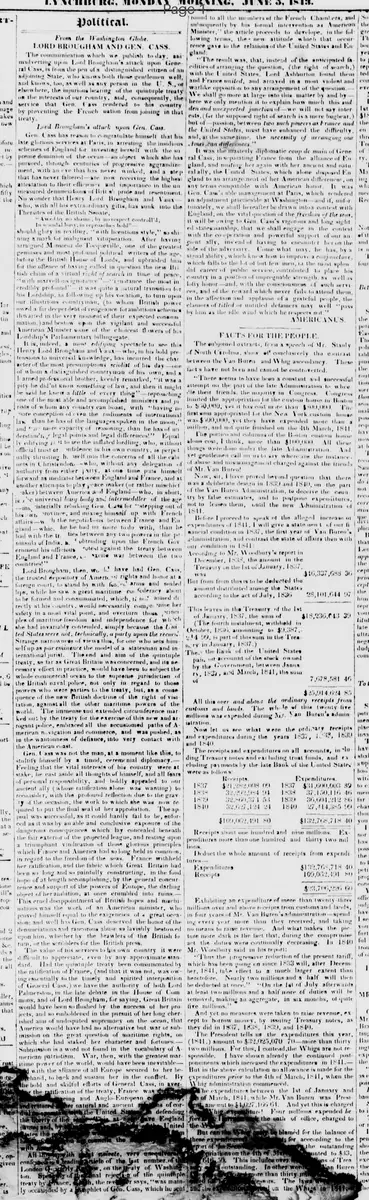
From the Washington Globe.
LORD BROUGHAM AND GEN. CASS.
The communication which we publish to-day, and adverting upon Lord Brougham's attack upon General Cass, is from the pen of a distinguished citizen of an adjoining State, who knows both those gentlemen well, and knows, too, as well as any person in the U. S., or elsewhere, the injurious bearing of the quintuple treaty on the interests of our country, and, consequently, the service that Gen. Cass rendered to his country by preventing the French nation from joining in that treaty.
Lord Brougham's attack upon Gen. Cass.
Gen. Cass has reason to congratulate himself that his late glorious services at Paris, in arresting the insidious schemes of England for investing herself with the supreme dominion of the ocean—an object which she has pursued, through centuries of progressive aggrandizement, with an eye that has never winked, and a step that has never faltered—are now receiving the highest attestation to their efficiency and importance in the unmeasured denunciations of British pride and resentment. No wonder that Henry Lord Brougham and Vaux—who, with all his extraordinary gifts, has sunk into the Thersites of the British Senate,
"Awed by no shame, by no respect controll'd.
In scandal busy, in reproaches bold"
should glory in reviling, "with licentious style," so shining a mark for malignant vituperation. After having arraigned Monsieur de Tocqueville, one of the greatest geniuses and most profound political writers of the age, before the British House of Lords, and upbraided him for the offence of having called in question the new British claim of a virtual right of search in time of peace, "with marvel at his ignorance"—"ignorance the most incredibly profound" It was quite a natural transition for his Lordship, to following up his vocation, to turn upon our illustrious countryman, (to whom British power owed a far deeper debt of vengeance for ambitions schemes thwarted in the very moment of their expected consummation,) and bestow upon the vigilant and successful American Minister some of the choicest flowers of his Lordship's Parliamentary bullingsgate.
It is, indeed, a most edifying spectacle to see this Henry Lord Brougham and Vaux—who, in his bold pretensions to universal knowledge, has incurred the character of the most presumptuous sciolist of his day—one of whom a distinguished countryman of his own, and a learned professional brother, keenly remarked, "it was a pity he didn't know something of law, and then it might be said he knew a little of every thing"—reproaching one of the most able and accomplished ministers and jurists of whom any country can boast, with "having no more conception of even the rudiments of international law than he has of the languages spoken in the moon." and "more capacity of reasoning, than he has of understanding legal points and legal differences!" Equally edifying is it to see the inflated lordling, who, without official trust or confidence in his own country, is perpetually thrusting himself into the concerns of all the cabinets in Christendom—who, without any delegation of authority from either party, at one time puts himself forward as mediator between England and France, and at another attempts to play peace maker (or rather mischief maker) between America and England—who, in short, is the universal busy body and intermeddler of the age —ministerially rebuking Gen. Cass for "stepping out of his province, and mixing himself up with French affairs—with the negotiations between France and England—which he had no more to do with, than he had with the treaties between any two powers in the peninsula of India," obtruding upon the French Government his officious protest against the treaty between England and France, to excite war between the two countries!"
Lord Brougham, then, would have had Gen. Cass, the trusted depository of American rights and honor at a foreign court, to stand by with folded arms and sealed lips, while he saw a great maritime confederacy about to be formed and consummated, which, if aimed directly at his country, would necessarily compromise her safety in a most vital point, and overturn those principles of maritime freedom and independence for which she had invariably contended, simply because the United States were not, technically, a party upon the record' Strange narrowness of views this, for one who sets himself up as par excellence the model of a statesman and international jurist. The end and aim of the quintuple treaty, so far as Great Britain was concerned, and its necessary effect in practice, would have been to subject the whole commercial ocean to the supreme jurisdiction of the British naval police, not only in regard to those powers who were parties to the treaty, but, as a consequence of the new British doctrine of the right of visitation, against all the other maritime powers of the world. The immense and extended circumference marked out by the treaty for the exercise of this new and arrogant police, embraced all the accustomed paths of American navigation and commerce, and was pushed, as in the wantonness of defiance, into very contact with the American coast.
Gen. Cass knew well this man, at a moment like this, (to stultify himself by a sinuous, ceremonial diplomacy,—trying that the vital interests of his country were at stake, his heart and all thoughts of himself, and all fears of personal responsibility, and boldly appealed to our ancient ally (whose ratification alone was wanting) France, with the profound sentiment due to the gravity of the occasion, the work to which she was now required to put the final seal of her approbation. The appeal was successful, as it could hardly fail to be, uncoated as it was by an able and conclusive exposure of the malignant consequences which lay concealed beneath the fair exterior of the proposed treaty, and resting upon a triumphant vindication of those glorious principles which France and America had so long held in common, in regard to the freedom of the seas. "France withheld her ratification, and the fabric which Great Britain had been so long and so painfully constructing, in the fond hope of at length accomplishing, by the general concurrence and support of the powers of Europe, the darling object of her ambition, at once crumbled into ruins.— "This cruel disappointment of British hopes and expectations was the work of an American minister, who proved himself equal to the exigencies of great occasions: and well has Gen. Cass deserved the honor of the slanderous and scurrilous abuse now lavishly bestowed upon him, whether by the haughty peers of the British firuin, or the worshippers of the British press,
The value of his services to his own country it were difficult to appreciate, even by any approximate standard. Had the quintuple treaty been consummated by the ratification of France, (and that it was not, was owing essentially to the timely and spirited interposition of General Cass.) we have the authority of both Lord Palmerston, in the late debate in the House of Commons, and of Lord Brougham, for saying, Great Britain would have been so flushed by the success of her projects, and so emboldened in the pursuit of her long cherished aim of undisputed supremacy on the ocean, that America would have had no alternative but war or submission on the great question of maritime rights, on which she had staked her character and fortunes.— Submission is a word not found in the vocabulary of American patriotism. War, then, with the greatest maritime power of the world, with the alliance of all Europe secured to her by-that treaty, to back and sustain her in the conflict.
By the bold and skillful efforts of General Cass, in averting the ratification of the treaty, France was brought back to her ancient position as the natural and ancient ally of the United States, and the liberty of the seas was preserved to the world. Unless the truth of history is sacrificed to party rancor, the name of Gen. Cass will ever be associated with this great event.
The treaty, Dr. says, " round to all the members of the French Chambers, and subsequently by his formal intervention as American Minister," the article proceeds to develop, in the following terms, the new attitude which that occurrence gave to the relations of the United States and England:
…Ihe result was, that, instead of the anticipated facilities of arranging the question, (the right of search,) with the United States, Lord Ashburton found them and France united, and arrayed in a most violent and warlike opposition to any arrangement of the question.— We shall go more at large into this matter by and by—here we only mention it to explain how much this sudden and unexpected junction of—we will not say interests, (for the supposed right of search is a mere bugbear,) but of—passion, between two such powers as France and the United States, must have enhanced the difficulty. and, at the same time, the necessity of arranging our American differences."
It was the masterly diplomatic coup de main of General Cass, in separating France from the alliance of England, and uniting her again with her ancient and natural ally, the United States, which alone disposed England to an arrangement of her American differences, on any terms compatible with American honor. It was Gen. Cass's able management at Paris, which rendered an adjustment practicable at Washington—and if, unfortunately, we shall hereafter be drawn into a contest with England, on the vital question of the freedom of the seas. It will be owing to Gen. Cass's vigorous and long-sighted statesmanship, that we shall engage in the contest with the co-operation and powerful support of our ancient ally, instead of having to encounter her on the side of the adversary. Come what may, he has, by a signal ability, which knew how to improve a conjuncture. which falls to the lot of but few men, to the most splendid career of public service, contributed to place his country in a position of impregnable strength, as well as lofty honor—and, with the consciousness of such services, and of the reward which never fails to attend them. in the affection and applause of a grateful people, the clamors of titled or untitled defamers may well "pass by him as the idle wind which he respects not."
AMERICANUS.
What sub-type of article is it?
What keywords are associated?
What entities or persons were involved?
Where did it happen?
Foreign News Details
Primary Location
Paris
Key Persons
Outcome
france withheld ratification of the quintuple treaty, preventing british naval supremacy, preserving maritime freedom, and aligning france with the united states against england.
Event Details
Gen. Cass, as U.S. Minister in Paris, intervened to prevent France from ratifying the quintuple treaty, which aimed to establish British dominance over ocean commerce through right of search and visitation. His successful appeal exposed the treaty's threats to American interests, leading to its collapse. This action drew criticism from Lord Brougham in the British House of Lords, who accused Cass of meddling in French affairs.