Thank you for visiting SNEWPapers!
Sign up free
Editorial
December 4, 1817
Richmond Enquirer
Richmond, Richmond County, Virginia
What is this article about?
An anonymous Baltimorean Republican defends Judge Bland against criticism in the Federal Gazette by Mr. Gwynn for accepting a temporary U.S. agency without resigning his state judgeship, arguing it does not violate constitutional provisions on offices.
Clipping
OCR Quality
95%
Excellent
Full Text
From the Baltimore Federal Gazette.]
JUDGE BLAND'S AGENCY—AND MR. GWYNN'S OFFICE.
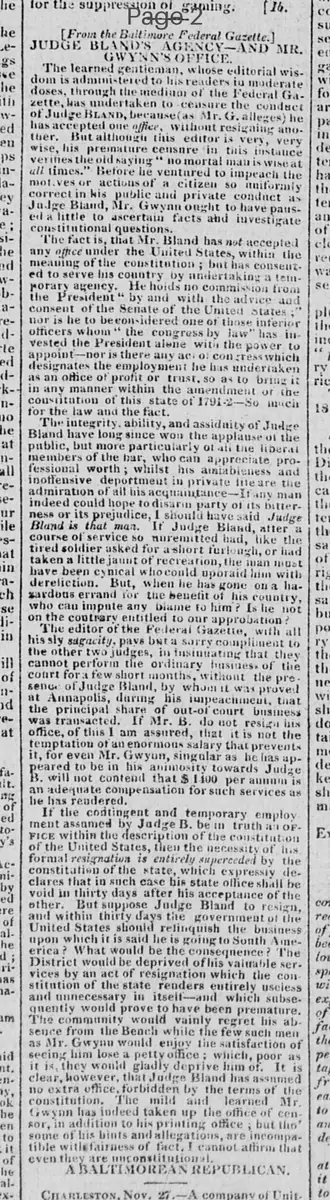
The learned gentleman, whose editorial wisdom is administered to his readers in moderate doses, through the medium of the Federal Gazette, has undertaken to censure the conduct of Judge Bland, because (as Mr. G. alleges) he has accepted one office, without resigning another. But although this editor is very, very wise, his premature censure in this instance verifies the old saying "no mortal man is wise at all times." Before he ventured to impeach the motives or actions of a citizen so uniformly correct in his public and private conduct as Judge Bland, Mr. Gwynn ought to have paused a little to ascertain facts and investigate constitutional questions.
The fact is, that Mr. Bland has not accepted any office under the United States, within the meaning of the constitution; but has consented to serve his country by undertaking a temporary agency. He holds no commission from the President "by and with the advice and consent of the Senate of the United States;" nor is he to be considered one of those inferior officers whom "the congress by law" has invested the President alone with the power to appoint—nor is there any act of congress which designates the employment he has undertaken as an office of profit or trust, so as to bring it in any manner within the amendment of the constitution of this state of 1801-2—So much for the law and the fact.
The integrity, ability, and assiduity of Judge Bland have long since won the applause of the public, but more particularly of all the liberal members of the bar, who can appreciate professional worth; whilst his amiableness and inoffensive deportment in private life are the admiration of all his acquaintance—It any man indeed could hope to disarm party of its bitterness or its prejudice, I should have said Judge Bland is that man. If Judge Bland, after a course of service so unremitted had, like the tired soldier asked for a short furlough, or had taken a little jaunt of recreation, the man must have been cynical who could upbraid him with dereliction. But, when he has gone on a hazardous errand for the benefit of his country, who can impute any blame to him? Is he not on the contrary entitled to our approbation?
The editor of the Federal Gazette, with all his sly sagacity, pays but a sorry compliment to the other two judges, in insinuating that they cannot perform the ordinary business of the court for a few short months, without the presence of Judge Bland, by whom it was proved at Annapolis, during his impeachment, that the principal share of out-of court business was transacted. If Mr. B. do not resign his office, of this I am assured, that it is not the temptation of an enormous salary that prevents it, for even Mr. Gwynn, singular as he has appeared to be in his animosity towards Judge B. will not contend that $1100 per annum is an adequate compensation for such services as he has rendered.
If the contingent and temporary employment assumed by Judge B. be in truth an OFFICE within the description of the constitution of the United States, then the necessity of his formal resignation is entirely superceded by the constitution of the state, which expressly declares that in such case his state office shall be void in thirty days after his acceptance of the other. But suppose Judge Bland to resign, and within thirty days the government of the United States should relinquish the business upon which it is said he is going to South America? What would be the consequence? The District would be deprived of his valuable services by an act of resignation which the constitution of the state renders entirely useless and unnecessary in itself—and which subsequently would prove to have been premature.
The community would vainly regret his absence from the Bench while the few such men as Mr. Gwynn would enjoy the satisfaction of seeing him lose a petty office; which, poor as it is, they would gladly deprive him of. It is clear, however, that Judge Bland has assumed no extra office, forbidden by the terms of the constitution. The mild and learned Mr. Gwynn has indeed taken up the office of censor, in addition to his printing office; but those of his hints and allegations, are incompatible with the fairness of fact. I cannot affirm that even they are unconstitutional.
A BALTIMOREAN REPUBLICAN.
JUDGE BLAND'S AGENCY—AND MR. GWYNN'S OFFICE.
The learned gentleman, whose editorial wisdom is administered to his readers in moderate doses, through the medium of the Federal Gazette, has undertaken to censure the conduct of Judge Bland, because (as Mr. G. alleges) he has accepted one office, without resigning another. But although this editor is very, very wise, his premature censure in this instance verifies the old saying "no mortal man is wise at all times." Before he ventured to impeach the motives or actions of a citizen so uniformly correct in his public and private conduct as Judge Bland, Mr. Gwynn ought to have paused a little to ascertain facts and investigate constitutional questions.
The fact is, that Mr. Bland has not accepted any office under the United States, within the meaning of the constitution; but has consented to serve his country by undertaking a temporary agency. He holds no commission from the President "by and with the advice and consent of the Senate of the United States;" nor is he to be considered one of those inferior officers whom "the congress by law" has invested the President alone with the power to appoint—nor is there any act of congress which designates the employment he has undertaken as an office of profit or trust, so as to bring it in any manner within the amendment of the constitution of this state of 1801-2—So much for the law and the fact.
The integrity, ability, and assiduity of Judge Bland have long since won the applause of the public, but more particularly of all the liberal members of the bar, who can appreciate professional worth; whilst his amiableness and inoffensive deportment in private life are the admiration of all his acquaintance—It any man indeed could hope to disarm party of its bitterness or its prejudice, I should have said Judge Bland is that man. If Judge Bland, after a course of service so unremitted had, like the tired soldier asked for a short furlough, or had taken a little jaunt of recreation, the man must have been cynical who could upbraid him with dereliction. But, when he has gone on a hazardous errand for the benefit of his country, who can impute any blame to him? Is he not on the contrary entitled to our approbation?
The editor of the Federal Gazette, with all his sly sagacity, pays but a sorry compliment to the other two judges, in insinuating that they cannot perform the ordinary business of the court for a few short months, without the presence of Judge Bland, by whom it was proved at Annapolis, during his impeachment, that the principal share of out-of court business was transacted. If Mr. B. do not resign his office, of this I am assured, that it is not the temptation of an enormous salary that prevents it, for even Mr. Gwynn, singular as he has appeared to be in his animosity towards Judge B. will not contend that $1100 per annum is an adequate compensation for such services as he has rendered.
If the contingent and temporary employment assumed by Judge B. be in truth an OFFICE within the description of the constitution of the United States, then the necessity of his formal resignation is entirely superceded by the constitution of the state, which expressly declares that in such case his state office shall be void in thirty days after his acceptance of the other. But suppose Judge Bland to resign, and within thirty days the government of the United States should relinquish the business upon which it is said he is going to South America? What would be the consequence? The District would be deprived of his valuable services by an act of resignation which the constitution of the state renders entirely useless and unnecessary in itself—and which subsequently would prove to have been premature.
The community would vainly regret his absence from the Bench while the few such men as Mr. Gwynn would enjoy the satisfaction of seeing him lose a petty office; which, poor as it is, they would gladly deprive him of. It is clear, however, that Judge Bland has assumed no extra office, forbidden by the terms of the constitution. The mild and learned Mr. Gwynn has indeed taken up the office of censor, in addition to his printing office; but those of his hints and allegations, are incompatible with the fairness of fact. I cannot affirm that even they are unconstitutional.
A BALTIMOREAN REPUBLICAN.
What sub-type of article is it?
Constitutional
Partisan Politics
What keywords are associated?
Judge Bland
Mr Gwynn
Constitutional Office
Temporary Agency
State Resignation
Federal Gazette
Baltimore Republican
What entities or persons were involved?
Judge Bland
Mr. Gwynn
Baltimore Federal Gazette
Editorial Details
Primary Topic
Defense Of Judge Bland's Temporary Agency Without Resigning State Office
Stance / Tone
Strongly Supportive Of Judge Bland And Critical Of Mr. Gwynn
Key Figures
Judge Bland
Mr. Gwynn
Baltimore Federal Gazette
Key Arguments
Judge Bland Has Not Accepted A U.S. Office Under The Constitution But A Temporary Agency
No Commission From President Or Congress Designates It As An Office Of Profit Or Trust
State Constitution Amendment Of 1801 2 Does Not Apply
Judge Bland's Integrity And Services Merit Approbation Not Censure
Criticism Implies Other Judges Cannot Manage Without Him
Resignation Unnecessary And Potentially Premature If U.S. Business Ends Soon
Mr. Gwynn's Role As Censor Is Unfair And Incompatible With Facts