Thank you for visiting SNEWPapers!
Sign up free
Litchfield Enquirer
Litchfield, Litchfield County, Connecticut
What is this article about?
In Virginia's House of Delegates, Mr. Wallace of Fauquier criticizes South Carolina's opposition to tariffs, highlighting their historical support for protective duties in 1789 and 1816, which forced Northern states to shift to manufacturing and prosper, while South Carolina now demands immediate repeal threatening the Union.
Merged-components note: These two components form a continuous editorial discussing the history of the tariff and South Carolina's changing stance on protectionism.
Clipping
OCR Quality
Full Text
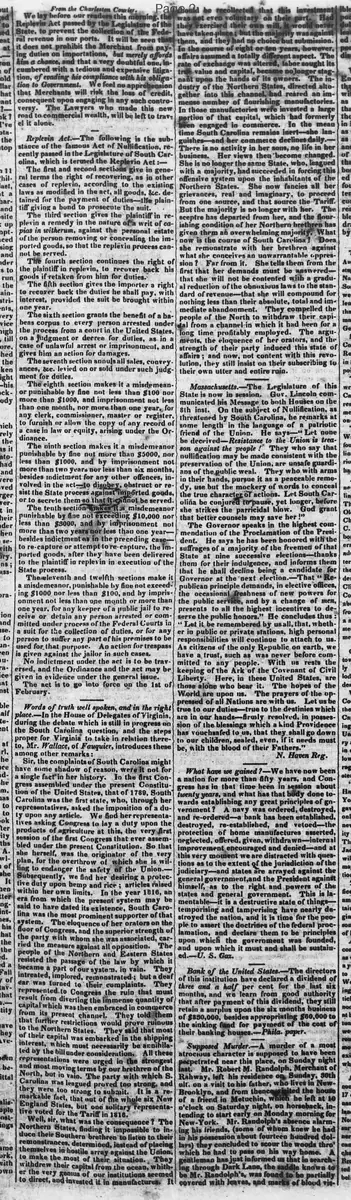
Sir, the complaints of South Carolina might have some shadow of reason, were it not for a single fact in her history. In the first Congress assembled under the present Constitution of the United States, that of 1789, South Carolina was the first state, who, through her representatives, asked the imposition of a duty upon any article. We find her representatives asking Congress to lay a duty upon the products of agriculture at this, the very first session of the first Congress that ever assembled under the present Constitution. So that she herself, was the originator of the very plan, for the overthrow of which she is willing to endanger the safety of the Union.—Subsequently, we find her desiring a protective duty upon hemp and rice; articles raised within her own limits. In the year 1816, an era from which the present system may be said to have dated its existence, South Carolina was the most prominent supporter of that system on the floor of Congress, and the superior strength of the party with whom she was associated, carried the measure against all opposition. The people of the Northern and Eastern States resisted the passage of the law by which it became a part of our system, in vain. They intreated, implored, remonstrated; but a deaf ear was turned to their complaints. They represented to Congress the ruin that must result from diverting the immense quantity of capital which was then embraced in commerce from its present channel. They told them that further restrictions would prove ruinous to the Northern States. They said that most of their capital was embarked in the shipping interest, which must necessarily be annihilated by the bill under consideration—representations were urged in the strongest and most moving terms by our brethren of the North, but in vain. The party with which South Carolina was leagued proved too strong and they were too strong to submit.
It is a remarkable fact, that out of the whole six New England States, but one solitary representative voted for the Tariff in 1816.
Well, sir, what was the consequence? The Northern States, finding it impossible to induce their Southern brethren to listen to their remonstrances, determined, instead of placing themselves in hostile array against the Union, to make the most of their situation. They withdrew their capital from the ocean, whither the very genius of our institutions seemed to direct, and invested it in manufactures. It was not even voluntary on their part. Had they exercised their own will, it would never have taken place; but the majority was against them, and they had no choice but submission.
In the course of eight or ten years, however, affairs assumed a totally different aspect. The rate of exchange was altered, labor sought its true value and capital, became no longer stagnant upon the hands of its owners. The industry of the Northern States, directed altogether into this channel, had reared an immense number of flourishing manufactories. In those manufactories were invested a large portion of that capital, which had formerly been engaged in commerce. In the mean time South Carolina remains inert—she languishes—and her commerce declines daily. There is no activity in her sons, no life in her business. Her views then become changed. She is no longer the same State, who, leagued with a majority, had succeeded in forcing this offensive system upon the inhabitants of the Northern States. She now fancies all her grievances, real and imaginary, to proceed from one source, and that source the Tariff. But the majority is no longer with her. The sceptre has departed from her, and the flourishing condition of her Northern brethren has given them an overwhelming majority. What now is the course of South Carolina? Does she remonstrate with her brethren against what she conceives an unwarrantable oppression? Far from it. She tells them from the first that her demands must be answered—that she will not be contented with a gradual reduction of the obnoxious laws to the standard of revenue—that she will compound for nothing less than their absolute, total and immediate abandonment. 'They' compelled the people of the North to withdraw their capital from a channel in which it had been for a long time profitably employed. The arguments, the eloquence of her orators, and the strength of their party induced this state of affairs; and now, not content with this revolution, they still insist on their subscribing to their own utter and entire ruin.
What sub-type of article is it?
What keywords are associated?
What entities or persons were involved?
Editorial Details
Primary Topic
South Carolina's Historical Support For Protective Tariffs
Stance / Tone
Critical Of South Carolina's Current Opposition To Tariffs
Key Figures
Key Arguments