Thank you for visiting SNEWPapers!
Sign up free
Literary
February 6, 1874
South Branch Intelligencer
Romney, Hampshire County, West Virginia
What is this article about?
In this sentimental tale, young Gerrie Jameson, living in genteel poverty with her widowed mother and sister, receives marriage proposals from wealthy Leon Payne, who sends diamonds, and poor clerk Harry Clarke, who sends verses. Tempted by luxury but valuing true love, she chooses Harry, who soon inherits wealth from oil on his farm.
Clipping
OCR Quality
95%
Excellent
Full Text
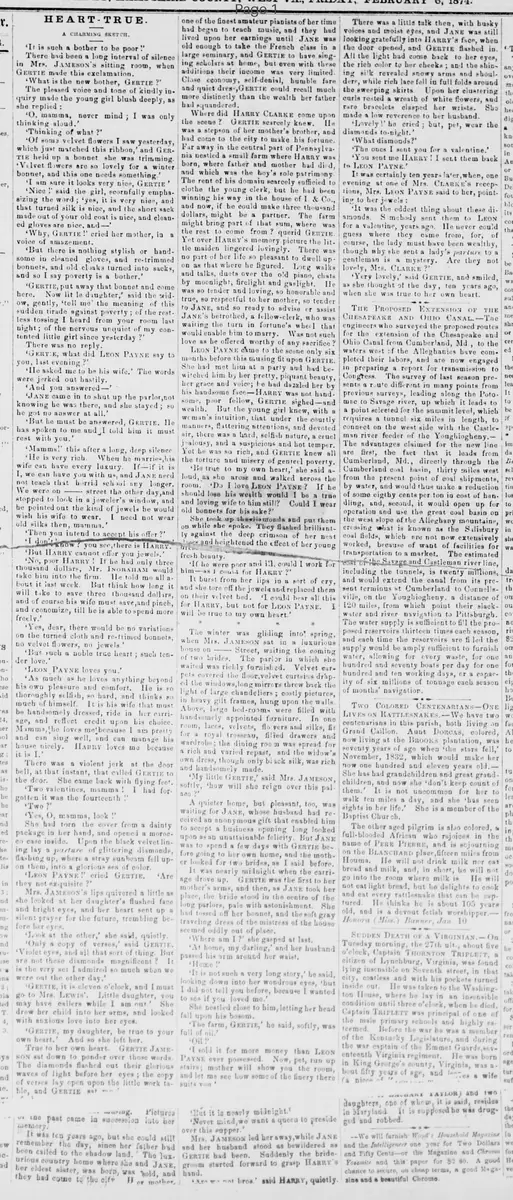
HEART-TRUE.
CHARMING SKETCH.
'It is such a bother to be poor!'
There had been a long interval of silence in Mrs. Jameson's sitting room, when Gerrie made this exclamation.
'What is the new bother, Gerrie?'
The pleased voice and tone of kindly inquiry made the young girl blush deeply, as she replied:
'O, mamma, never mind; I was only thinking aloud.'
'Thinking of what?'
'Of some velvet flowers I saw yesterday, which just matched this ribbon,' and Gerrie held up a bonnet she was trimming.
'Velvet flowers are so lovely for a winter bonnet, and this one needs something.'
'I am sure it looks very nice, Gerrie.'
'Nice!' said the girl, scornfully emphasizing the word; 'yes, it is very nice, and that turned silk is nice, and the short sack made out of your old coat is nice, and cleaned gloves are nice, and—'
'Why, Gerrie!' cried her mother, in a voice of amazement.
But there is nothing stylish or handsome in cleaned gloves, and re-trimmed bonnets, and old cloaks turned into sacks, and so I say poverty is a bother.'
'Gerrie, put away that bonnet and come here. Now little daughter,' said the widow, gently, 'tell me the meaning of this sudden tirade against poverty; of the restless tossing I heard from your room last night; of the nervous unquiet of my contented little girl since yesterday?'
There was no reply.
'Gerrie, what did Leon Payne say to you, last evening?'
'He asked me to be his wife.' The words were jerked out hastily.
'And you answered—'
'Jane came in to shut up the parlor, not knowing he was there, and she stayed; so he got no answer at all.'
But he must be answered, Gerrie. He has spoken to me and I told him it must rest with you.'
'Mamma!' this after a long, deep silence.
'He is very rich. When he marries, his wife can have every luxury. If—if it is I, we can have you with us, and Jane need not teach that horrid school any longer.
We were on — street the other day, and stopped to look in a jeweler's window, and he pointed out the kind of jewels he would wish his wife to wear. I need not wear old silks then, mamma.'
'Then you intend to accept his offer?'
'I don't know; you see, there is Harry.'
'But Harry cannot offer you jewels.'
'No, poor Harry! If he had only three thousand dollars, Mr. Ironman would take him into the firm. He told me all about it last week. But think how long it will take to save three thousand dollars, and of course his wife must save, and pinch, and economize, till he is able to spend more freely.'
Yes, dear, there would be no variations on the turned cloth and re-trimmed bonnets, no velvet flowers, no jewels.'
'But such a noble true heart; such tender love.'
'Leon Payne loves you.'
'As much as he loves anything beyond his own pleasure and comfort. He is so thoroughly selfish, so hard, and thinks so much of himself. It is his wife that must be handsomely dressed, ride in her carriage, and reflect credit upon his choice.
Mamma, he loves me because I am pretty and can sing well, and can manage his house nicely. Harry loves me because it is I.'
There was a violent jerk at the door bell, at that instant, that called Gerrie to the door. She came back with flying feet.
'Two valentines, mamma! I had forgotten it was the fourteenth!'
'Two?'
'Yes, O, mamma, look!'
She had torn the cover from a dainty package in her hand, and opened a morocco case inside. Upon the black velvet lining lay a parure of glittering diamonds, flashing up, where a stray sunbeam fell upon them, into a glorious sea of color.
'Leon Payne!' cried Gerrie.
'Are they not exquisite?'
Mrs. Jameson's lips quivered a little as she looked at her daughter's flushed face and bright eyes, and her heart sent up a silent prayer for the future, trembling before her eyes.
'Look at the other,' she said, quietly.
'Only a copy of verses,' said Gerrie. 'Violet eyes, and all that sort of thing. But are not these diamonds magnificent? It is the very set I admired so much when we were out the other day.'
'Gerrie, it is eleven o'clock, and I must go to Mrs. Lewis'. Little daughter, you may have callers while I am out.' She drew her child into her arms, and looked with anxious love into her eyes.
'Gerrie, my daughter, be true to your own heart.' And so she left her.
True to her own heart. Gerrie Jameson sat down to ponder over those words.
The diamonds flashed out their glorious waves of light before her eyes; the copy of verses lay open upon the little work table, and Gerrie sat thinking.
Pictures of the past came in succession into her memory.
It was ten years ago, but she could still remember the day, since her father had been called to the shadow land. The luxurious country home where she and Jane, her eldest sister, was born, was sold, and they had come to the city. Her mother, one of the finest amateur pianists of her time, had began to teach music, and they had lived upon her earnings until Jane was old enough to take the French class in a large seminary, and Gerrie to have singing scholars at home, but even with these additions their income was very limited.
Close economy, self-denial, humble fare and quiet dress—Gerrie could recall much more distinctly than the wealth her father had squandered.
Where did Harry Clarke come upon the scene? Gerrie scarcely knew. He was a stepson of her mother's brother, and had come to the city to make his fortune.
Far away in the central part of Pennsylvania nestled a small farm where Harry was born, where father and mother had died, and which was the boy's sole patrimony.
The rent of his domain scarcely sufficed to clothe the young clerk, but he had been winning his way in the house of I. & Co., and now, if he could make three thousand dollars, might be a partner. The farm might bring part of that sum, where was the rest to come from? queried Gerrie.
Yet over Harry's memory picture the little maiden lingered lovingly. There was no part of her life so pleasant to dwell upon as that where he figured. Long walks and talks, duets over the old piano, chats by moonlight, firelight and gaslight. He was so tender and loving, so honorable and true, so respectful to her mother, so tender to Jane, and so ready to advise or assist Jane's betrothed, a fellow-clerk, who was waiting the turn in fortune's wheel that would enable him to marry. Was not such love as he offered worthy of any sacrifice?
Leon Payne came to the scene only six months before this musing fit upon Gerrie.
She had met him at a party and had bewitched him by her pretty, piquant beauty, her grace and voice; he had dazzled her by his handsome face—Harry was not handsome, poor fellow, Gerrie sighed—and wealth. But the young girl knew, with a woman's intuition, that under the courtly manners, flattering attentions, and devoted air, there was a hard, selfish nature, a cruel jealousy, and a suspicious and hot temper.
Yet he was so rich, and Gerrie knew all the torture and misery of genteel poverty.
'Be true to my own heart,' she said aloud, as she arose and walked across the room. Do I love Leon Payne? If he should lose his wealth would I be a true and loving wife to him still? Could I wear old bonnets for his sake?'
She took up the diamonds and put them on while she spoke. They flashed brilliantly against the deep crimson of her neat dress and heightened the effect of her young fresh beauty.
'If he were poor and ill, could I work for him—as I could for Harry?'
It burst from her lips in a sort of cry, and she tore off the jewels and replaced them on their velvet bed. 'I could bear all this for Harry, but not for Leon Payne. I will be true to my own heart.'
The winter was gliding into spring, when Mrs. Jameson sat in a luxurious house on — Street, waiting the coming of two brides. The parlor in which she waited was richly furnished. Velvet carpets covered the floor, velvet curtains draped the windows, long mirrors threw back the light of large chandeliers; costly pictures, in heavy gilt frames, hung upon the walls.
Above, large bed-rooms were filled with handsomely appointed furniture. In one room, laces, velvets, flowers and silks, fit for a royal trousseau, filled drawers and wardrobe; the dining room was spread for a rich and varied repast, and the widow's own dress, though only black silk, was rich and handsomely made.
'My little Gerrie,' said Mrs. Jameson, softly, 'how will she reign over this palace?'
A quieter home, but pleasant, too, was waiting for Jane, whose husband had received an anonymous gift that enabled him to accept a business opening long looked upon as an unattainable felicity. But Jane was to spend a few days with Gerrie before going to her own home, and the mother looked for two brides, as I said before.
It was nearly midnight when the carriage drove up. Gerrie was the first to her mother's arms, and then, as Jane took her place, the bride stood in the centre of the long parlors, pale with astonishment. She had tossed off her bonnet, and the soft gray traveling dress of the mistress of the house seemed oddly out of place.
'Where am I?' she gasped at last.
'At home, my darling,' and her husband passed his arm around her waist.
'Home.'
'It is not such a very long story,' he said looking down into her wondrous eyes, 'but I did not tell you before, because I wanted to see if you loved me.'
She nestled close to him, letting her head fall upon his bosom.
The farm, Gerrie,' he said, softly, 'was full of oil.'
'Oil!'
'I sold it for more money than Leon Payne ever possessed. Now, pet, run up stairs; mother will show you the room, and let me see how some of the finery there suits you. Never mind; we want a queen to preside over this supper.'
Mrs. Jameson led her away, while Jane and her husband stood as bewildered as Gerrie had been. Suddenly the bridegroom started forward to grasp Harry's hand.
'Are we not brothers?' said Harry, quietly.
There was a little talk then, with husky voices and moist eyes, and Jane was still looking gratefully into Harry's face, when the door opened, and Gerrie flashed in.
All the light had come back to her eyes, the rich color to her cheeks: and the shining silk revealed snowy arms and shoulders, while rich lace fell in full folds around the sweeping skirts. Upon her clustering curls rested a wreath of white flowers, and rare bracelets clasped her wrists. She made a low reverence to her husband.
'Lovely!' he cried; but, pet, wear the diamonds to-night.'
'What diamonds?'
'The ones I sent you for a valentine.'
'You sent me Harry! I sent them back to Leon Payne.'
It was certainly ten years later, when, one evening at one of Mrs. Clarke's receptions, Mrs. Leon Payne said to her, pointing to her jewels:
'It was the oddest thing about these diamonds. Somebody sent them to Leon for a valentine, years ago. He never could guess where they came from, for, of course, the lady must have been wealthy, though why she sent a lady's parure to a gentleman is a mystery. Are they not lovely, Mrs. Clarke?'
'Very lovely,' said Gerrie, and smiled, as she thought of the day, ten years ago, when she was true to her own heart.
CHARMING SKETCH.
'It is such a bother to be poor!'
There had been a long interval of silence in Mrs. Jameson's sitting room, when Gerrie made this exclamation.
'What is the new bother, Gerrie?'
The pleased voice and tone of kindly inquiry made the young girl blush deeply, as she replied:
'O, mamma, never mind; I was only thinking aloud.'
'Thinking of what?'
'Of some velvet flowers I saw yesterday, which just matched this ribbon,' and Gerrie held up a bonnet she was trimming.
'Velvet flowers are so lovely for a winter bonnet, and this one needs something.'
'I am sure it looks very nice, Gerrie.'
'Nice!' said the girl, scornfully emphasizing the word; 'yes, it is very nice, and that turned silk is nice, and the short sack made out of your old coat is nice, and cleaned gloves are nice, and—'
'Why, Gerrie!' cried her mother, in a voice of amazement.
But there is nothing stylish or handsome in cleaned gloves, and re-trimmed bonnets, and old cloaks turned into sacks, and so I say poverty is a bother.'
'Gerrie, put away that bonnet and come here. Now little daughter,' said the widow, gently, 'tell me the meaning of this sudden tirade against poverty; of the restless tossing I heard from your room last night; of the nervous unquiet of my contented little girl since yesterday?'
There was no reply.
'Gerrie, what did Leon Payne say to you, last evening?'
'He asked me to be his wife.' The words were jerked out hastily.
'And you answered—'
'Jane came in to shut up the parlor, not knowing he was there, and she stayed; so he got no answer at all.'
But he must be answered, Gerrie. He has spoken to me and I told him it must rest with you.'
'Mamma!' this after a long, deep silence.
'He is very rich. When he marries, his wife can have every luxury. If—if it is I, we can have you with us, and Jane need not teach that horrid school any longer.
We were on — street the other day, and stopped to look in a jeweler's window, and he pointed out the kind of jewels he would wish his wife to wear. I need not wear old silks then, mamma.'
'Then you intend to accept his offer?'
'I don't know; you see, there is Harry.'
'But Harry cannot offer you jewels.'
'No, poor Harry! If he had only three thousand dollars, Mr. Ironman would take him into the firm. He told me all about it last week. But think how long it will take to save three thousand dollars, and of course his wife must save, and pinch, and economize, till he is able to spend more freely.'
Yes, dear, there would be no variations on the turned cloth and re-trimmed bonnets, no velvet flowers, no jewels.'
'But such a noble true heart; such tender love.'
'Leon Payne loves you.'
'As much as he loves anything beyond his own pleasure and comfort. He is so thoroughly selfish, so hard, and thinks so much of himself. It is his wife that must be handsomely dressed, ride in her carriage, and reflect credit upon his choice.
Mamma, he loves me because I am pretty and can sing well, and can manage his house nicely. Harry loves me because it is I.'
There was a violent jerk at the door bell, at that instant, that called Gerrie to the door. She came back with flying feet.
'Two valentines, mamma! I had forgotten it was the fourteenth!'
'Two?'
'Yes, O, mamma, look!'
She had torn the cover from a dainty package in her hand, and opened a morocco case inside. Upon the black velvet lining lay a parure of glittering diamonds, flashing up, where a stray sunbeam fell upon them, into a glorious sea of color.
'Leon Payne!' cried Gerrie.
'Are they not exquisite?'
Mrs. Jameson's lips quivered a little as she looked at her daughter's flushed face and bright eyes, and her heart sent up a silent prayer for the future, trembling before her eyes.
'Look at the other,' she said, quietly.
'Only a copy of verses,' said Gerrie. 'Violet eyes, and all that sort of thing. But are not these diamonds magnificent? It is the very set I admired so much when we were out the other day.'
'Gerrie, it is eleven o'clock, and I must go to Mrs. Lewis'. Little daughter, you may have callers while I am out.' She drew her child into her arms, and looked with anxious love into her eyes.
'Gerrie, my daughter, be true to your own heart.' And so she left her.
True to her own heart. Gerrie Jameson sat down to ponder over those words.
The diamonds flashed out their glorious waves of light before her eyes; the copy of verses lay open upon the little work table, and Gerrie sat thinking.
Pictures of the past came in succession into her memory.
It was ten years ago, but she could still remember the day, since her father had been called to the shadow land. The luxurious country home where she and Jane, her eldest sister, was born, was sold, and they had come to the city. Her mother, one of the finest amateur pianists of her time, had began to teach music, and they had lived upon her earnings until Jane was old enough to take the French class in a large seminary, and Gerrie to have singing scholars at home, but even with these additions their income was very limited.
Close economy, self-denial, humble fare and quiet dress—Gerrie could recall much more distinctly than the wealth her father had squandered.
Where did Harry Clarke come upon the scene? Gerrie scarcely knew. He was a stepson of her mother's brother, and had come to the city to make his fortune.
Far away in the central part of Pennsylvania nestled a small farm where Harry was born, where father and mother had died, and which was the boy's sole patrimony.
The rent of his domain scarcely sufficed to clothe the young clerk, but he had been winning his way in the house of I. & Co., and now, if he could make three thousand dollars, might be a partner. The farm might bring part of that sum, where was the rest to come from? queried Gerrie.
Yet over Harry's memory picture the little maiden lingered lovingly. There was no part of her life so pleasant to dwell upon as that where he figured. Long walks and talks, duets over the old piano, chats by moonlight, firelight and gaslight. He was so tender and loving, so honorable and true, so respectful to her mother, so tender to Jane, and so ready to advise or assist Jane's betrothed, a fellow-clerk, who was waiting the turn in fortune's wheel that would enable him to marry. Was not such love as he offered worthy of any sacrifice?
Leon Payne came to the scene only six months before this musing fit upon Gerrie.
She had met him at a party and had bewitched him by her pretty, piquant beauty, her grace and voice; he had dazzled her by his handsome face—Harry was not handsome, poor fellow, Gerrie sighed—and wealth. But the young girl knew, with a woman's intuition, that under the courtly manners, flattering attentions, and devoted air, there was a hard, selfish nature, a cruel jealousy, and a suspicious and hot temper.
Yet he was so rich, and Gerrie knew all the torture and misery of genteel poverty.
'Be true to my own heart,' she said aloud, as she arose and walked across the room. Do I love Leon Payne? If he should lose his wealth would I be a true and loving wife to him still? Could I wear old bonnets for his sake?'
She took up the diamonds and put them on while she spoke. They flashed brilliantly against the deep crimson of her neat dress and heightened the effect of her young fresh beauty.
'If he were poor and ill, could I work for him—as I could for Harry?'
It burst from her lips in a sort of cry, and she tore off the jewels and replaced them on their velvet bed. 'I could bear all this for Harry, but not for Leon Payne. I will be true to my own heart.'
The winter was gliding into spring, when Mrs. Jameson sat in a luxurious house on — Street, waiting the coming of two brides. The parlor in which she waited was richly furnished. Velvet carpets covered the floor, velvet curtains draped the windows, long mirrors threw back the light of large chandeliers; costly pictures, in heavy gilt frames, hung upon the walls.
Above, large bed-rooms were filled with handsomely appointed furniture. In one room, laces, velvets, flowers and silks, fit for a royal trousseau, filled drawers and wardrobe; the dining room was spread for a rich and varied repast, and the widow's own dress, though only black silk, was rich and handsomely made.
'My little Gerrie,' said Mrs. Jameson, softly, 'how will she reign over this palace?'
A quieter home, but pleasant, too, was waiting for Jane, whose husband had received an anonymous gift that enabled him to accept a business opening long looked upon as an unattainable felicity. But Jane was to spend a few days with Gerrie before going to her own home, and the mother looked for two brides, as I said before.
It was nearly midnight when the carriage drove up. Gerrie was the first to her mother's arms, and then, as Jane took her place, the bride stood in the centre of the long parlors, pale with astonishment. She had tossed off her bonnet, and the soft gray traveling dress of the mistress of the house seemed oddly out of place.
'Where am I?' she gasped at last.
'At home, my darling,' and her husband passed his arm around her waist.
'Home.'
'It is not such a very long story,' he said looking down into her wondrous eyes, 'but I did not tell you before, because I wanted to see if you loved me.'
She nestled close to him, letting her head fall upon his bosom.
The farm, Gerrie,' he said, softly, 'was full of oil.'
'Oil!'
'I sold it for more money than Leon Payne ever possessed. Now, pet, run up stairs; mother will show you the room, and let me see how some of the finery there suits you. Never mind; we want a queen to preside over this supper.'
Mrs. Jameson led her away, while Jane and her husband stood as bewildered as Gerrie had been. Suddenly the bridegroom started forward to grasp Harry's hand.
'Are we not brothers?' said Harry, quietly.
There was a little talk then, with husky voices and moist eyes, and Jane was still looking gratefully into Harry's face, when the door opened, and Gerrie flashed in.
All the light had come back to her eyes, the rich color to her cheeks: and the shining silk revealed snowy arms and shoulders, while rich lace fell in full folds around the sweeping skirts. Upon her clustering curls rested a wreath of white flowers, and rare bracelets clasped her wrists. She made a low reverence to her husband.
'Lovely!' he cried; but, pet, wear the diamonds to-night.'
'What diamonds?'
'The ones I sent you for a valentine.'
'You sent me Harry! I sent them back to Leon Payne.'
It was certainly ten years later, when, one evening at one of Mrs. Clarke's receptions, Mrs. Leon Payne said to her, pointing to her jewels:
'It was the oddest thing about these diamonds. Somebody sent them to Leon for a valentine, years ago. He never could guess where they came from, for, of course, the lady must have been wealthy, though why she sent a lady's parure to a gentleman is a mystery. Are they not lovely, Mrs. Clarke?'
'Very lovely,' said Gerrie, and smiled, as she thought of the day, ten years ago, when she was true to her own heart.
What sub-type of article is it?
Prose Fiction
What themes does it cover?
Love Romance
Moral Virtue
What keywords are associated?
True Love
Poverty
Wealth
Valentines
Diamonds
Marriage
Oil Farm
Sentimental Sketch
Literary Details
Title
Heart True.
Key Lines
'Gerrie, My Daughter, Be True To Your Own Heart.'
'I Could Bear All This For Harry, But Not For Leon Payne. I Will Be True To My Own Heart.'
'The Farm, Gerrie,' He Said, Softly, 'Was Full Of Oil.'
'You Sent Me Harry! I Sent Them Back To Leon Payne.'
'Very Lovely,' Said Gerrie, And Smiled, As She Thought Of The Day, Ten Years Ago, When She Was True To Her Own Heart.