Thank you for visiting SNEWPapers!
Sign up free
Editorial
February 5, 1830
Rhode Island American, Statesman And Providence Gazette
Providence, Providence County, Rhode Island
What is this article about?
An editorial critiques the use of whipping and pillory as punishments, arguing they fail to prevent crime and may harden offenders. It cites reoffending by pardoned individuals and England's high crime rates despite severe penalties, advocating solitary confinement and hard labor instead.
Clipping
OCR Quality
98%
Excellent
Full Text
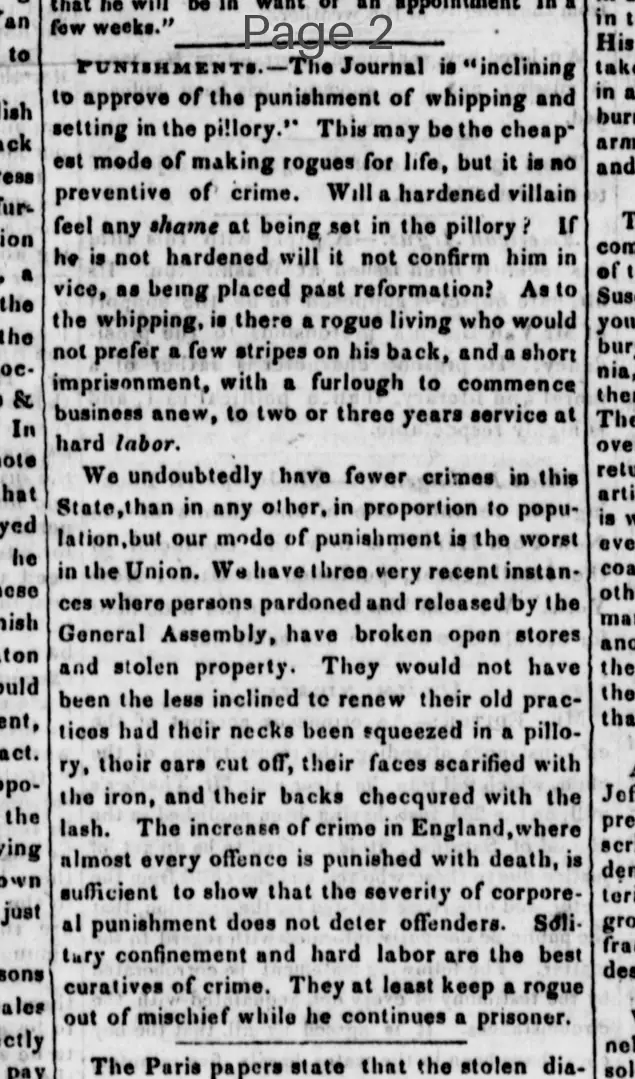
PUNISHMENTS.-The Journal is "inclining to approve of the punishment of whipping and setting in the pillory." This may be the cheapest mode of making rogues for life, but it is no preventive of crime. Will a hardened villain feel any shame at being set in the pillory? If he is not hardened will it not confirm him in vice, as being placed past reformation? As to the whipping, is there a rogue living who would not prefer a few stripes on his back, and a short imprisonment, with a furlough to commence business anew, to two or three years service at hard labor.
We undoubtedly have fewer crimes in this State, than in any other, in proportion to population, but our mode of punishment is the worst in the Union. We have three very recent instances where persons pardoned and released by the General Assembly, have broken open stores and stolen property. They would not have been the less inclined to renew their old practices had their necks been squeezed in a pillory, their ears cut off, their faces scarified with the iron, and their backs chequered with the lash. The increase of crime in England, where almost every offence is punished with death, is sufficient to show that the severity of corporal punishment does not deter offenders. Solitary confinement and hard labor are the best curatives of crime. They at least keep a rogue out of mischief while he continues a prisoner.
We undoubtedly have fewer crimes in this State, than in any other, in proportion to population, but our mode of punishment is the worst in the Union. We have three very recent instances where persons pardoned and released by the General Assembly, have broken open stores and stolen property. They would not have been the less inclined to renew their old practices had their necks been squeezed in a pillory, their ears cut off, their faces scarified with the iron, and their backs chequered with the lash. The increase of crime in England, where almost every offence is punished with death, is sufficient to show that the severity of corporal punishment does not deter offenders. Solitary confinement and hard labor are the best curatives of crime. They at least keep a rogue out of mischief while he continues a prisoner.
What sub-type of article is it?
Crime Or Punishment
Legal Reform
What keywords are associated?
Punishments
Crime Prevention
Corporal Punishment
Pillory
Whipping
Solitary Confinement
Hard Labor
Penal Reform
What entities or persons were involved?
The Journal
General Assembly
England
Editorial Details
Primary Topic
Ineffectiveness Of Corporal Punishments
Stance / Tone
Opposition To Whipping And Pillory, Advocacy For Solitary Confinement And Hard Labor
Key Figures
The Journal
General Assembly
England
Key Arguments
Whipping And Pillory Do Not Prevent Crime And May Harden Offenders
Hardened Villains Feel No Shame In Pillory
Criminals Prefer Short Whipping And Imprisonment Over Long Hard Labor
Recent Pardoned Criminals Reoffended Despite Release
England's Severe Punishments Including Death Have Not Reduced Crime
Solitary Confinement And Hard Labor Are Better For Curing And Preventing Crime