Thank you for visiting SNEWPapers!
Sign up free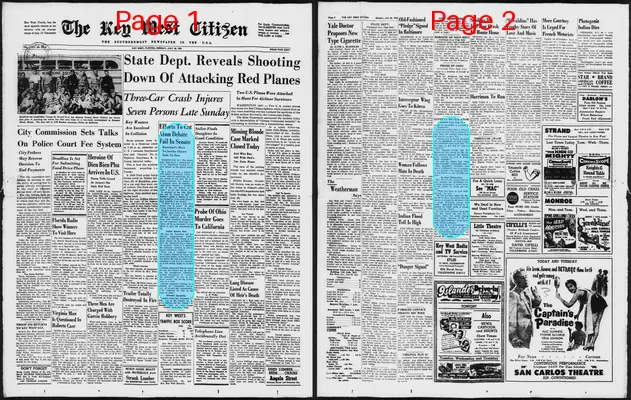
The Key West Citizen
Key West, Monroe County, Florida
What is this article about?
The U.S. Senate rejected Republican leader Knowland's motion to invoke cloture on the atomic energy bill debate, with 44 votes in favor and 42 against, falling short of the required 64. Leaders discussed alternatives to shorten debate amid ongoing marathon sessions, with President Eisenhower supporting continued efforts.
Merged-components note: Continuation of narrative story on atomic energy debate; relabel page 2 'domestic_news' to 'story' as it fits full narrative article.
Clippings
1 of 2
OCR Quality
Full Text
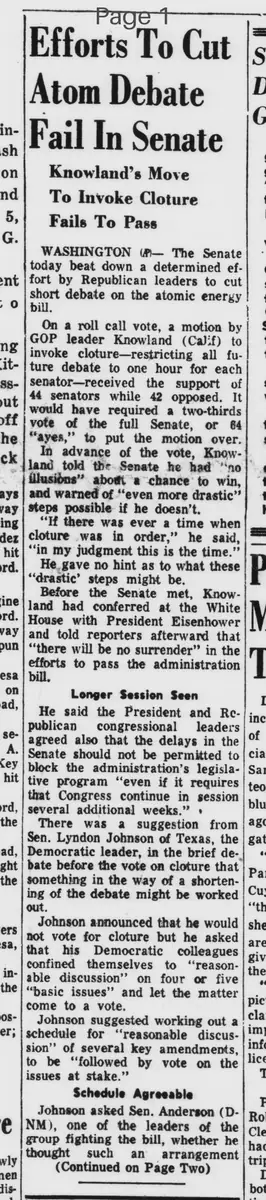
Knowland's Move To Invoke Cloture Fails To Pass
WASHINGTON (P) - The Senate today beat down a determined effort by Republican leaders to cut short debate on the atomic energy bill.
On a roll call vote, a motion by GOP leader Knowland (Calif) to invoke cloture-restricting all future debate to one hour for each senator-received the support of 44 senators while 42 opposed. It would have required a two-thirds vote of the full Senate, or 64 "ayes," to put the motion over.
In advance of the vote, Knowland told the Senate he had no illusions about a chance to win, and warned of "even more drastic" steps possible if he doesn't.
"If there was ever a time when cloture was in order," he said, "in my judgment this is the time."
He gave no hint as to what these "drastic" steps might be.
Before the Senate met, Knowland had conferred at the White House with President Eisenhower and told reporters afterward that "there will be no surrender" in the efforts to pass the administration bill.
Longer Session Seen
He said the President and Republican congressional leaders agreed also that the delays in the Senate should not be permitted to block the administration's legislative program "even if it requires that Congress continue in session several additional weeks."
There was a suggestion from Sen. Lyndon Johnson of Texas, the Democratic leader, in the brief debate before the vote on cloture that something in the way of a shortening of the debate might be worked out.
Johnson announced that he would not vote for cloture but he asked that his Democratic colleagues confined themselves to "reasonable discussion" on four or five "basic issues" and let the matter come to a vote.
Johnson suggested working out a schedule for "reasonable discussion" of several key amendments to be "followed by vote on the issues at stake."
Schedule Agreeable
Johnson asked Sen. Anderson (D-NM), one of the leaders of the group fighting the bill, whether he thought such an arrangement
(Continued on Page Two)
EFFORTS TO CUT ATOM
(Continued from Page One)
might be acceptable to a majority of Democrats.
Anderson replied that if Johnson "came forward with a program of that kind, we wouldn't have near the trouble we have had."
Johnson said he hoped he could get an agreement on such a plan and Anderson came back that "I'd be happy to join him in such an endeavor."
Sen. Holland (D-Fla) told the Senate he was voting for the closure petition because that mechanism "should be used to break futile filibusters."
He said the debate had "long since exceeded a reasonable time."
Sen. Humphrey (D-Minn) said that if a filibuster was in progress it was because "the majority leader has driven us into all-night sessions."
No Real Deliberation
Sen. Hill (D-Ala) argued that the long sessions had prohibited reasonable discussion of actual issues in the debate by tiring out senators.
"There has been no real deliberation," he said.
The bill has been before the Senate for 10 days. Knowland kept the Senate in session for 86 hours, with a single 25-minute recess, last week. Knowland indicated to reporters he might make a second try later for cloture.
He said some senators have told him they would not vote for a cloture today, but might change their minds "because of the extreme obstructionism" if the marathon debate continues.
He said he was determined "we are going to continue in session day and night until we vote on the amendments and the bill" and that President Eisenhower has approved that course.
What sub-type of article is it?
What themes does it cover?
What keywords are associated?
What entities or persons were involved?
Where did it happen?
Story Details
Key Persons
Location
Washington
Event Date
Today
Story Details
Republican leader Knowland's motion to invoke cloture on the atomic energy bill failed in the Senate with 44-42 vote, short of 64 needed. Discussions between leaders like Johnson and Anderson suggested possible agreements for reasonable debate on key issues. Knowland vowed continued marathon sessions with Eisenhower's support to pass the bill.