Thank you for visiting SNEWPapers!
Sign up free
Alexandria Gazette
Alexandria, Alexandria County, District Of Columbia
What is this article about?
Sir Everard Home, eminent surgeon, accused of stealing John Hunter's manuscripts for his 'Lectures on Comparative Anatomy' and burning them to conceal the theft. Parliamentary investigation in 1823 confirms the fraud, consigning Home to infamy while causing irreparable loss to science.
Clipping
OCR Quality
Full Text
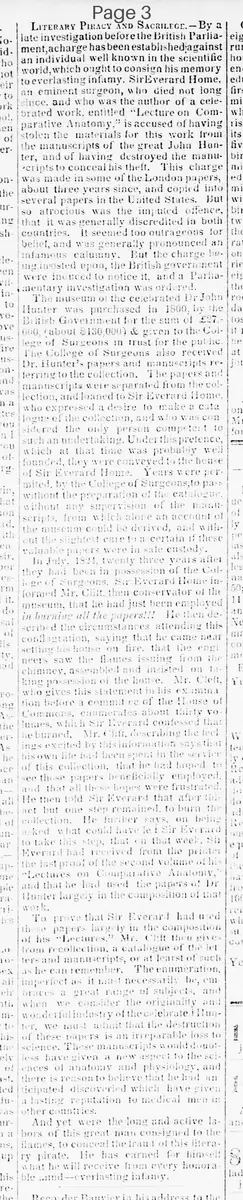
The museum of the celebrated Dr. John Hunter was purchased in 1800, by the British Government for the sum of £15,000, (about $130,000) & given to the College of Surgeons in trust for the public. The College of Surgeons also received Dr. Hunter's papers and manuscripts referring to the collection. The papers and manuscripts were separated from the collection, and loaned to Sir Everard Home who expressed a desire to make a catalogue of the collection, and who was considered the only person competent to such an undertaking. Under this pretence which at that time was probably well founded, they were conveyed to the house of Sir Everard Home. Years were permitted, by the College of Surgeons, to pass without the preparation of the catalogue, without any supervision of the manuscripts, from which alone an account of the museum could be derived, and without the slightest care to ascertain if these valuable papers were in safe custody.
In July, 1823, twenty three years after they had been in possession of the College of Surgeons, Sir Everard Home informed Mr. Clift, then conservator of the museum, that he had just been employed in burning all the papers!!! He then described the circumstances attending this conflagration, saying that he came near setting his house on fire, that the engine men saw the flames issuing from the chimney, assembled and insisted on taking possession of the house. Mr. Clift, who gives this statement in his examination before a committee of the House of Commons, enumerates about thirty volumes, which Sir Everard confessed that he burned, Mr. Clift, describing the feelings excited by this information says that his own life had been spent in the service of this collection, that he had hoped to see those papers beneficially employed, and that all these hopes were frustrated He then told Sir Everard that after this act but one step remained, to burn the collection. He further says, on being asked what could have led Sir Everard to take this step, that at that week, Sir Everard had received from the printer the last proof of the second volume of his "Lectures on Comparative Anatomy, and that he had used the papers of Dr. Hunter largely in the composition of that work.
To prove that Sir Everard had used the papers largely in the composition of his "Lectures." Mr. Clift thus gives from recollection, a catalogue of the letters and manuscripts, or at least of such as he can remember. The enumeration, imperfect as it must necessarily be, embraces a great range of subjects, and when we consider the originality and wonderful illustrations of the celebrated Hunter, we must admit that the destruction of these papers is an irreparable loss to science. These manuscripts would doubtless have given a new aspect to the sciences of anatomy and physiology, and there is reason to believe that he had anticipated discoveries which have given a lasting reputation to medical men in other countries.
And yet were the long and active labors of this great man consigned to the flames, to conceal the fraud of this literary pirate. He has earned for himself what he will receive from every honorable mind—everlasting infamy.
What sub-type of article is it?
What themes does it cover?
What keywords are associated?
What entities or persons were involved?
Where did it happen?
Story Details
Key Persons
Location
London, England
Event Date
July 1823
Story Details
Sir Everard Home borrowed John Hunter's manuscripts to catalog the museum but used them to plagiarize his 'Lectures on Comparative Anatomy,' then burned about thirty volumes in 1823 to hide the theft. Mr. Clift's testimony in a Parliamentary investigation exposed the fraud, causing irreparable loss to science and infamy for Home.