Thank you for visiting SNEWPapers!
Sign up free
Literary
March 17, 1832
Providence Patriot, Columbian Phenix
Providence, Providence County, Rhode Island
What is this article about?
Abridged biographical account from the Newgate Calendar of Eugene Aram (1704-1759), scholar and murderer, including his early life, languages study, 1745 murder of Daniel Clark with accomplice Houseman, discovery of remains in 1758, trial, ingenious defense, execution, and a philosophical extract on death and the afterlife.
Clipping
OCR Quality
95%
Excellent
Full Text
EUGENE ARAM.
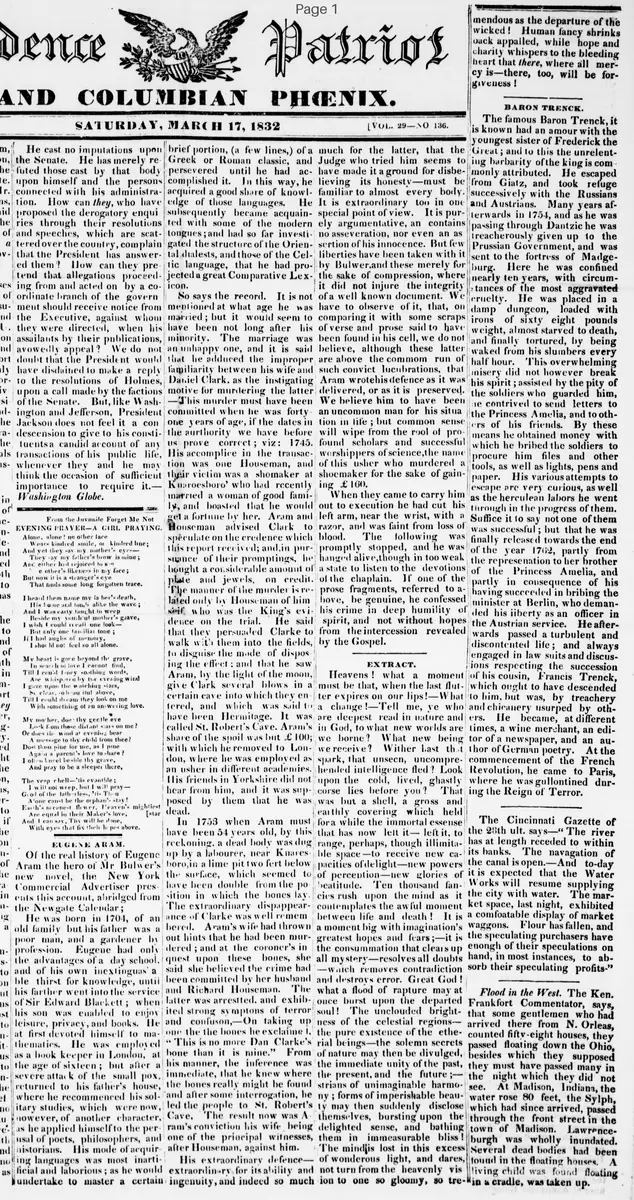
Of the real history of Eugene Aram the hero of Mr Bulwer's new novel, the New York Commercial Advertiser presents this account, abridged from the Newgate Calendar;
He was born in 1704, of an old family but his father was a poor man, and a gardener by profession. Eugene had only the advantages of a day school, and of his own inextinguishable thirst for knowledge, until his father went into the service of Sir Edward Blackett: when his son was enabled to enjoy leisure, privacy, and books. He at first devoted himself to mathematics. He was employed as a book keeper in London, at the age of sixteen; but after a severe attack of the small pox, returned to his father's house, where he recommenced his solitary studies, which were now, however, of another character, as he applied himself to the perusal of poets, philosophers, and historians.
His mode of acquiring languages was most artificial and laborious; as he would undertake to master a certain brief portion, (a few lines,) of a Greek or Roman classic, and persevered until he had accomplished it. In this way, he acquired a good share of knowledge of those languages. He subsequently became acquainted with some of the modern tongues; and had so far investigated the structure of the Oriental dialects, and those of the Celtic language, that he had projected a great Comparative Lexicon.
So says the record. It is not mentioned at what age he was married; but it would seem to have been not long after his minority. The marriage was an unhappy one, and it is said that he adduced the improper familiarity between his wife and Daniel Clark, as the instigating motive for murdering the latter--This murder must have been committed when he was forty one years of age, if the dates in the authority we have before us prove correct; viz: 1745.
His accomplice in the transaction was one Houseman, and their victim was a shoemaker at Knaresborough who had recently married a woman of good family, and boasted that he would get a fortune by her. Aram and Houseman advised Clark to speculate on the credence which this report received; and, in pursuance of their promptings, he bought a considerable amount of plate and jewels, on credit.
The manner of the murder is related only by Houseman of himself, who was the King's evidence on the trial. He said that they persuaded Clarke to walk with them into the fields, to disguise the mode of disposing the effects : and that he saw Aram, by the light of the moon, give Clark several blows in a certain cave into which they entered, and which was said to have been Hermitage. It was called St. Robert's Cave. Aram's share of the spoil was but £100; with which he removed to London, where he was employed as an usher in different academies.
His friends in Yorkshire did not hear from him, and it was supposed by them that he was dead.
In 1758 when Aram must have been 54 years old, by this reckoning, a dead body was dug up by a labourer, near Knaresborough, in a lime pit two feet below the surface, which seemed to have been double from the position in which the bones lay.
The extraordinary disappearance of Clarke was well remembered. Aram's wife had thrown out hints that he had been murdered ; and at the coroner's inquest upon these bones, she said she believed the crime had been committed by her husband and Richard Houseman. The latter was arrested, and exhibited strong symptoms of terror and confusion,--On taking up one of the bones he exclaimed, "This is no more Dan Clarke's bone than it is mine." From his manner, the inference was immediate, that he knew where the bones really might be found and after some interrogation, he led the people to St. Robert's Cave. The result now was Aram's conviction his wife being one of the principal witnesses, after Houseman, against him.
His extraordinary defence--extraordinary, for its ability and ingenuity, and indeed so much for the latter, that the Judge who tried him seems to have made it a ground for disbelieving its honesty--must be familiar to almost every body.
It is extraordinary too in one special point of view. It is purely argumentative, and contains no asseveration, nor even an assertion of his innocence. But few liberties have been taken with it by Bulwer, and these merely for the sake of compression, where it did not injure the integrity of a well known document. We have to observe of it, that, on comparing it with some scraps of verse and prose said to have been found in his cell, we do not believe, although these latter are above the common run of such convict lucubrations, that Aram wrote his defence as it was delivered, or as it is preserved. We believe him to have been an uncommon man for his situation in life ; but common sense will wipe from the roll of profound scholars and successful worshippers of science, the name of this usher who murdered a shoemaker for the sake of gaining £160.
When they came to carry him out to execution he had cut his left arm, near the wrist, with a razor, and was faint from loss of blood. The following was promptly stopped, and he was hanged alive, though in too weak a state to listen to the devotions of the chaplain. If one of the prose fragments, referred to above, be genuine, he confessed his crime in deep humility of spirit, and not without hopes from the intercession revealed by the Gospel.
EXTRACT.
Heavens! what a moment must be that, when the last flutter expires on our lips!--What a change!--Tell me, ye who are deepest read in nature and in God, to what new worlds are we borne? What new being we receive? Whither last that spark, that unseen, uncomprehended intelligence fled? Look upon the cold, livid, ghastly corse lies before you? That was but a shell, a gross and earthly covering which held for a while the immortal essence that has now left it--left it, to range, perhaps, though illimitable space--to receive new capacities of delight--new powers of perception--new glories of beatitude. Ten thousand fancies rush upon the mind as it contemplates the awful moment between life and death! It is a moment big with imagination's greatest hopes and fears;--it is the consummation that clears up all mystery--resolves all doubts which removes contradiction and destroys error. Great God! what a flood of rapture may at once burst upon the departed soul! The unclouded brightness of the celestial regions--the pure existence of the ethereal beings--the solemn secrets of nature may then be divulged, the immediate unity of the past, the present, and the future; strains of unimaginable harmony; forms of imperishable beauty may then suddenly disclose themselves, bursting upon the delighted sense, and bathing them in immeasurable bliss!
The mind is lost in this excess of wondrous light, and dares not turn from the heavenly vision to one so gloomy, so tremendous as the departure of the wicked! Human fancy shrinks back appalled, while hope and charity whispers to the bleeding heart that there, where all mercy is--there, too, will be forgiveness!
Of the real history of Eugene Aram the hero of Mr Bulwer's new novel, the New York Commercial Advertiser presents this account, abridged from the Newgate Calendar;
He was born in 1704, of an old family but his father was a poor man, and a gardener by profession. Eugene had only the advantages of a day school, and of his own inextinguishable thirst for knowledge, until his father went into the service of Sir Edward Blackett: when his son was enabled to enjoy leisure, privacy, and books. He at first devoted himself to mathematics. He was employed as a book keeper in London, at the age of sixteen; but after a severe attack of the small pox, returned to his father's house, where he recommenced his solitary studies, which were now, however, of another character, as he applied himself to the perusal of poets, philosophers, and historians.
His mode of acquiring languages was most artificial and laborious; as he would undertake to master a certain brief portion, (a few lines,) of a Greek or Roman classic, and persevered until he had accomplished it. In this way, he acquired a good share of knowledge of those languages. He subsequently became acquainted with some of the modern tongues; and had so far investigated the structure of the Oriental dialects, and those of the Celtic language, that he had projected a great Comparative Lexicon.
So says the record. It is not mentioned at what age he was married; but it would seem to have been not long after his minority. The marriage was an unhappy one, and it is said that he adduced the improper familiarity between his wife and Daniel Clark, as the instigating motive for murdering the latter--This murder must have been committed when he was forty one years of age, if the dates in the authority we have before us prove correct; viz: 1745.
His accomplice in the transaction was one Houseman, and their victim was a shoemaker at Knaresborough who had recently married a woman of good family, and boasted that he would get a fortune by her. Aram and Houseman advised Clark to speculate on the credence which this report received; and, in pursuance of their promptings, he bought a considerable amount of plate and jewels, on credit.
The manner of the murder is related only by Houseman of himself, who was the King's evidence on the trial. He said that they persuaded Clarke to walk with them into the fields, to disguise the mode of disposing the effects : and that he saw Aram, by the light of the moon, give Clark several blows in a certain cave into which they entered, and which was said to have been Hermitage. It was called St. Robert's Cave. Aram's share of the spoil was but £100; with which he removed to London, where he was employed as an usher in different academies.
His friends in Yorkshire did not hear from him, and it was supposed by them that he was dead.
In 1758 when Aram must have been 54 years old, by this reckoning, a dead body was dug up by a labourer, near Knaresborough, in a lime pit two feet below the surface, which seemed to have been double from the position in which the bones lay.
The extraordinary disappearance of Clarke was well remembered. Aram's wife had thrown out hints that he had been murdered ; and at the coroner's inquest upon these bones, she said she believed the crime had been committed by her husband and Richard Houseman. The latter was arrested, and exhibited strong symptoms of terror and confusion,--On taking up one of the bones he exclaimed, "This is no more Dan Clarke's bone than it is mine." From his manner, the inference was immediate, that he knew where the bones really might be found and after some interrogation, he led the people to St. Robert's Cave. The result now was Aram's conviction his wife being one of the principal witnesses, after Houseman, against him.
His extraordinary defence--extraordinary, for its ability and ingenuity, and indeed so much for the latter, that the Judge who tried him seems to have made it a ground for disbelieving its honesty--must be familiar to almost every body.
It is extraordinary too in one special point of view. It is purely argumentative, and contains no asseveration, nor even an assertion of his innocence. But few liberties have been taken with it by Bulwer, and these merely for the sake of compression, where it did not injure the integrity of a well known document. We have to observe of it, that, on comparing it with some scraps of verse and prose said to have been found in his cell, we do not believe, although these latter are above the common run of such convict lucubrations, that Aram wrote his defence as it was delivered, or as it is preserved. We believe him to have been an uncommon man for his situation in life ; but common sense will wipe from the roll of profound scholars and successful worshippers of science, the name of this usher who murdered a shoemaker for the sake of gaining £160.
When they came to carry him out to execution he had cut his left arm, near the wrist, with a razor, and was faint from loss of blood. The following was promptly stopped, and he was hanged alive, though in too weak a state to listen to the devotions of the chaplain. If one of the prose fragments, referred to above, be genuine, he confessed his crime in deep humility of spirit, and not without hopes from the intercession revealed by the Gospel.
EXTRACT.
Heavens! what a moment must be that, when the last flutter expires on our lips!--What a change!--Tell me, ye who are deepest read in nature and in God, to what new worlds are we borne? What new being we receive? Whither last that spark, that unseen, uncomprehended intelligence fled? Look upon the cold, livid, ghastly corse lies before you? That was but a shell, a gross and earthly covering which held for a while the immortal essence that has now left it--left it, to range, perhaps, though illimitable space--to receive new capacities of delight--new powers of perception--new glories of beatitude. Ten thousand fancies rush upon the mind as it contemplates the awful moment between life and death! It is a moment big with imagination's greatest hopes and fears;--it is the consummation that clears up all mystery--resolves all doubts which removes contradiction and destroys error. Great God! what a flood of rapture may at once burst upon the departed soul! The unclouded brightness of the celestial regions--the pure existence of the ethereal beings--the solemn secrets of nature may then be divulged, the immediate unity of the past, the present, and the future; strains of unimaginable harmony; forms of imperishable beauty may then suddenly disclose themselves, bursting upon the delighted sense, and bathing them in immeasurable bliss!
The mind is lost in this excess of wondrous light, and dares not turn from the heavenly vision to one so gloomy, so tremendous as the departure of the wicked! Human fancy shrinks back appalled, while hope and charity whispers to the bleeding heart that there, where all mercy is--there, too, will be forgiveness!
What sub-type of article is it?
Essay
Soliloquy
What themes does it cover?
Death Mortality
Moral Virtue
What keywords are associated?
Eugene Aram
Murder
Biography
Trial
Execution
Death
Afterlife
Newgate Calendar
Literary Details
Title
Eugene Aram.
Subject
Real History Of Eugene Aram, Hero Of Mr Bulwer's New Novel, Abridged From The Newgate Calendar
Form / Style
Biographical Prose Sketch With Philosophical Extract On Death
Key Lines
Heavens! What A Moment Must Be That, When The Last Flutter Expires On Our Lips! What A Change! Tell Me, Ye Who Are Deepest Read In Nature And In God, To What New Worlds Are We Borne? What New Being We Receive? Whither Last That Spark, That Unseen, Uncomprehended Intelligence Fled?
Great God! What A Flood Of Rapture May At Once Burst Upon The Departed Soul! The Unclouded Brightness Of The Celestial Regions The Pure Existence Of The Ethereal Beings The Solemn Secrets Of Nature May Then Be Divulged, The Immediate Unity Of The Past, The Present, And The Future; Strains Of Unimaginable Harmony; Forms Of Imperishable Beauty May Then Suddenly Disclose Themselves, Bursting Upon The Delighted Sense, And Bathing Them In Immeasurable Bliss!
The Mind Is Lost In This Excess Of Wondrous Light, And Dares Not Turn From The Heavenly Vision To One So Gloomy, So Tremendous As The Departure Of The Wicked! Human Fancy Shrinks Back Appalled, While Hope And Charity Whispers To The Bleeding Heart That There, Where All Mercy Is There, Too, Will Be Forgiveness!