Thank you for visiting SNEWPapers!
Sign up free
Story
March 15, 1830
Lynchburg Virginian
Lynchburg, Virginia
What is this article about?
Excerpts from historical sources including the American Gardener, Knight's Treatise, Loudon, and Col. Pickering on techniques for pruning apple and standard trees to ensure light penetration, structural integrity, and optimal fruit production, with recommendations for conical shapes and spring timing.
Clipping
OCR Quality
95%
Excellent
Full Text
From the American Gardener.
PRUNING.
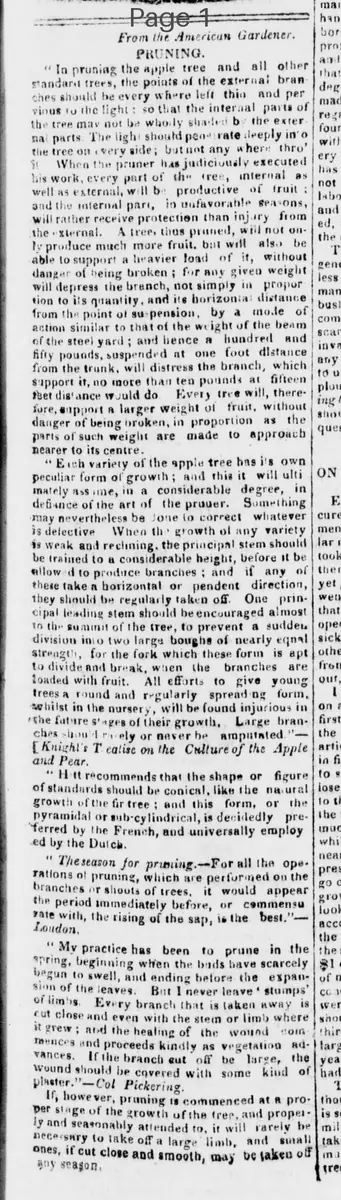
"In pruning the apple tree and all other standard trees, the points of the external branches should be everywhere left thin and pervious to the light: so that the internal parts of the tree may not be wholly shaded by the external. The light should penetrate deeply into the tree on every side; but not anywhere through. When the pruner has judiciously executed his work, every part of the tree, internal as well as external, will be productive of fruit: and the internal part, in unfavorable seasons, will rather receive protection than injury from the external. A tree, thus pruned, will not only produce much more fruit, but will also be able to support a heavier load of it, without danger of being broken; for any given weight will depress the branch, not simply in proportion to its quantity, and its horizontal distance from the point of suspension, by a mode of action similar to that of the weight of the beam of the steel yard; and hence a hundred and fifty pounds, suspended at one foot distance from the trunk, will distress the branch, which support it, no more than ten pounds at fifteen feet distance would do. Every tree will, therefore, support a larger weight of fruit, without danger of being broken, in proportion as the parts of such weight are made to approach nearer to its centre.
"Each variety of the apple tree has its own peculiar form of growth; and this it will ultimately assume, in a considerable degree, in defiance of the art of the pruner. Something may nevertheless be done to correct whatever is defective in the growth of any variety. If it is weak and reclining, the principal stem should be trained to a considerable height, before it be allowed to produce branches: and if any of these take a horizontal or pendent direction, they should be regularly taken off. One principal leading stem should be encouraged almost to the summit of the tree, to prevent a sudden division into two large boughs of nearly equal strength's, for the fork which these form is apt to divide and break, when the branches are loaded with fruit. All efforts to give young trees a round and regularly spreading form, whilst in the nursery, will be found injurious in the future stages of their growth. Large branches should rely or never be amputated"—
[Knight's Treatise on the Culture of the Apple and Pear.]
"It recommends that the shape or figure of standards should be conical, like the natural growth of the fir tree; and this form, or the pyramidal or sub-cylindrical, is decidedly preferred by the French, and universally employed by the Dutch.
"The season for pruning.—For all the operations of pruning, which are performed on the branches or shoots of trees, it would appear the period immediately before, or commensurate with, the rising of the sap, is the best."—
Loudon.
"My practice has been to prune in the spring, beginning when the buds have scarcely begun to swell, and ending before the expansion of the leaves of limbs. Every branch that is taken away is cut close and even with the stem or limb where it grew and the healing of the wound commences and proceeds kindly as vegetation advances. The wound should be covered with some kind of plaster."—Col. Pickering.
If, however, pruning is commenced at a proper stage of the growth of the tree, and properly and seasonably attended to, it will rarely be necessary to take off a large limb, and small ones, if cut close and smooth, may be taken off any season.
PRUNING.
"In pruning the apple tree and all other standard trees, the points of the external branches should be everywhere left thin and pervious to the light: so that the internal parts of the tree may not be wholly shaded by the external. The light should penetrate deeply into the tree on every side; but not anywhere through. When the pruner has judiciously executed his work, every part of the tree, internal as well as external, will be productive of fruit: and the internal part, in unfavorable seasons, will rather receive protection than injury from the external. A tree, thus pruned, will not only produce much more fruit, but will also be able to support a heavier load of it, without danger of being broken; for any given weight will depress the branch, not simply in proportion to its quantity, and its horizontal distance from the point of suspension, by a mode of action similar to that of the weight of the beam of the steel yard; and hence a hundred and fifty pounds, suspended at one foot distance from the trunk, will distress the branch, which support it, no more than ten pounds at fifteen feet distance would do. Every tree will, therefore, support a larger weight of fruit, without danger of being broken, in proportion as the parts of such weight are made to approach nearer to its centre.
"Each variety of the apple tree has its own peculiar form of growth; and this it will ultimately assume, in a considerable degree, in defiance of the art of the pruner. Something may nevertheless be done to correct whatever is defective in the growth of any variety. If it is weak and reclining, the principal stem should be trained to a considerable height, before it be allowed to produce branches: and if any of these take a horizontal or pendent direction, they should be regularly taken off. One principal leading stem should be encouraged almost to the summit of the tree, to prevent a sudden division into two large boughs of nearly equal strength's, for the fork which these form is apt to divide and break, when the branches are loaded with fruit. All efforts to give young trees a round and regularly spreading form, whilst in the nursery, will be found injurious in the future stages of their growth. Large branches should rely or never be amputated"—
[Knight's Treatise on the Culture of the Apple and Pear.]
"It recommends that the shape or figure of standards should be conical, like the natural growth of the fir tree; and this form, or the pyramidal or sub-cylindrical, is decidedly preferred by the French, and universally employed by the Dutch.
"The season for pruning.—For all the operations of pruning, which are performed on the branches or shoots of trees, it would appear the period immediately before, or commensurate with, the rising of the sap, is the best."—
Loudon.
"My practice has been to prune in the spring, beginning when the buds have scarcely begun to swell, and ending before the expansion of the leaves of limbs. Every branch that is taken away is cut close and even with the stem or limb where it grew and the healing of the wound commences and proceeds kindly as vegetation advances. The wound should be covered with some kind of plaster."—Col. Pickering.
If, however, pruning is commenced at a proper stage of the growth of the tree, and properly and seasonably attended to, it will rarely be necessary to take off a large limb, and small ones, if cut close and smooth, may be taken off any season.
What sub-type of article is it?
Agricultural Advice
Horticultural Instruction
What keywords are associated?
Pruning
Apple Tree
Standard Trees
Light Penetration
Fruit Production
Tree Structure
Spring Pruning
What entities or persons were involved?
Col. Pickering
Knight
Loudon
Story Details
Key Persons
Col. Pickering
Knight
Loudon
Story Details
Instructions on pruning apple and standard trees to allow light penetration for fruit production, maintain a leading stem to prevent breakage, prefer conical shapes, and prune in spring before bud swell with wound covering.