Thank you for visiting SNEWPapers!
Sign up free
Daily State Sentinel
Indianapolis, Marion County, Indiana
What is this article about?
N.Y. News editorial contrasts British refusal to let operatives celebrate Shakespeare in Green Park with U.S. Civil War military banishments of mechanics in Tennessee and Ohio for not extending contracts, highlighting greater American injustices.
Clipping
OCR Quality
Full Text
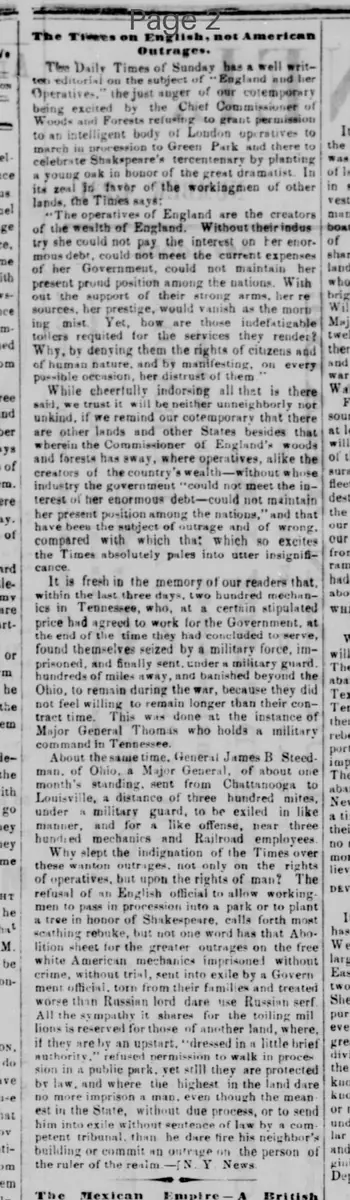
The Daily Times of Sunday has a well written article on the subject of "England and her Operatives," the just anger of our cotemporary being excited by the "Chief Commissioner of Woods and Forests refusing to grant permission to an intelligent body of London operatives to march in procession to Green Park and there to celebrate Shakspeare's tercentenary by planting a young oak in honor of the great dramatist. In lieu of the workingmen of other lands, the Times says:
"The operatives of England are the creators of the wealth of England. Without their industry she could not pay the interest on her enormous debt, could not meet the current expenses of her Government, could not maintain her present proud position among the nations. Without the support of their strong arms, her resources, her prestige, would vanish as the morning mist. Yet, how are those indefatigable toilers requited for the services they render? Why, by denying them the rights of citizens and of human nature, and by manifesting, on every possible occasion, her distrust of them."
While cheerfully indorsing all that is there said, we trust it will be neither unneighborly nor unkind, if we remind our cotemporary that there are other lands and other States besides that wherein the Commissioner of England's woods and forests has sway, where operatives, alike the creators of the country's wealth - without whose industry the government "could not meet the interest of her enormous debt - could not maintain her present position among the nations," and that have been the subject of outrage and of wrong, compared with which that which so excites the Times absolutely pales into utter insignificance.
It is fresh in the memory of our readers that, within the last three days, two hundred mechanics in Tennessee, who, at a certain stipulated price had agreed to work for the Government, at the end of the time they had concluded to serve, found themselves seized by a military force, imprisoned, and finally sent, under a military guard, hundreds of miles away, and banished beyond the Ohio, to remain during the war, because they did not feel willing to remain longer than their contract time. This was done at the instance of Major General Thomas who holds a military command in Tennessee.
About the same time, General James B. Steedman, of Ohio, a Major General, of about one month's standing, sent from Chattanooga to Louisville, a distance of three hundred miles, under a military guard, to be exiled in like manner, and for a like offense, near three hundred mechanics and Railroad employees.
Why slept the indignation of the Times over these wanton outrages, not only on the rights of operatives, but upon the rights of man? The refusal of an English official to allow workingmen to pass in procession into a park or to plant a tree in honor of Shakespeare, calls forth most scathing rebuke, but not one word has that Abolition sheet for the greater outrages on the free white American mechanics imprisoned without crime, without trial, sent into exile by a Government official, torn from their families and treated worse than Russian lords dare use Russian serfs.
All the sympathy it shares for the toiling millions is reserved for those of another land, where, if they are by an upstart, "dressed in a little brief authority," refused permission to walk in procession in a public park, yet still they are protected by law, and where the highest in the land dare no more imprison a man, even though the meanest in the State, without due process, or to send him into exile without sentence of law by a competent tribunal, than he dare fire his neighbor's building or commit an outrage on the person of the ruler of the realm. - N. Y. News.
What sub-type of article is it?
What themes does it cover?
What keywords are associated?
What entities or persons were involved?
Where did it happen?
Story Details
Key Persons
Location
Tennessee, Ohio, England
Event Date
During The War
Story Details
The article criticizes the Daily Times for decrying British denial of London operatives' procession to Green Park for Shakespeare's tercentenary, while ignoring U.S. military outrages: 200 Tennessee mechanics banished beyond the Ohio for not extending contracts, ordered by Major General Thomas; and 300 mechanics and railroad employees sent from Chattanooga to Louisville for exile by General James B. Steedman.