Thank you for visiting SNEWPapers!
Sign up free
The Enquirer
Richmond, Henrico County, Virginia
What is this article about?
Reports suggest US government received dispatches from Mr. Monroe indicating probable favorable resolution of differences with France via permanent treaty. In England, hopes for peace with US and France, but obstacles include restoring Hanover from Prussia, complicating negotiations per Fox and Grenville's views.
Clipping
OCR Quality
Full Text
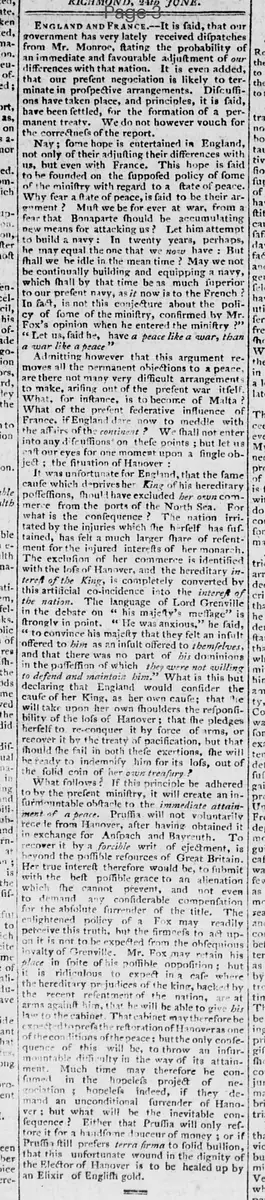
Nay: some hopes is entertained in England, not only of their adjusting their differences with us, but even with France. This hope is said to be founded on the supposed policy of some of the ministry with regard to a state of peace. Why fear a state of peace, is said to be their argument? Must we be for ever at war, from a fear that Bonaparte should be accumulating new means for attacking us? Let him attempt to build a navy: In twenty years, perhaps, he may equal the one that we now have: But shall we while idle in the mean time? May we not be continually building and equipping a navy, which shall by that time be as much superior to our present navy, as it now is to the French?
In fact, is not this conjecture about the policy of some of the ministry, confirmed by Mr. Fox's opinion when he entered the ministry? "Let us, said he, have a peace like a war, than a war like a peace."
Admitting however that this argument removes all the permanent objections to a peace, are there not many very difficult arrangements to make, arising out of the present war itself. What, for instance, is to become of Malta? What of the present federative influence of France, if England dare now to meddle with the affairs of the continent? We shall not enter into any discussions on these points; but let us cast our eyes for one moment upon a single object: the situation of Hanover:
It was unfortunate for England, that the same cause which deprives her King of his hereditary possessions, should have excluded her own commerce from the ports of the North Sea. For what is the consequence? The nation irritated by the injuries which she herself has sustained, has felt a much larger share of resentment for the injured interests of her monarch. The exclusion of her commerce is identified with the loss of Hanover, and the hereditary interest of the King, is completely converted by this artificial co-incidence into the interest of the nation. The language of Lord Grenville in the debate on "his majesty's message" is strongly in point. "He was anxious," he said, "to convince his majesty that they felt an insult offered to him as an insult offered to themselves, and that there was no part of his dominions in the possession of which they were not willing to defend and maintain him." What is this but declaring that England would consider the cause of her King, as her own cause: that she will take upon her own shoulders the responsibility of the loss of Hanover: that she pledges herself to re-conquer it by force of arms, or recover it by the treaty of pacification, but that should she fail in both these exertions, she will be ready to indemnify him for its loss, out of the solid coin of her own treasury?
What follows? If this principle be adhered to by the present ministry, it will create an insurmountable obstacle to the immediate attainment of a peace. Prussia will not voluntarily recede from Hanover, after having obtained it in exchange for Anspach and Bayreuth. To recover it by a forcible writ of ejectment, is beyond the possible resources of Great Britain. Her true interest therefore would be, to submit with the best possible grace to an alienation which she cannot prevent, and not even to demand any considerable compensation for the absolute surrender of the title. The enlightened policy of a Fox may readily perceive this truth, but the firmness to act upon it is not to be expected from the obsequious loyalty of Grenville. Mr. Fox may retain his place in spite of his possible opposition; but it is ridiculous to expect in a case where the hereditary prejudices of the king, backed by the recent resentment of the nation, are at arms against him, that he will be able to give his law to the cabinet. That cabinet may therefore be expected to press the restoration of Hanover as one of the conditions of the peace: but the only consequence of this will be, to throw an insurmountable difficulty in the way of its attainment. Much time may therefore be consumed in the hopeless project of negociation; hopeless indeed, "if they demand an unconditional surrender of Hanover; but what will be the inevitable consequence? Either that Prussia will only restore it for a handsome douceur of money; or if Prussia still prefers terra firma to solid bullion, that this unfortunate wound in the dignity of the Elector of Hanover is to be healed up by an Elixir of English gold.
What sub-type of article is it?
What keywords are associated?
What entities or persons were involved?
Where did it happen?
Foreign News Details
Primary Location
England
Key Persons
Outcome
probability of favorable us-france treaty; english hopes for peace hindered by hanover restoration demands, potentially requiring compensation to prussia.
Event Details
US dispatches from Mr. Monroe suggest imminent favorable resolution with France via permanent treaty. In England, ministry debates peace policy, citing Fox's views, but faces obstacles like Malta and especially Hanover's loss to Prussia, which national resentment ties to commerce exclusion, making restoration a key negotiation hurdle likely delaying peace.