Thank you for visiting SNEWPapers!
Sign up free
The Hillsborough Recorder
Hillsboro, Orange County, North Carolina
What is this article about?
A soldier from the North Carolina Regiment describes the regiment's journey from Brazos to San Francisco, Mexico, the impacts of disease and harsh conditions during the Mexican-American War, and reflects on the heavy losses and moral costs of the conflict, hoping for its end after Vera Cruz's capture.
Clipping
OCR Quality
Full Text
San Francisco, April 10, 1847.
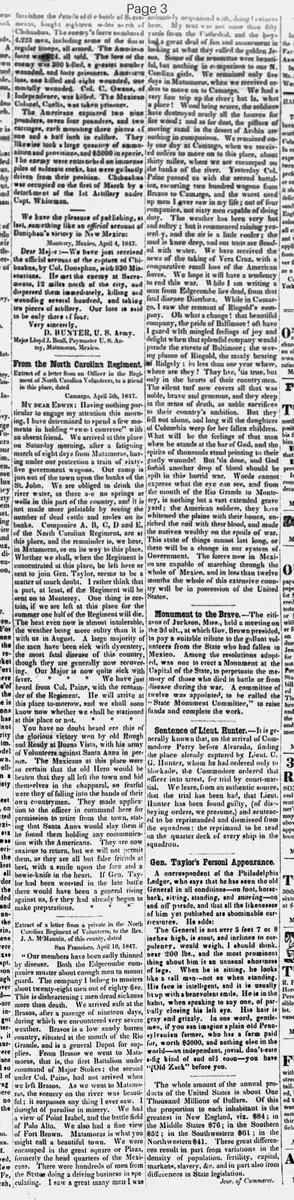
'Our members have been sadly thinned by disease. Both the Edgecombe companies muster about enough men to mount guard. The company I belong to musters about twenty-eight men out of eighty-five. This is disheartening: men dread sickness more than death. We arrived safe at the Brasos, after a passage of nineteen days, during which we encountered very severe weather. Brasos is a low sandy barren country, situated at the mouth of the Rio Grande, and is a general Depot of supplies. From Brasos we went to Matamoros, that is, the first Battalion under command of Major Stokes: the second under Col. Paine, had not arrived when we left Brasos. As we went to Matamoros, the scenery on the river was beautiful; it surpasses any thing I ever saw. I thought of paradise in misery. We had a view of Point Isabel, and the battle field of Palo Alto. We also had a fine view of Fort Brown. Matamoros is what you might call a beautiful town. We were encamped in the great square or Plaza, formerly the head quarters of the Mexicans. There were hundreds of men from the States doing a driving business in speculating. I saw a great many men I was intimately acquainted with, doing business here. My tent was not more than fifty yards from the Cathedral, and the boys had a great deal of fun and amusement in looking at what they called the golden Jesus. Some of the senoritas were beautiful, but nothing in comparison to our N. Carolina girls. We remained only five days in Matamoros, when we received orders to move on to Camargo. We had a very fine trip up the river; but la, what a place! Wood being scarce, the soldiers have destroyed nearly all the houses for fire wood; and as for dust, the pillars of moving sand in the desert of Arabia are nothing in comparison. We remained only one day at Camargo, when we received orders to move on to this place, about thirty miles, where we are encamped on the banks of the river. Yesterday Col. Paine passed us with the second battalion, escorting two hundred wagons from Brazos to Camargo, and the worst used up men I ever saw in my life; out of four companies, not sixty men capable of doing duty. The weather has been very hot and sultry; but it commenced raining yesterday, and the air is a little cooler; the mud is knee deep, and our tents are flooded with water. We have received the news of the taking of Vera Cruz, with a comparative small loss of the American forces. We hope it will have a tendency to end this war. While I am writing a man from Edgecombe lies dead, from that fatal disease Diarrhoea. While in Camargo, I saw the remnant of Ringold's company. Oh what a change! that beautiful company, the pride of Baltimore! oft have I gazed with mingled feelings of joy and delight when that splendid company would parade the streets of Baltimore; the waving plume of Ringold, the manly bearing of Ridgely: in less than one year where, where are they? They live, 'tis true, but only in the hearts of their countrymen. The silent turf now covers all that was noble, brave and generous, and they sleep in the arms of death, as noble sacrifices to their country's ambition. But they fell not alone, and long will the daughters of Columbia weep for her fallen children. What will be the feelings of that man when he stands at the bar of God, and the spirits of thousands stand pointing to their ghastly wounds! But 'tis done, and God forbid another drop of blood should be spilt in this horrid war. Words cannot express what the eye can see, and from the mouth of the Rio Grande to Monterey, is nothing but a vast extended grave yard; the American soldiers, they have whitened the plains with their bones, enriched the soil with their blood, and made the natives wealthy on the spoils of war. This state of things cannot last long, or there will be a change in our system of Government. The forces now in Mexico are capable of marching through the whole of Mexico, and in less than twelve months the whole of this extensive country will be in possession of the United States.'
What sub-type of article is it?
What themes does it cover?
What keywords are associated?
What entities or persons were involved?
Letter to Editor Details
Author
A Private In The North Carolina Regiment Of Volunteers
Recipient
Rev. J. A. Mcmannin
Main Argument
the letter recounts the regiment's grueling journey and heavy losses to disease and harsh conditions in mexico, laments the war's devastating human cost, and expresses hope that the capture of vera cruz will hasten its end to prevent further bloodshed.
Notable Details