Thank you for visiting SNEWPapers!
Sign up free
Literary
September 9, 1819
Daily National Intelligencer
Washington, District Of Columbia
What is this article about?
Biographical sketch of Stephen Hopkins (1707-1785), Rhode Island patriot and statesman. Born in Providence (now Scituate), he served as Justice, surveyor, Chief Justice, Governor, and signer of the Declaration of Independence. Advocated for colonial rights; engaged in trade, agriculture; died July 20, 1785.
Clipping
OCR Quality
98%
Excellent
Full Text
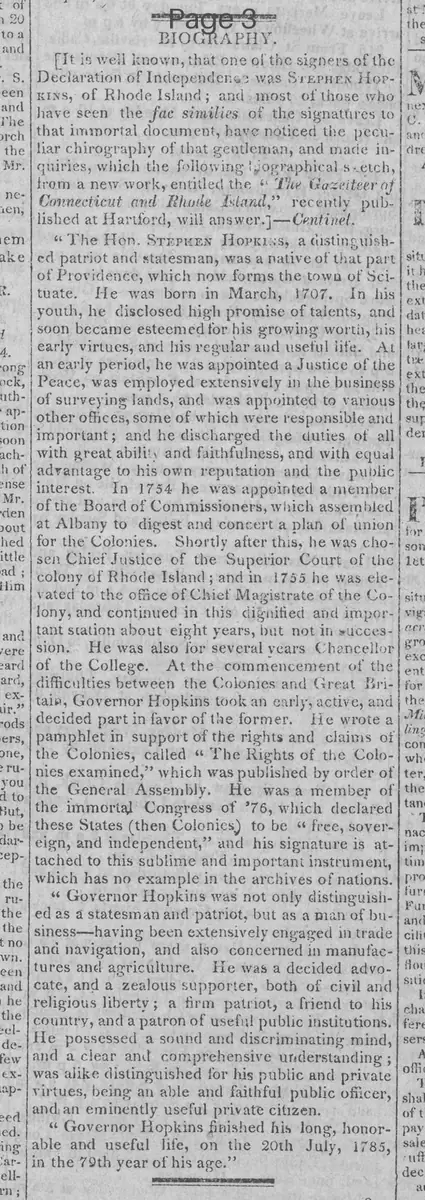
BIOGRAPHY.
[It is well known, that one of the signers of the Declaration of Independence was Stephen Hopkins, of Rhode Island; and most of those who have seen the fac similes of the signatures to that immortal document, have noticed the peculiar chirography of that gentleman, and made inquiries, which the following biographical sketch, from a new work, entitled the "Gazetteer of Connecticut and Rhode Island," recently published at Hartford, will answer.] Centinel.
"The Hon. Stephen Hopkins, a distinguished patriot and statesman, was a native of that part of Providence, which now forms the town of Scituate. He was born in March, 1707. In his youth, he disclosed high promise of talents, and soon became esteemed for his growing worth, his early virtues, and his regular and useful life. At an early period, he was appointed a Justice of the Peace, was employed extensively in the business of surveying lands, and was appointed to various other offices, some of which were responsible and important; and he discharged the duties of all with great ability and faithfulness, and with equal advantage to his own reputation and the public interest. In 1754 he was appointed a member of the Board of Commissioners, which assembled at Albany to digest and concert a plan of union for the Colonies. Shortly after this, he was chosen Chief Justice of the Superior Court of the colony of Rhode Island; and in 1755 he was elevated to the office of Chief Magistrate of the Colony, and continued in this dignified and important station about eight years, but not in succession. He was also for several years Chancellor of the College. At the commencement of the difficulties between the Colonies and Great Britain, Governor Hopkins took an early, active, and decided part in favor of the former. He wrote a pamphlet in support of the rights and claims of the Colonies, called "The Rights of the Colonies examined," which was published by order of the General Assembly. He was a member of the immortal Congress of '76, which declared these States (then Colonies) to be "free, sovereign, and independent," and his signature is attached to this sublime and important instrument, which has no example in the archives of nations.
"Governor Hopkins was not only distinguished as a statesman and patriot, but as a man of business—having been extensively engaged in trade and navigation, and also concerned in manufactures and agriculture. He was a decided advocate, and a zealous supporter, both of civil and religious liberty; a firm patriot, a friend to his country, and a patron of useful public institutions. He possessed a sound and discriminating mind, and a clear and comprehensive understanding; was alike distinguished for his public and private virtues, being an able and faithful public officer, and an eminently useful private citizen.
"Governor Hopkins finished his long, honorable and useful life, on the 20th July, 1785, in the 79th year of his age."
[It is well known, that one of the signers of the Declaration of Independence was Stephen Hopkins, of Rhode Island; and most of those who have seen the fac similes of the signatures to that immortal document, have noticed the peculiar chirography of that gentleman, and made inquiries, which the following biographical sketch, from a new work, entitled the "Gazetteer of Connecticut and Rhode Island," recently published at Hartford, will answer.] Centinel.
"The Hon. Stephen Hopkins, a distinguished patriot and statesman, was a native of that part of Providence, which now forms the town of Scituate. He was born in March, 1707. In his youth, he disclosed high promise of talents, and soon became esteemed for his growing worth, his early virtues, and his regular and useful life. At an early period, he was appointed a Justice of the Peace, was employed extensively in the business of surveying lands, and was appointed to various other offices, some of which were responsible and important; and he discharged the duties of all with great ability and faithfulness, and with equal advantage to his own reputation and the public interest. In 1754 he was appointed a member of the Board of Commissioners, which assembled at Albany to digest and concert a plan of union for the Colonies. Shortly after this, he was chosen Chief Justice of the Superior Court of the colony of Rhode Island; and in 1755 he was elevated to the office of Chief Magistrate of the Colony, and continued in this dignified and important station about eight years, but not in succession. He was also for several years Chancellor of the College. At the commencement of the difficulties between the Colonies and Great Britain, Governor Hopkins took an early, active, and decided part in favor of the former. He wrote a pamphlet in support of the rights and claims of the Colonies, called "The Rights of the Colonies examined," which was published by order of the General Assembly. He was a member of the immortal Congress of '76, which declared these States (then Colonies) to be "free, sovereign, and independent," and his signature is attached to this sublime and important instrument, which has no example in the archives of nations.
"Governor Hopkins was not only distinguished as a statesman and patriot, but as a man of business—having been extensively engaged in trade and navigation, and also concerned in manufactures and agriculture. He was a decided advocate, and a zealous supporter, both of civil and religious liberty; a firm patriot, a friend to his country, and a patron of useful public institutions. He possessed a sound and discriminating mind, and a clear and comprehensive understanding; was alike distinguished for his public and private virtues, being an able and faithful public officer, and an eminently useful private citizen.
"Governor Hopkins finished his long, honorable and useful life, on the 20th July, 1785, in the 79th year of his age."
What sub-type of article is it?
Essay
What themes does it cover?
Political
Liberty Freedom
Patriotism
What keywords are associated?
Stephen Hopkins
Declaration Independence
Rhode Island
Governor
Patriot
Statesman
Colonial Rights
Civil Liberty
What entities or persons were involved?
From The "Gazetteer Of Connecticut And Rhode Island"
Literary Details
Author
From The "Gazetteer Of Connecticut And Rhode Island"
Subject
Biography Of Stephen Hopkins, Signer Of The Declaration Of Independence
Form / Style
Biographical Sketch In Prose
Key Lines
He Was A Member Of The Immortal Congress Of '76, Which Declared These States (Then Colonies) To Be "Free, Sovereign, And Independent," And His Signature Is Attached To This Sublime And Important Instrument, Which Has No Example In The Archives Of Nations.
He Was A Decided Advocate, And A Zealous Supporter, Both Of Civil And Religious Liberty; A Firm Patriot, A Friend To His Country, And A Patron Of Useful Public Institutions.
Governor Hopkins Finished His Long, Honorable And Useful Life, On The 20th July, 1785, In The 79th Year Of His Age.