Thank you for visiting SNEWPapers!
Sign up free
Daily National Intelligencer
Washington, District Of Columbia
What is this article about?
Pelham urges Congress to regulate East India trade by requiring bonds for vessels to return proceeds, limiting it to domestic needs to preserve specie capital and prevent export of unused goods. He critiques protecting duties as ineffective for manufacturing, advocates agricultural trade with Europe/West Indies without specie, and suggests prohibiting specie exports there.
Clipping
OCR Quality
Full Text
FOR THE NATIONAL INTELLIGENCER.
To do what is right, seek to know what others think.
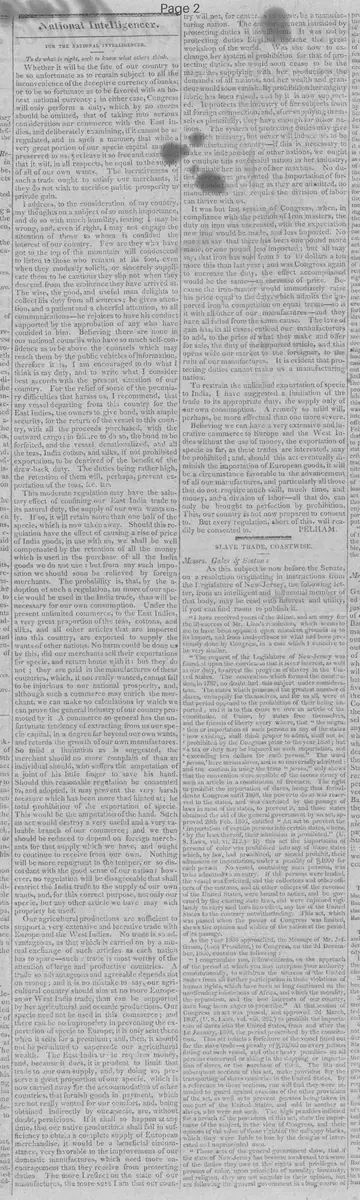
Whether it will be the fate of our country to be so unfortunate as to remain subject to all the inconvenience of the deceptive currency of banks; or to be so fortunate as to be favored with an honest national currency; in either case, Congress will only perform a duty, which by no means should be omitted, that of taking into serious consideration our commerce with the East Indies, and deliberately examining, if it cannot be so regulated, and in such a manner, that while a very great portion of our specie capital may be preserved to us, yet leave it so free and extensive, that it will, in all respects, be equal to the supply of all of our own wants. The lucrativeness of such a trade ought to satisfy our merchants, if they do not wish to sacrifice public prosperity to private gain.
I address, to the consideration of my country, my thoughts on a subject of so much importance, and do so with much humility, fearing I may be wrong, and, even if right, I may not engage the attention of those to whom is confided the interest of our country. Few are they who have got to the top of the mountain will condescend to listen to those who remain at its foot, even when they modestly solicit, or sincerely supplicate them to be cautious they slip not when they descend from the eminence they have arrived at.
The wise, the good, and useful man delights to collect his duty from all sources; he gives attention, and a patient and a cheerful attention, to all communications--he rejoices to have his conduct supported by the approbation of any who have confided in him. Believing there are none in our national councils who have so much self-confidence as to be above the counsels which may reach them by the public vehicles of information, therefore it is, I am encouraged to do what I think is my duty, and to write what I consider best accords with the present situation of our country. For the relief of some of the pecuniary difficulties that harass us, I recommend, that any vessel departing from this country for the East Indies, the owners to give bond, with ample security, for the return of the vessel to this country, with all the proceeds purchased, with the outward cargo; in failure to do so, the bond to be forfeited, and the vessel denationalized, and all the teas, India cotton, and silks, if not prohibited exportation, to be deprived of the benefit of the draw-back duty. The duties being rather high, the retention of them will, perhaps, prevent exportation of the teas, &c. &c.
This moderate regulation may have the salutary effect of confining our East India trade to its natural duty, the supply of our own wants only. If so, it will retain more than one half of the specie, which is now taken away. Should this regulation have the effect of causing a rise of price of India goods, in use with us, we shall be well compensated by the retention of all the money which is used in the purchase of all the India goods we do not use: but from any such imposition we should soon be relieved by foreign merchants. The probability is, that, by the adoption of such a regulation, no more of our specie would be used in the India trade, than will be necessary for our own consumption. Under the present unlimited commerce, to the East Indies, a very great proportion of the teas, cottons, and silks, and all other articles that are imported into this country, are exported to supply the wants of other nations. No harm could be done us by this, did our merchants sell their exportations for specie, and return home with it: but they do not; they are paid in the manufactures of these countries, which, if not really wanted, cannot fail to be injurious to our national prosperity, and, although such a commerce may enrich the merchant, we can make no calculations by which we can prove the general industry of our country promoted by it. A commerce so general has the unfortunate tendency of extracting from us our specie capital, in a degree far beyond our own wants, and retards the growth of our own manufactures.
So mild a limitation as is suggested, the merchant should no more complain of than an individual should, who suffers the amputation of a joint of his little finger to save his hand. Should this reasonable regulation be consented to, and adopted, it may prevent the very harsh measure which has been more than hinted at; the total prohibition of the exportation of specie. This would be the amputation of the hand. Such an act would destroy a very useful and a very valuable branch of our commerce; and we then should be reduced to depend on foreign merchants for that supply which we have, and ought to continue to receive from our own. Nothing will be more repugnant to the temper, or so discordant with the good sense of our nation: however, no regulation will be disagreeable that shall restrict the India trade to the supply of our own wants, and, for this correct purpose, not only our specie, but any other article we have may with propriety be used.
Our agricultural productions are sufficient to support a very extensive and lucrative trade with Europe and the West Indies. No trade is so advantageous, as that which is carried on by a mutual exchange of such articles as each nation has to spare--such trade is most worthy of the attention of large and productive countries. A trade so advantageous and agreeable depends not on money; and it is no mistake to say, our agricultural country should aim at no more European or West India trade, than can be supported by her agricultural and oceanic productions. Our specie need not be used in this commerce; and there can be no impropriety in preventing the exportation of specie to Europe; it is only sent there when it sells for a premium; and, then, it should not be permitted to supersede our agricultural wealth. The East India trade requires money, and, because it does, it is prudent to limit that trade to our own supply, and, by doing so, preserve a great proportion of our specie, which is now carried away for the accommodation of other countries, that furnish goods in payment, which are not really wanted for our comfort, and, being obtained indirectly by our specie, are, without doubt, pernicious. If it shall so happen at any time, that our native productions shall fail in sufficiency to obtain a complete supply of European merchandise, it would be a beneficial circumstance, very favorable to the improvement of our domestic manufactures, which need more encouragement than they receive from protecting duties. The more I reflect on the state of our manufactures, the more sure I am that our country will not, for centuries to come, be a manufacturing nation. The encouragement intended by protecting duties is insufficient. It was not by protecting duties England became the great workshop of the world. Was she now to exchange her system of prohibition for that of protecting duties, she would soon cease to be the magazine, supplying with her productions the demands of all nations, and her wealth and grandeur would soon vanish. By prohibition her mighty fabric has been raised, and by it is now supported. It protects the industry of her subjects from all foreign competition, and, after supplying themselves plentifully, they have enough for other nations. The system of protecting duties may give us a rich treasury, but never will induce us to be a manufacturing country--if this is necessary to make us independent of other nations, we ought to emulate this successful nation in her industry, and imitate her in some of her maxims. No duties have as yet prevented the importation of foreign goods; and so long as they are admitted, no manufactures that require the division of labor can thrive with us.
It was but last session of Congress, when, in compliance with the petition of Iron masters, the duty on iron was increased, with the expectation new iron would be made, and less imported. No one can say that there has been one pound more made, or one pound less imported; but all may say, that iron has sold from 5 to 10 dollars a ton more this than last year; and was Congress again to increase the duty, the effect accomplished would be the same--an increase of price. Because the iron-master would immediately raise his price equal to the duty, which admits the imported iron in competition on equal terms--so is it with all other of our manufactures--and they have all failed from the same cause. The love of gain has, in all cases, enticed our manufacturers to add, to the price of what they make and offer for sale, the duty of the imported article, and this opens wide our market to the foreigner, to the ruin of our manufactures. It is evident that protecting duties cannot make us a manufacturing nation.
To restrain the unlimited exportation of specie to India, I have suggested a limitation of the trade to its appropriate duty, the supply only of our own consumption. A remedy so mild will, perhaps, be more effectual than one more severe. Believing we can have a very extensive and lucrative commerce to Europe and the West Indies without the use of money, the exportation of specie as far, as these trades are interested, may be prohibited; and, should this act eventually diminish the importation of European goods, it will be a circumstance favorable to the advancement of all our manufactures, and particularly all those that do not require much skill, much time, and money, and a division of labor--all that do, can only be brought to perfection by prohibition. This, our country is not now prepared to consent to. But every regulation, short of this, will readily be consented to.
PELHAM.
What sub-type of article is it?
What themes does it cover?
What keywords are associated?
What entities or persons were involved?
Letter to Editor Details
Author
Pelham
Recipient
National Intelligencer
Main Argument
congress should regulate east india trade by requiring bonds for vessels to return with proceeds, limiting it to domestic supply to retain specie capital and avoid exporting unused goods paid in foreign manufactures; protecting duties fail to promote domestic manufacturing, unlike england's prohibition system; prohibit specie exports to europe to favor agricultural trade.
Notable Details