Thank you for visiting SNEWPapers!
Sign up free
Story
May 5, 1939
The Gary American
Gary, Lake County, Indiana
What is this article about?
Chicago lawyers and civic leaders traveled to Springfield to advocate for bills protecting Negro rights, including Sen. Wallace's bill to outlaw restrictive covenants. Testimony was given, but a hearing was blocked, shifting the fight back to Chicago.
Clipping
OCR Quality
95%
Excellent
Full Text
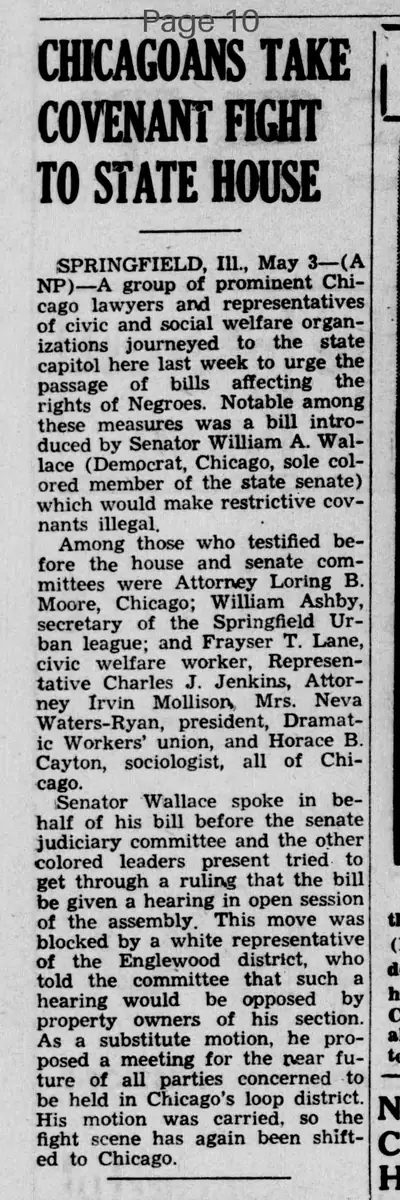
CHICAGOANS TAKE
COVENANT FIGHT
TO STATE HOUSE
SPRINGFIELD, Ill., May 3--(ANP)--A group of prominent Chicago lawyers and representatives of civic and social welfare organizations journeyed to the state capitol here last week to urge the passage of bills affecting the rights of Negroes. Notable among these measures was a bill introduced by Senator William A. Wallace (Democrat, Chicago, sole colored member of the state senate) which would make restrictive covenants illegal.
Among those who testified before the house and senate committees were Attorney Loring B. Moore, Chicago; William Ashby, secretary of the Springfield Urban league; and Frayser T. Lane, civic welfare worker, Representative Charles J. Jenkins, Attorney Irvin Mollison, Mrs. Neva Waters-Ryan, president, Dramatic Workers' union, and Horace B. Cayton, sociologist, all of Chicago.
Senator Wallace spoke in behalf of his bill before the senate judiciary committee and the other colored leaders present tried to get through a ruling that the bill be given a hearing in open session of the assembly. This move was blocked by a white representative of the Englewood district, who told the committee that such a hearing would be opposed by property owners of his section.
As a substitute motion, he proposed a meeting for the near future of all parties concerned to be held in Chicago's loop district. His motion was carried, so the fight scene has again been shifted to Chicago.
COVENANT FIGHT
TO STATE HOUSE
SPRINGFIELD, Ill., May 3--(ANP)--A group of prominent Chicago lawyers and representatives of civic and social welfare organizations journeyed to the state capitol here last week to urge the passage of bills affecting the rights of Negroes. Notable among these measures was a bill introduced by Senator William A. Wallace (Democrat, Chicago, sole colored member of the state senate) which would make restrictive covenants illegal.
Among those who testified before the house and senate committees were Attorney Loring B. Moore, Chicago; William Ashby, secretary of the Springfield Urban league; and Frayser T. Lane, civic welfare worker, Representative Charles J. Jenkins, Attorney Irvin Mollison, Mrs. Neva Waters-Ryan, president, Dramatic Workers' union, and Horace B. Cayton, sociologist, all of Chicago.
Senator Wallace spoke in behalf of his bill before the senate judiciary committee and the other colored leaders present tried to get through a ruling that the bill be given a hearing in open session of the assembly. This move was blocked by a white representative of the Englewood district, who told the committee that such a hearing would be opposed by property owners of his section.
As a substitute motion, he proposed a meeting for the near future of all parties concerned to be held in Chicago's loop district. His motion was carried, so the fight scene has again been shifted to Chicago.
What sub-type of article is it?
Historical Event
What themes does it cover?
Justice
What keywords are associated?
Restrictive Covenants
Negro Rights
Civil Rights Bill
Chicago Advocates
Springfield Legislature
What entities or persons were involved?
Senator William A. Wallace
Attorney Loring B. Moore
William Ashby
Frayser T. Lane
Representative Charles J. Jenkins
Attorney Irvin Mollison
Mrs. Neva Waters Ryan
Horace B. Cayton
Where did it happen?
Springfield, Ill.; Chicago
Story Details
Key Persons
Senator William A. Wallace
Attorney Loring B. Moore
William Ashby
Frayser T. Lane
Representative Charles J. Jenkins
Attorney Irvin Mollison
Mrs. Neva Waters Ryan
Horace B. Cayton
Location
Springfield, Ill.; Chicago
Event Date
Last Week [Before May 3]
Story Details
Chicago advocates urged passage of anti-restrictive covenant bill in Springfield; testimony given but open hearing blocked, leading to proposed Chicago meeting.