Thank you for visiting SNEWPapers!
Sign up free
Editorial
July 11, 1771
The Massachusetts Spy
Boston, Suffolk County, Massachusetts
What is this article about?
An anonymous editorial in The Centinel criticizes British mandates instructing the colonial governor to veto tax bills including custom house commissioners and control agent selection, arguing this exempts officials from taxes, burdens the poor, fosters corruption, and threatens freedom.
Merged-components note: Merged image into editorial due to spatial overlap in bounding boxes.
Clipping
OCR Quality
75%
Good
Full Text
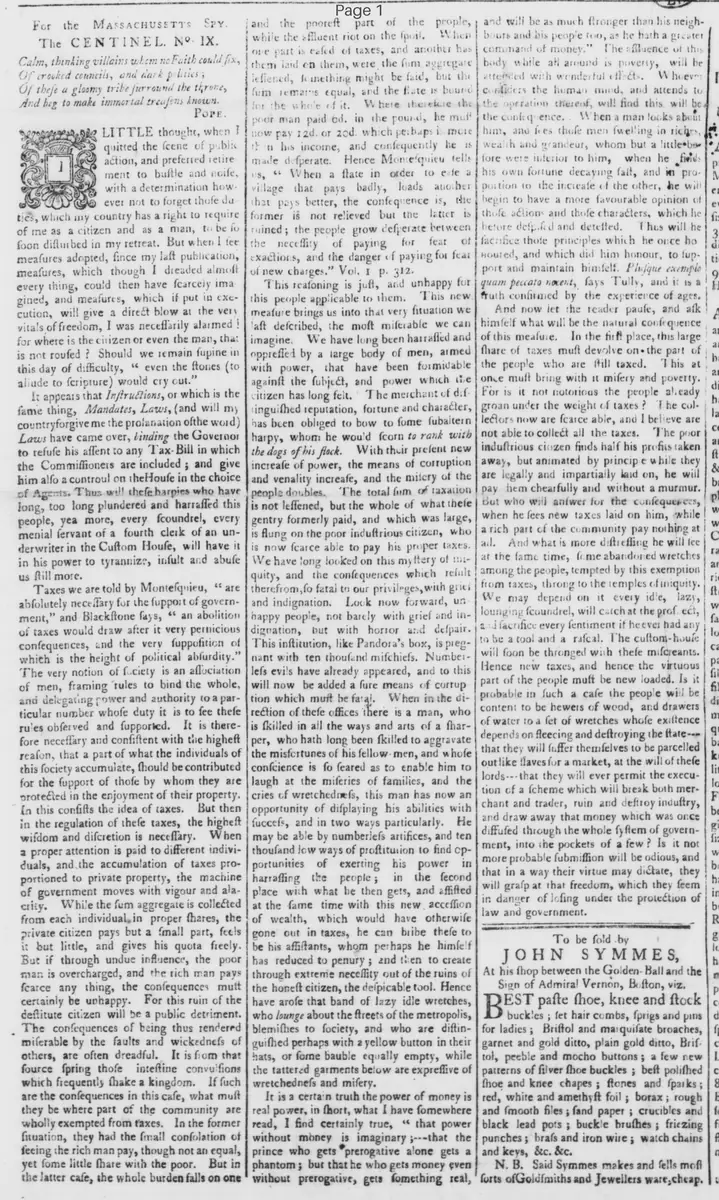
The CENTINEL. No. IX.
Calm, thinking villains whom no Faith could fix,
Of crooked councils, and dark politics;
Of these a gloomy tribe surround the throne,
And beg to make immortal treasons known.
POPE.
LITTLE thought, when I quitted the scene of public action, and preferred retirement to bustle and noise, with a determination however not to forget those duties, which my country has a right to require of me as a citizen and as a man, to be so soon disturbed in my retreat. But when I see measures adopted, since my last publication, measures, which though I dreaded almost every thing, could then have scarcely imagined, and measures, which if put in execution, will give a direct blow at the very vitals of freedom, I was necessarily alarmed! for where is the citizen or even the man, that is not roused? Should we remain supine in this day of difficulty, "even the stones (to allude to scripture) would cry out."
It appears that Instructions, or which is the same thing, Mandates, Laws, (and will my country forgive me the profanation of the word) Laws have come over, binding the Governor to refuse his assent to any Tax-Bill in which the Commissioners are included; and give him also a controul on the House in the choice of Agents. Thus will these harpies who have long, too long plundered and harassed this people, yea more, every coundrel, every menial servant of a fourth clerk of an under-writer in the Custom House, will have it in his power to tyrannize, insult and abuse us still more.
Taxes we are told by Montesquieu, "are absolutely necessary for the support of government," and Blackstone says, "an abolition of taxes would draw after it very pernicious consequences, and the very supposition of which is the height of political absurdity."
The very notion of society is an association of men, framing rules to bind the whole, and delegating power and authority to a particular number whose duty it is to see these rules observed and supported. It is therefore necessary and consistent with the highest reason, that a part of what the individuals of this society accumulate, should be contributed for the support of those by whom they are protected in the enjoyment of their property. In this consists the idea of taxes. But then in the regulation of these taxes, the highest wisdom and discretion is necessary. When a proper attention is paid to different individuals, and the accumulation of taxes proportioned to private property, the machine of government moves with vigour and alacrity. While the sum aggregate is collected from each individual in proper shares, the private citizen pays but a small part, feels it but little, and gives his quota freely.
But if through undue influence, the poor man is overcharged, and the rich man pays scarce any thing, the consequences must certainly be unhappy. For this ruin of the destitute citizen will be a public detriment. The consequences of being thus rendered miserable by the faults and wickedness of others, are often dreadful. It is from that source spring those intestine convulsions which frequently shake a kingdom. If such are the consequences in this case, what must they be where part of the community are wholly exempted from taxes. In the former situation, they had the small consolation of seeing the rich man pay, though not an equal, yet some little share with the poor. But in the latter case, the whole burden falls on one and the poorest part of the people, while the affluent riot on the spoil. When one part is eased of taxes, and another has them laid on them, were the sum aggregate lessened, something might be said, but the sum remains equal, and the state is bound for the whole list. Where thereto the poor man paid 6d. in the pound, he must now pay 12d. or 20d. which perhaps is more than his income, and consequently he is made desperate. Hence Montesquieu tells us, "When a state in order to ease a village that pays badly, loads another that pays better, the consequence is, the former is not relieved but the latter is ruined; the people grow desperate between the necessity of paying for fear of exactions, and the danger of paying for fear of new charges." Vol. I p. 312.
This reasoning is just, and unhappy for this people applicable to them. This new measure brings us into that very situation we last described, the most miserable we can imagine. We have long been harassed and oppressed by a large body of men, armed with power, that have been formidable against the subject, and power which the citizen has long felt. The merchant of distinguished reputation, fortune and character, has been obliged to bow to some subaltern harpy, whom he would scorn to rank with the dogs of his flock. With their present new increase of power, the means of corruption and venality increase, and the misery of the people doubles. The total sum of taxation is not lessened, but the whole of what these gentry formerly paid, and which was large, is flung on the poor industrious citizen, who is now scarce able to pay his proper taxes.
We have long looked on this mystery of iniquity, and the consequences which result therefrom, so fatal to our privileges, with grief and indignation. Look now forward, unhappy people, not barely with grief and indignation, but with horror and despair. This institution, like Pandora's box, is pregnant with ten thousand mischiefs. Numberless evils have already appeared, and to this will now be added a sure means of corruption which must be fatal. When in the direction of these offices there is a man, who is skilled in all the ways and arts of a sharper, who hath long been skilled to aggravate the misfortunes of his fellow-men, and whose conscience is so seared as to enable him to laugh at the miseries of families, and the cries of wretchedness, this man has now an opportunity of displaying his abilities with success, and in two ways particularly.
He may be able by numberless artifices, and ten thousand low ways of prostitution to find opportunities of exerting his power in harassing the people; in the second place with what he then gets, and assisted at the same time with this new accession of wealth, which would have otherwise gone out in taxes, he can bribe these to be his assistants, whom perhaps he himself has reduced to penury; and then to create through extreme necessity out of the ruins of the honest citizen, the despicable tool. Hence have arose that band of lazy idle wretches, who lounge about the streets of the metropolis, blemishes to society, and who are distinguished perhaps with a yellow button in their hats, or some bauble equally empty, while the tattered garments below are expressive of wretchedness and misery.
It is a certain truth the power of money is real power, in short, what I have somewhere read, I find certainly true, "that power without money is imaginary ;---that the prince who gets prerogative alone gets a phantom; but that he who gets money even without prerogative, gets something real, and will be as much stronger than his neighbours and his people too, as he hath a greater command of money." The affluence of this body while all around is poverty, will be attended with wonderful ill-at. Whoever considers the human mind, and attends to the operation thereof, will find this will be the consequence. When a man looks about him, and sees those men swelling in riches, wealth and grandeur, whom but a little before were inferior to him, when he finds his own fortune decaying fast, and in proportion to the increase of the other, he will begin to have a more favourable opinion of those actions and those characters, which he before despised and detested. Thus will he sacrifice those principles which he once boasted, and which did him honour, to support and maintain himself. Pluresque exempla quam peccato nocent, Says Tully, and it is a truth confirmed by the experience of ages.
And now let the reader pause, and ask himself what will be the natural consequence of this measure. In the first place, this large share of taxes must devolve on the part of the people who are still taxed. This at once must bring with it misery and poverty. For is it not notorious the people already groan under the weight of taxes? The collectors now are scarce able, and I believe are not able to collect all the taxes. The poor industrious citizen finds half his profits taken away, but animated by principle while they are legally and impartially laid on, he will pay them cheerfully and without a murmur. But who will answer for the consequences, when he sees new taxes laid on him, while a rich part of the community pay nothing at all. And what is more distressing he will see at the same time, some abandoned wretches among the people, tempted by this exemption from taxes, throng to the temples of iniquity. We may depend on it every idle, lazy, lounging scoundrel, will catch at the prospect, a sacrifice every sentiment if he ever had any to be a tool and a rascal. The custom-house will soon be thronged with these miscreants. Hence new taxes, and hence the virtuous part of the people must be new loaded. Is it probable in such a case the people will be content to be hewers of wood, and drawers of water to a set of wretches whose existence depends on fleecing and destroying the state--- that they will suffer themselves to be parcelled out like slaves for a market, at the will of these lords---that they will ever permit the execution of a scheme which will break both merchant and trader, ruin and destroy industry, and draw away that money which was once diffused through the whole system of government, into the pockets of a few? Is it not more probable submission will be odious, and that in a way their virtue may dictate, they will grasp at that freedom, which they seem in danger of losing under the protection of law and government.
Calm, thinking villains whom no Faith could fix,
Of crooked councils, and dark politics;
Of these a gloomy tribe surround the throne,
And beg to make immortal treasons known.
POPE.
LITTLE thought, when I quitted the scene of public action, and preferred retirement to bustle and noise, with a determination however not to forget those duties, which my country has a right to require of me as a citizen and as a man, to be so soon disturbed in my retreat. But when I see measures adopted, since my last publication, measures, which though I dreaded almost every thing, could then have scarcely imagined, and measures, which if put in execution, will give a direct blow at the very vitals of freedom, I was necessarily alarmed! for where is the citizen or even the man, that is not roused? Should we remain supine in this day of difficulty, "even the stones (to allude to scripture) would cry out."
It appears that Instructions, or which is the same thing, Mandates, Laws, (and will my country forgive me the profanation of the word) Laws have come over, binding the Governor to refuse his assent to any Tax-Bill in which the Commissioners are included; and give him also a controul on the House in the choice of Agents. Thus will these harpies who have long, too long plundered and harassed this people, yea more, every coundrel, every menial servant of a fourth clerk of an under-writer in the Custom House, will have it in his power to tyrannize, insult and abuse us still more.
Taxes we are told by Montesquieu, "are absolutely necessary for the support of government," and Blackstone says, "an abolition of taxes would draw after it very pernicious consequences, and the very supposition of which is the height of political absurdity."
The very notion of society is an association of men, framing rules to bind the whole, and delegating power and authority to a particular number whose duty it is to see these rules observed and supported. It is therefore necessary and consistent with the highest reason, that a part of what the individuals of this society accumulate, should be contributed for the support of those by whom they are protected in the enjoyment of their property. In this consists the idea of taxes. But then in the regulation of these taxes, the highest wisdom and discretion is necessary. When a proper attention is paid to different individuals, and the accumulation of taxes proportioned to private property, the machine of government moves with vigour and alacrity. While the sum aggregate is collected from each individual in proper shares, the private citizen pays but a small part, feels it but little, and gives his quota freely.
But if through undue influence, the poor man is overcharged, and the rich man pays scarce any thing, the consequences must certainly be unhappy. For this ruin of the destitute citizen will be a public detriment. The consequences of being thus rendered miserable by the faults and wickedness of others, are often dreadful. It is from that source spring those intestine convulsions which frequently shake a kingdom. If such are the consequences in this case, what must they be where part of the community are wholly exempted from taxes. In the former situation, they had the small consolation of seeing the rich man pay, though not an equal, yet some little share with the poor. But in the latter case, the whole burden falls on one and the poorest part of the people, while the affluent riot on the spoil. When one part is eased of taxes, and another has them laid on them, were the sum aggregate lessened, something might be said, but the sum remains equal, and the state is bound for the whole list. Where thereto the poor man paid 6d. in the pound, he must now pay 12d. or 20d. which perhaps is more than his income, and consequently he is made desperate. Hence Montesquieu tells us, "When a state in order to ease a village that pays badly, loads another that pays better, the consequence is, the former is not relieved but the latter is ruined; the people grow desperate between the necessity of paying for fear of exactions, and the danger of paying for fear of new charges." Vol. I p. 312.
This reasoning is just, and unhappy for this people applicable to them. This new measure brings us into that very situation we last described, the most miserable we can imagine. We have long been harassed and oppressed by a large body of men, armed with power, that have been formidable against the subject, and power which the citizen has long felt. The merchant of distinguished reputation, fortune and character, has been obliged to bow to some subaltern harpy, whom he would scorn to rank with the dogs of his flock. With their present new increase of power, the means of corruption and venality increase, and the misery of the people doubles. The total sum of taxation is not lessened, but the whole of what these gentry formerly paid, and which was large, is flung on the poor industrious citizen, who is now scarce able to pay his proper taxes.
We have long looked on this mystery of iniquity, and the consequences which result therefrom, so fatal to our privileges, with grief and indignation. Look now forward, unhappy people, not barely with grief and indignation, but with horror and despair. This institution, like Pandora's box, is pregnant with ten thousand mischiefs. Numberless evils have already appeared, and to this will now be added a sure means of corruption which must be fatal. When in the direction of these offices there is a man, who is skilled in all the ways and arts of a sharper, who hath long been skilled to aggravate the misfortunes of his fellow-men, and whose conscience is so seared as to enable him to laugh at the miseries of families, and the cries of wretchedness, this man has now an opportunity of displaying his abilities with success, and in two ways particularly.
He may be able by numberless artifices, and ten thousand low ways of prostitution to find opportunities of exerting his power in harassing the people; in the second place with what he then gets, and assisted at the same time with this new accession of wealth, which would have otherwise gone out in taxes, he can bribe these to be his assistants, whom perhaps he himself has reduced to penury; and then to create through extreme necessity out of the ruins of the honest citizen, the despicable tool. Hence have arose that band of lazy idle wretches, who lounge about the streets of the metropolis, blemishes to society, and who are distinguished perhaps with a yellow button in their hats, or some bauble equally empty, while the tattered garments below are expressive of wretchedness and misery.
It is a certain truth the power of money is real power, in short, what I have somewhere read, I find certainly true, "that power without money is imaginary ;---that the prince who gets prerogative alone gets a phantom; but that he who gets money even without prerogative, gets something real, and will be as much stronger than his neighbours and his people too, as he hath a greater command of money." The affluence of this body while all around is poverty, will be attended with wonderful ill-at. Whoever considers the human mind, and attends to the operation thereof, will find this will be the consequence. When a man looks about him, and sees those men swelling in riches, wealth and grandeur, whom but a little before were inferior to him, when he finds his own fortune decaying fast, and in proportion to the increase of the other, he will begin to have a more favourable opinion of those actions and those characters, which he before despised and detested. Thus will he sacrifice those principles which he once boasted, and which did him honour, to support and maintain himself. Pluresque exempla quam peccato nocent, Says Tully, and it is a truth confirmed by the experience of ages.
And now let the reader pause, and ask himself what will be the natural consequence of this measure. In the first place, this large share of taxes must devolve on the part of the people who are still taxed. This at once must bring with it misery and poverty. For is it not notorious the people already groan under the weight of taxes? The collectors now are scarce able, and I believe are not able to collect all the taxes. The poor industrious citizen finds half his profits taken away, but animated by principle while they are legally and impartially laid on, he will pay them cheerfully and without a murmur. But who will answer for the consequences, when he sees new taxes laid on him, while a rich part of the community pay nothing at all. And what is more distressing he will see at the same time, some abandoned wretches among the people, tempted by this exemption from taxes, throng to the temples of iniquity. We may depend on it every idle, lazy, lounging scoundrel, will catch at the prospect, a sacrifice every sentiment if he ever had any to be a tool and a rascal. The custom-house will soon be thronged with these miscreants. Hence new taxes, and hence the virtuous part of the people must be new loaded. Is it probable in such a case the people will be content to be hewers of wood, and drawers of water to a set of wretches whose existence depends on fleecing and destroying the state--- that they will suffer themselves to be parcelled out like slaves for a market, at the will of these lords---that they will ever permit the execution of a scheme which will break both merchant and trader, ruin and destroy industry, and draw away that money which was once diffused through the whole system of government, into the pockets of a few? Is it not more probable submission will be odious, and that in a way their virtue may dictate, they will grasp at that freedom, which they seem in danger of losing under the protection of law and government.
What sub-type of article is it?
Taxation
Constitutional
Economic Policy
What keywords are associated?
Taxation
Corruption
Custom House
Governor Veto
Colonial Freedom
Unfair Burdens
Economic Oppression
What entities or persons were involved?
Governor
Commissioners
Custom House Officials
Montesquieu
Blackstone
Editorial Details
Primary Topic
Opposition To British Mandates Exempting Custom House Officials From Colonial Taxes
Stance / Tone
Strongly Alarmed And Critical Of Government Corruption And Unfair Taxation
Key Figures
Governor
Commissioners
Custom House Officials
Montesquieu
Blackstone
Key Arguments
Taxes Are Necessary But Must Be Fair And Proportional To Property.
Exempting Officials Shifts Burden To The Poor, Causing Misery And Desperation.
This Measure Increases Corruption And Power Of Venal Officials.
Unfair Taxation Leads To Social Convulsions And Loss Of Principles.
People Will Resist This Threat To Freedom And Industry.