Thank you for visiting SNEWPapers!
Sign up free
Editorial
May 25, 1827
The Virginian
Lynchburg, Virginia
What is this article about?
Editorial from Baltimore Patriot warns against electing General Jackson president, citing Thomas Jefferson's post-election statement fearing it signals American susceptibility to military rule, akin to Caesar's fate. Appeals to neutrals to consider Jefferson's view over Jackson's military glory.
Clipping
OCR Quality
95%
Excellent
Full Text
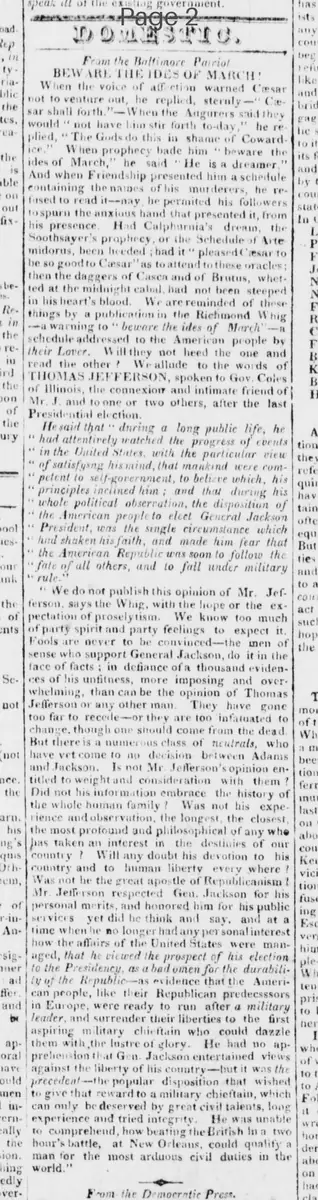
DOMESTIC.
From the Baltimore Patriot.
BEWARE THE IDES OF MARCH.
When the voice of affection warned Caesar not to venture out, he replied, sternly—"Caesar shall forth."—When the Augurers said they would "not have him stir forth to-day," he replied, "The Gods do this in shame of Cowardice."
When prophecy bade him "beware the ides of March," he said "He is a dreamer." And when Friendship presented him a schedule containing the names of his murderers, he refused to read it—nay he permitted his followers to spurn the anxious hand that presented it, from his presence. Had Calpurnia's dream, the Soothsayer's prophecy, or the Schedule of Artemidorus, been heeded; had it "pleased Caesar to be so good to Caesar" as to attend to these oracles; then the daggers of Cassius and of Brutus, whetted at the midnight cabal, had not been steeped in his heart's blood. We are reminded of these things by a publication in the Richmond Whig—a warning to "beware the ides of March'—a schedule addressed to the American people by their Lover. Will they not heed the one and read the other? We allude to the words of THOMAS JEFFERSON, spoken to Gov. Coles of Illinois, the connection and intimate friend of Mr. J. and to one or two others, after the last Presidential election.
He said that "during a long public life, he had attentively watched the progress of events in the United States, with the particular view of satisfying his mind, that mankind were competent to self-government, to believe which, his principles inclined him; and that during his whole political observation, the disposition of the American people to elect General Jackson President, was the single circumstance which had shaken his faith, and made him fear that the American Republic was soon to follow the fate of all others, and to fall under military rule."
We do not publish this opinion of Mr. Jefferson, says the Whig, with the hope or the expectation of proselytism. We know too much of party spirit and party feelings to expect it. Fools are never to be convinced—the men of sense who support General Jackson, do it in the face of facts; in defiance of a thousand evidences of his unfitness, more imposing and overwhelming, than can be the opinion of Thomas Jefferson or any other man. They have gone too far to recede—or they are too infatuated to change, though one should come from the dead. But there is a numerous class of neutrals, who have yet come to no decision between Adams and Jackson. Is not Mr. Jefferson's opinion entitled to weight and consideration with them? Did not his information embrace the history of the whole human family? Was not his experience and observation, the longest, the closest, the most profound and philosophical of any who has taken an interest in the destinies of our country? Will any doubt his devotion to his country and to human liberty every where? Was not he the great apostle of Republicanism? Mr. Jefferson respected Gen. Jackson for his personal merits, and honored him for his public services; yet did he think and say, and at a time when he no longer had any personal interest how the affairs of the United States were managed, that he viewed the prospect of his election to the Presidency, as a bad omen for the durability of the Republic—as evidence that the American people, like their Republican predecessors in Europe, were ready to run after a military leader, and surrender their liberties to the first aspiring military chieftain who could dazzle them with the lustre of glory. He had no apprehension that Gen. Jackson entertained views against the liberty of his country—but it was the precedent—the popular disposition that wished to give that reward to a military chieftain, which can only be deserved by great civil talents, long experience and tried integrity. He was unable to comprehend, how beating the British in a two hour's battle, at New Orleans, could qualify a man for the most arduous civil duties in the world.
From the Baltimore Patriot.
BEWARE THE IDES OF MARCH.
When the voice of affection warned Caesar not to venture out, he replied, sternly—"Caesar shall forth."—When the Augurers said they would "not have him stir forth to-day," he replied, "The Gods do this in shame of Cowardice."
When prophecy bade him "beware the ides of March," he said "He is a dreamer." And when Friendship presented him a schedule containing the names of his murderers, he refused to read it—nay he permitted his followers to spurn the anxious hand that presented it, from his presence. Had Calpurnia's dream, the Soothsayer's prophecy, or the Schedule of Artemidorus, been heeded; had it "pleased Caesar to be so good to Caesar" as to attend to these oracles; then the daggers of Cassius and of Brutus, whetted at the midnight cabal, had not been steeped in his heart's blood. We are reminded of these things by a publication in the Richmond Whig—a warning to "beware the ides of March'—a schedule addressed to the American people by their Lover. Will they not heed the one and read the other? We allude to the words of THOMAS JEFFERSON, spoken to Gov. Coles of Illinois, the connection and intimate friend of Mr. J. and to one or two others, after the last Presidential election.
He said that "during a long public life, he had attentively watched the progress of events in the United States, with the particular view of satisfying his mind, that mankind were competent to self-government, to believe which, his principles inclined him; and that during his whole political observation, the disposition of the American people to elect General Jackson President, was the single circumstance which had shaken his faith, and made him fear that the American Republic was soon to follow the fate of all others, and to fall under military rule."
We do not publish this opinion of Mr. Jefferson, says the Whig, with the hope or the expectation of proselytism. We know too much of party spirit and party feelings to expect it. Fools are never to be convinced—the men of sense who support General Jackson, do it in the face of facts; in defiance of a thousand evidences of his unfitness, more imposing and overwhelming, than can be the opinion of Thomas Jefferson or any other man. They have gone too far to recede—or they are too infatuated to change, though one should come from the dead. But there is a numerous class of neutrals, who have yet come to no decision between Adams and Jackson. Is not Mr. Jefferson's opinion entitled to weight and consideration with them? Did not his information embrace the history of the whole human family? Was not his experience and observation, the longest, the closest, the most profound and philosophical of any who has taken an interest in the destinies of our country? Will any doubt his devotion to his country and to human liberty every where? Was not he the great apostle of Republicanism? Mr. Jefferson respected Gen. Jackson for his personal merits, and honored him for his public services; yet did he think and say, and at a time when he no longer had any personal interest how the affairs of the United States were managed, that he viewed the prospect of his election to the Presidency, as a bad omen for the durability of the Republic—as evidence that the American people, like their Republican predecessors in Europe, were ready to run after a military leader, and surrender their liberties to the first aspiring military chieftain who could dazzle them with the lustre of glory. He had no apprehension that Gen. Jackson entertained views against the liberty of his country—but it was the precedent—the popular disposition that wished to give that reward to a military chieftain, which can only be deserved by great civil talents, long experience and tried integrity. He was unable to comprehend, how beating the British in a two hour's battle, at New Orleans, could qualify a man for the most arduous civil duties in the world.
What sub-type of article is it?
Partisan Politics
Constitutional
What keywords are associated?
Jackson Election
Jefferson Warning
Military Rule
Republican Liberty
Caesar Parallel
Presidential Fitness
Party Spirit
What entities or persons were involved?
Thomas Jefferson
General Jackson
Gov. Coles
Caesar
Cassius
Brutus
John Quincy Adams
Richmond Whig
Baltimore Patriot
Editorial Details
Primary Topic
Warning Against Electing General Jackson Due To Fears Of Military Rule
Stance / Tone
Strongly Anti Jackson, Cautionary Against Military Leadership In Presidency
Key Figures
Thomas Jefferson
General Jackson
Gov. Coles
Caesar
Cassius
Brutus
John Quincy Adams
Richmond Whig
Baltimore Patriot
Key Arguments
Jefferson Feared Jackson's Election Shook His Faith In American Self Government
Election Of Military Leader Signals Readiness For Military Rule Like Historical Republics
Jackson's Battle Of New Orleans Victory Does Not Qualify Him For Civil Presidency
Jefferson's Opinion Should Sway Neutrals In Adams Jackson Contest
Precedent Of Rewarding Military Glory Over Civil Talents Endangers Republic