Thank you for visiting SNEWPapers!
Sign up free
Story
February 17, 1941
The Nome Nugget
Nome, Nome County, Alaska
What is this article about?
Article discusses potential importance of tin deposits in Alaska for U.S. national defense amid WWII, highlighting historical discovery in 1903, low production, global dependencies, and calls for $2M exploration funding.
Clipping
OCR Quality
97%
Excellent
Full Text
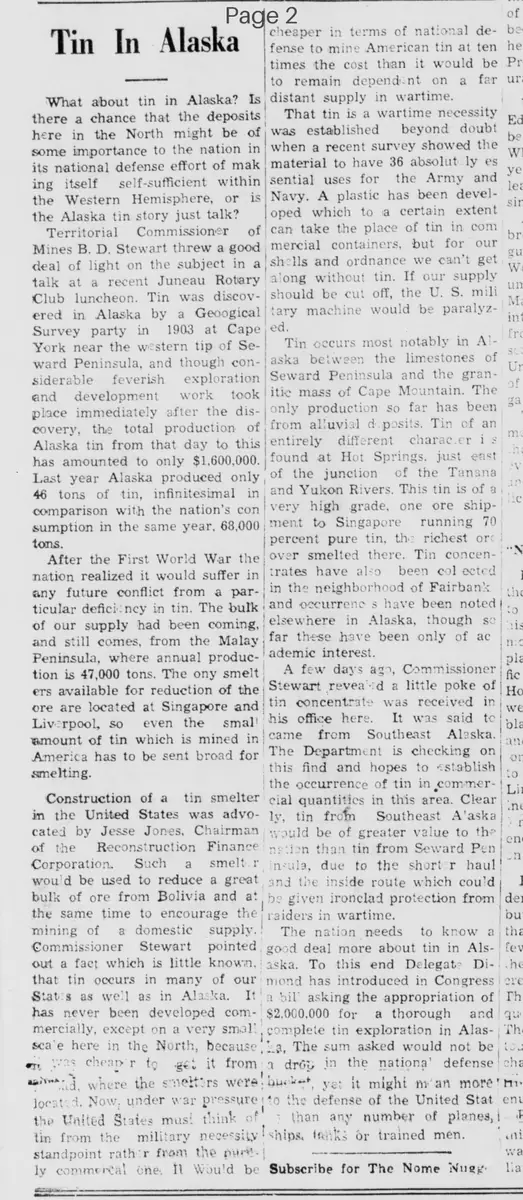
Tin In Alaska
What about tin in Alaska? Is there a chance that the deposits here in the North might be of some importance to the nation in its national defense effort of making itself self-sufficient within the Western Hemisphere, or is the Alaska tin story just talk?
Territorial Commissioner of Mines B. D. Stewart threw a good deal of light on the subject in a talk at a recent Juneau Rotary Club luncheon. Tin was discovered in Alaska by a Geological Survey party in 1903 at Cape York near the western tip of Seward Peninsula, and though considerable feverish exploration and development work took place immediately after the discovery, the total production of Alaska tin from that day to this has amounted to only $1,600,000.
Last year Alaska produced only 46 tons of tin, infinitesimal in comparison with the nation's consumption in the same year, 68,000 tons.
After the First World War the nation realized it would suffer in any future conflict from a particular deficiency in tin. The bulk of our supply had been coming, and still comes, from the Malay Peninsula, where annual production is 47,000 tons. The only smelters available for reduction of the ore are located at Singapore and Liverpool, so even the small amount of tin which is mined in America has to be sent abroad for smelting.
Construction of a tin smelter in the United States was advocated by Jesse Jones, Chairman of the Reconstruction Finance Corporation.
Such a smelter would be used to reduce a great bulk of ore from Bolivia and at the same time to encourage the mining of a domestic supply.
Commissioner Stewart pointed out a fact which is little known, that tin occurs in many of our States as well as in Alaska. It has never been developed commercially, except on a very small scale here in the North, because it was cheaper to get it from abroad, where the smelters were located. Now, under war pressure the United States must think of tin from the military necessity standpoint rather from the purely commercial one. I would be cheaper in terms of national defense to mine American tin at ten times the cost than it would be to remain dependent on a far distant supply in wartime.
That tin is a wartime necessity was established beyond doubt when a recent survey showed the material to have 36 absolutely essential uses for the Army and Navy. A plastic has been developed which to a certain extent can take the place of tin in commercial containers, but for our shells and ordnance we can't get along without tin. If our supply should be cut off, the U. S. military machine would be paralyzed.
Tin occurs most notably in Alaska between the limestones of Seward Peninsula and the granitic mass of Cape Mountain. The only production so far has been from alluvial deposits. Tin of an entirely different character is found at Hot Springs, just east of the junction of the Tanana and Yukon Rivers. This tin is of a very high grade, one ore shipment to Singapore running 70 percent pure tin, the richest ore ever smelted there. Tin concentrates have also been collected in the neighborhood of Fairbanks and occurrences have been noted elsewhere in Alaska, though so far these have been only of academic interest.
A few days ago, Commissioner Stewart revealed a little poke of tin concentrate was received in his office here. It was said to come from Southeast Alaska.
The Department is checking on this find and hopes to establish the occurrence of tin in commercial quantities in this area. Clearly, tin from Southeast Alaska would be of greater value to the nation than tin from Seward Peninsula, due to the shorter haul and the inside route which could be given ironclad protection from raiders in wartime.
The nation needs to know a good deal more about tin in Alaska. To this end Delegate Dimond has introduced in Congress a bill asking the appropriation of $2,000,000 for a thorough and complete tin exploration in Alaska. The sum asked would not be a drop in the national defense bucket, yet it might mean more to the defense of the United States than any number of planes, ships, tanks or trained men.
Subscribe for The Nome Nugget.
What about tin in Alaska? Is there a chance that the deposits here in the North might be of some importance to the nation in its national defense effort of making itself self-sufficient within the Western Hemisphere, or is the Alaska tin story just talk?
Territorial Commissioner of Mines B. D. Stewart threw a good deal of light on the subject in a talk at a recent Juneau Rotary Club luncheon. Tin was discovered in Alaska by a Geological Survey party in 1903 at Cape York near the western tip of Seward Peninsula, and though considerable feverish exploration and development work took place immediately after the discovery, the total production of Alaska tin from that day to this has amounted to only $1,600,000.
Last year Alaska produced only 46 tons of tin, infinitesimal in comparison with the nation's consumption in the same year, 68,000 tons.
After the First World War the nation realized it would suffer in any future conflict from a particular deficiency in tin. The bulk of our supply had been coming, and still comes, from the Malay Peninsula, where annual production is 47,000 tons. The only smelters available for reduction of the ore are located at Singapore and Liverpool, so even the small amount of tin which is mined in America has to be sent abroad for smelting.
Construction of a tin smelter in the United States was advocated by Jesse Jones, Chairman of the Reconstruction Finance Corporation.
Such a smelter would be used to reduce a great bulk of ore from Bolivia and at the same time to encourage the mining of a domestic supply.
Commissioner Stewart pointed out a fact which is little known, that tin occurs in many of our States as well as in Alaska. It has never been developed commercially, except on a very small scale here in the North, because it was cheaper to get it from abroad, where the smelters were located. Now, under war pressure the United States must think of tin from the military necessity standpoint rather from the purely commercial one. I would be cheaper in terms of national defense to mine American tin at ten times the cost than it would be to remain dependent on a far distant supply in wartime.
That tin is a wartime necessity was established beyond doubt when a recent survey showed the material to have 36 absolutely essential uses for the Army and Navy. A plastic has been developed which to a certain extent can take the place of tin in commercial containers, but for our shells and ordnance we can't get along without tin. If our supply should be cut off, the U. S. military machine would be paralyzed.
Tin occurs most notably in Alaska between the limestones of Seward Peninsula and the granitic mass of Cape Mountain. The only production so far has been from alluvial deposits. Tin of an entirely different character is found at Hot Springs, just east of the junction of the Tanana and Yukon Rivers. This tin is of a very high grade, one ore shipment to Singapore running 70 percent pure tin, the richest ore ever smelted there. Tin concentrates have also been collected in the neighborhood of Fairbanks and occurrences have been noted elsewhere in Alaska, though so far these have been only of academic interest.
A few days ago, Commissioner Stewart revealed a little poke of tin concentrate was received in his office here. It was said to come from Southeast Alaska.
The Department is checking on this find and hopes to establish the occurrence of tin in commercial quantities in this area. Clearly, tin from Southeast Alaska would be of greater value to the nation than tin from Seward Peninsula, due to the shorter haul and the inside route which could be given ironclad protection from raiders in wartime.
The nation needs to know a good deal more about tin in Alaska. To this end Delegate Dimond has introduced in Congress a bill asking the appropriation of $2,000,000 for a thorough and complete tin exploration in Alaska. The sum asked would not be a drop in the national defense bucket, yet it might mean more to the defense of the United States than any number of planes, ships, tanks or trained men.
Subscribe for The Nome Nugget.
What sub-type of article is it?
Curiosity
Historical Event
What themes does it cover?
Exploration
Triumph
What keywords are associated?
Tin Alaska
National Defense
Tin Mining
Seward Peninsula
Exploration Funding
What entities or persons were involved?
B. D. Stewart
Jesse Jones
Delegate Dimond
Where did it happen?
Alaska
Story Details
Key Persons
B. D. Stewart
Jesse Jones
Delegate Dimond
Location
Alaska
Event Date
1903
Story Details
Tin discovered in Alaska in 1903 near Cape York, Seward Peninsula; limited production of $1.6M total; emphasis on strategic value for defense due to wartime needs and foreign supply risks; calls for smelter and $2M exploration funding.