Thank you for visiting SNEWPapers!
Sign up free
Semi Weekly Standard
Raleigh, Wake County, North Carolina
What is this article about?
A North Carolina voter rebuts Rep. Edwin G. Reade's pro-Know Nothing letter, denying Northern anti-slavery unanimity, defending Democrats against abolition charges, critiquing Pierce's appointments, and decrying Know Nothing secrecy with historical analogies. Advocates fair representation and union.
Merged-components note: These two components are sequential in reading order (58 and 59) and contain continuous text from the same letter to the editor, with the first ending mid-sentence and the second continuing directly.
Clipping
OCR Quality
Full Text
LETTER OF HON. EDWIN G. READE.
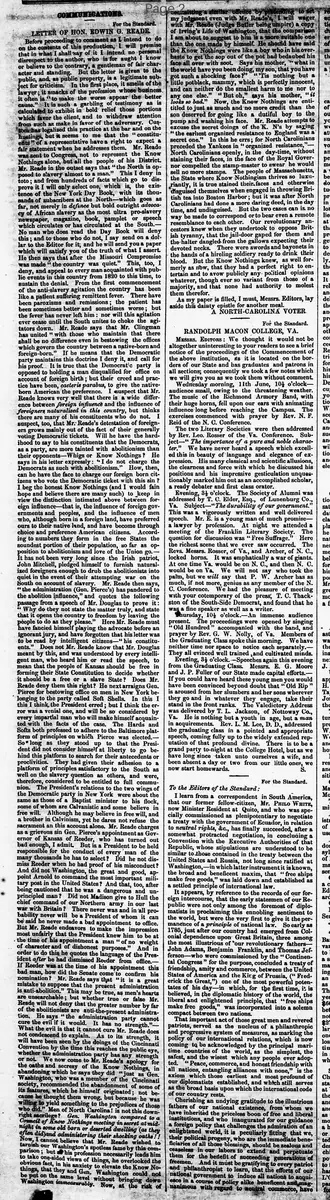
Before proceeding to comment as I intend to do on the contents of this production, I will premise that in what I shall say of it I intend no personal disrespect to the author, who is for aught I know or believe to the contrary, a gentleman of fair character and standing. But the letter is given to the public, and, as public property, is a legitimate subject for criticism. In the first place, it smacks of the profession whose business it often is 'to make the worse appear the better cause.' It is such a garbling of testimony as is calculated to exhibit in bold relief those portions which favor the client, and to withdraw attention from such as make in favor of the adversary. Custom has legalized this practice at the bar and on the hustings but it seems to me that the 'constituents' of a representative have a right to expect a fair statement when he addresses them. Mr. Reade was sent to Congress, not to represent the Know Nothings alone, but all the people of his District. Mr. Reade in the outset says that 'the North is opposed to slavery almost to a man.' This I deny in toto; and from hundreds of facts which go to disprove it I will only select one, which is, the existence of the New York Day Book, with its thousands of subscribers at the North—which goes as far, not merely in defence but bold outright advocacy of African slavery as the most ultra pro-slavery newspaper, magazine, book, pamphlet or speech which circulates or has circulated at the South. No man who does read the Day Book will deny this: and to those who do not, I say send on a dollar to the Editor for it; and he will send you a paper which will satisfy you of the truth of what I assert. He then says that after the Missouri Compromise was made 'the country was quiet.' This, too, I deny, and appeal to every man acquainted with public events in this country from 1820 to this time, to sustain the denial. From the first commencement of the anti-slavery agitation the country has been like a patient suffering remittent fever. There have been paroxysms and remissions; the patient has been sometimes better and sometimes worse; but the fever has never left him: nor will this agitation ever cease until the South unites to choke the agitators down. Mr. Reade says that Mr. Clingman has united 'with those who maintain that there shall be no difference even in bestowing the offices which govern the country between a native-born and foreign-born.' If he means that the Democratic party maintains this doctrine I deny it, and call for his proof. It is true that the Democratic party is opposed to holding a man disqualified for office on account of foreign birth; but their creed and practice have been, caeteris paribus, to give the native-born American the preference. I suspect that Mr. Reade knows very well that there is a wide difference between foreign influence and the influence of foreigners naturalized in this country, but thinks there are many of his constituents who do not. I suspect, too, that Mr. Reade's detestation of foreigners grows mainly out of the fact of their generally voting Democratic tickets. Will he have the hardihood to say to his constituents that the Democrats, as a party, are more tainted with abolitionism than their opponents—Whigs or Know Nothings? He says in his letter expressly: 'I do not charge the Democrats as such with abolitionism.' How, then, can he have the face to charge our foreign born citizens who vote the Democratic ticket with this sin? I beg the honest Know Nothings (and I would fain hope and believe there are many such) to keep in view the distinction intimated above between foreign influence—that is, the influence of foreign governments and peoples, and the influence of men who, although born in a foreign land, have preferred ours to their native land, and have become through choice and preference American citizens. According to numbers they form in the free States the soundest portion of their population, so far as opposition to abolitionism and love of the Union go. It has not been very long since the Irish patriot, John Mitchell, pledged himself to furnish naturalized foreigners enough to drub the abolitionists into quiet in the event of their attempting war on the South on account of slavery. Mr. Reade then says, 'the administration (Gov. Pierce's) has pandered to the abolition influence,' and quotes the following passage from a speech of Mr. Douglas to prove it: 'Why do they not state the matter truly, and state that it opens the country to freedom by leaving the people to do as they please.' Here Mr. Reade must have fancied himself playing the advocate before an ignorant jury, and have forgotten that his letter was to be read by intelligent citizens—'his constituents.' Does not Mr. Reade know that Mr. Douglas meant by this, and was understood by every intelligent man, who heard him or read the speech, to mean that the people of Kansas should be free in forming their State Constitution to decide whether it should be a free or a slave State? Does Mr. Reade deny them this right? He next arraigns Gen. Pierce for bestowing office on men in New York belonging to the party called Soft Shells. In this I think the President erred; but I think the error was a venial one, and will be so considered by every impartial man who will make himself acquainted with the facts of the case. The Hards and Softs both professed to adhere to the Baltimore platform of principles on which Pierce was elected. So long as they stood up to that the President did not consider himself at liberty to go behind this platform to search for their antecedents or proclivities. They had given their adhesion to a platform of principles satisfactory to the South as well on the slavery question as others, and were, therefore, considered to be entitled to full communion. The President's relations to the two wings of the Democratic party in New York were about the same as those of a Baptist minister to his flock, some of whom are Calvinistic and some believe in free will. Although he may believe in free will, and a brother in Calvinism, yet he dares not refuse the sacrament on this account alone. Mr. Reade charges as a grievous sin Gen. Pierce's appointment as Governor of Kansas of Reeder, who has turned out bad enough, I admit. But is a President to be held responsible for the conduct of every man of the many thousands he has to select? Did he not dismiss Reeder when he had proof of his misconduct? And did not Washington, the great and good, appoint Arnold to command the most important military post in the United States? And that, too, after being cautioned that he was a dangerous and unprincipled man? Did not Madison give to Hull the chief command of our Northern army in our last war with Britain? There never was and in all probability never will be a President of whom it can be said he never made a bad appointment to office. But Mr. Reade endeavors to make the impression most unfairly that the President knew him to be at the time of his appointment a man 'of no weight of character and of dishonest purposes.' And in order to do this he quotes the language of the President after he had dismissed Reeder from office. If Reeder was at the time of his appointment this bad man, how did the Senate come to confirm his nomination? Mr. Reade says that 'it is a great mistake to suppose that the present administration is anti-abolition.' This may be true, as men's hearts are unsearchable; but whether true or false Mr. Reade will not deny that the greater number by far of the abolitionists are anti-the-present administration. He says 'the administration party cannot cure the evil if it would. It has no strength.' What the evil is that it cannot cure Mr. Reade does not condescend to explain. As to its strength, it will have been seen by the doings of the Cincinnati Convention by the time this reaches the public eye, whether the administration party has any strength or not. We now come to Mr. Reade's apology for the oaths and secrecy of the Know Nothings, in abandoning which he says they did 'just as Gen. Washington, who was a member of the Cincinnati society, recommended the abandonment of some of its features, which he himself originated; not because he thought them wrong, but because he was willing to yield something to the prejudices of those who did.' Men of North Carolina! is not this downright sacrilege? Gen. Washington compared to a Council of Know Nothings meeting in secret at midnight in some old barn or deserted dwelling (as they often did) and administering their shocking oaths!! Now, I cannot believe that Mr. Reade wished to tarnish our Washington's spotless name by this comparison; but as his profession necessarily leads him to take one-sided views of things, he overlooked the obvious fact, in his anxiety to elevate the Know Nothings, that they and Gen. Washington could not be put on the same level without bringing down Washington immeasurably. Now, at the risk of my judgment even with Mr. Reade (Judge Butler being umpire) a copy of Irving's Life of Washington, that the comparison I am about to suggest to him is a more suitable one than the one made by himself. He should have said the Know Nothings were like a boy who in his over-haste to get the sop out of the pot had bedaubed his face all over with soot. Says his mother, 'what in the world have you been doing, my son, that you have got such a shocking face?' ''Tis nothing but a little pot-black, mammy, which is perfectly innocent, and can neither do the smallest harm to me nor to any one else.' 'But oh,' says his mother, 'it looks so bad.' Now, the Know Nothings are entitled to just as much and no more credit than the son deserved for going like a dutiful boy to the pump and washing his face. Mr. Reade attempts to excuse the secret doings of the K. N's by saying 'the earliest organized resistance to England was a secret one.' In this he errs; for North Carolinians preceded the Yankees in 'organized resistance,' North Carolinians openly, in the day-time, without staining their faces, in the face of the Royal Governor compelled the stamp-master to swear he would sell no more stamps. The people of Massachusetts, the State where Know Nothingism thrives so luxuriantly, it is true stained their faces and otherwise disguised themselves when engaged in throwing British tea into Boston Harbor; but it was after North Carolinians had done a more daring deed, in the day time, and undisguised. But the two cases can in no way be made to correspond or to bear even a remote resemblance to each other. Our revolutionary ancestors knew when they undertook to oppose British tyranny, that the jail-door gaped for them and the halter dangled from the gallows expecting their devoted necks. There were swords and bayonets in the hands of a hireling soldiery ready to drink their blood. But the Know Nothings knew, as well formerly as now, that they had a perfect right to entertain and to avow publicly any political opinions whatever, though ever so variant from those of a majority, and that none had authority to molest them therefor. As my paper is filled, I must, Messrs. Editors, lay aside this dainty epistle for another meal.
A NORTH-CAROLINA VOTER
What sub-type of article is it?
What themes does it cover?
What keywords are associated?
What entities or persons were involved?
Letter to Editor Details
Author
A North Carolina Voter
Recipient
For The Standard.
Main Argument
the writer criticizes hon. edwin g. reade's letter for biased advocacy favoring know nothings over fair representation of all constituents, disputes claims of universal northern opposition to slavery and democratic pandering to abolitionists, defends naturalized citizens and democratic policies, and condemns the secrecy of know nothing oaths while drawing unfavorable historical comparisons.
Notable Details