Thank you for visiting SNEWPapers!
Sign up free
Literary
January 15, 1955
The Key West Citizen
Key West, Monroe County, Florida
What is this article about?
Sunday school lesson by Ralph Rogers on Christ's identity as the Son of God, based on Matthew 16:13-17 and John 14:8-14. Discusses public opinions of Jesus as prophet or king, contrasts with Peter's confession of faith, critiques materialistic views, links to modern global aid as Christ-like action, and stresses the need for personal faith over proof.
Clipping
OCR Quality
98%
Excellent
Full Text
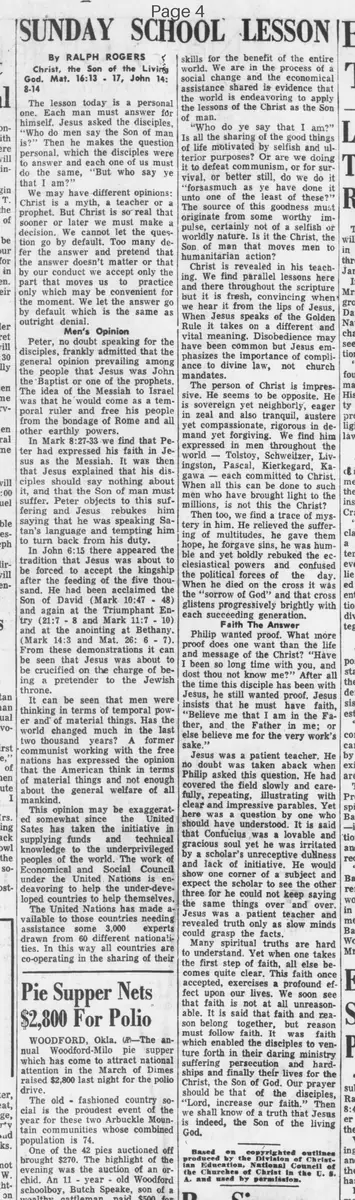
SUNDAY SCHOOL LESSON
By Ralph Rogers
Christ, the Son of the Living God. Mat. 16:13 - 17, John 14: 8-14
The lesson today is a personal one. Each man must answer for himself. Jesus asked the disciples, "Who do men say the Son of man is?" Then he makes the question personal, which the disciples were to answer and each one of us must do the same, "But who say ye that I am?"
We may have different opinions: Christ is a myth, a teacher or a prophet. But Christ is so real that sooner or later we must make a decision. We cannot let the question go by default. Too many defer the answer and pretend that the answer doesn't matter or that by our conduct we accept only the part that moves us to practice only which may be convenient for the moment. We let the answer go by default which is the same as outright denial.
Men's Opinion
Peter, no doubt speaking for the disciples, frankly admitted that the general opinion prevailing among the people that Jesus was John the Baptist or one of the prophets.
The idea of the Messiah to Israel was that he would come as a temporal ruler and free his people from the bondage of Rome and all other earthly powers.
In Mark 8:27-33 we find that Peter had expressed his faith in Jesus as the Messiah. It was then that Jesus explained that his disciples should say nothing about it, and that the Son of man must suffer. Peter objects to this suffering and Jesus rebukes him saying that he was speaking Satan's language and tempting him to turn back from his duty.
In John 6:15 there appeared the tradition that Jesus was about to be forced to accept the kingship after the feeding of the five thousand. He had been acclaimed the Son of David (Mark 10:47 - 48) and again at the Triumphant Entry (21:7 - 8 and Mark 11:7 - 10) and at the anointing at Bethany. (Mark 14:3 and Mat. 26: 6 - 7).
From these demonstrations it can be seen that Jesus was about to be crucified on the charge of being a pretender to the Jewish throne.
It can be seen that men were thinking in terms of temporal power and of material things. Has the world changed much in the last two thousand years? A former communist working with the free nations has expressed the opinion that the American think in terms of material things and not enough about the general welfare of all mankind.
This opinion may be exaggerated somewhat since the United States has taken the initiative in supplying funds and technical knowledge to the underprivileged peoples of the world. The work of Economical and Social Council under the United Nations is endeavoring to help the under-developed countries to help themselves. The United Nations has made available to those countries needing assistance some 3,000 experts drawn from 60 different nationalities. In this way all countries are co-operating in the sharing of their skills for the benefit of the entire world. We are in the process of a social change and the economical assistance shared is evidence that the world is endeavoring to apply the lessons of the Christ as the Son of man.
"Who do ye say that I am?"
Is all the sharing of the good things of life motivated by selfish and ulterior purposes? Or are we doing it to defeat communism, or for survival, or better still, do we do it "forsasmuch as ye have done it unto one of the least of these?'
The source of this goodness must originate from some worthy impulse, certainly not of a selfish or worldly nature. Is it the Christ, the Son of man that moves men to humanitarian action?
Christ is revealed in his teaching. We find parallel lessons here and there throughout the scripture but it is fresh, convincing when we hear it from the lips of Jesus.
When Jesus speaks of the Golden Rule it takes on a different and vital meaning. Disobedience may have been common but Jesus emphasizes the importance of compliance to divine law, not church mandates.
The person of Christ is impressive. He seems to be opposite. He is sovereign yet neighborly, eager in zeal and also tranquil, austere yet compassionate, rigorous in demand yet forgiving. We find him expressed in men throughout the world - Tolstoy, Schweitzer, Livingston, Pascal, Kierkegard, Kagawa - each committed to Christ.
When all this can be done to such men who have brought light to the millions, is not this the Christ?
Then too, we find a trace of mystery in him. He relieved the suffering of multitudes, he gave them hope, he forgave sins, he was humble and yet boldly rebuked the ecclesiastical powers and confused the political forces of the day.
When he died on the cross it was the "sorrow of God" and that cross glistens progressively brightly with each succeeding generation.
Faith The Answer
Philip wanted proof. What more proof does one want than the life and message of the Christ? "Have I been so long time with you, and dost thou not know me?" After all the time this disciple has been with Jesus, he still wanted proof. Jesus insists that he must have faith.
"Believe me that I am in the Father, and the Father in me; or else believe me for the very work's sake."
Jesus was a patient teacher. He no doubt was taken aback when Philip asked this question. He had covered the field slowly and carefully, repeating, illustrating with clear and impressive parables. Yet here was a question by one who should have understood. It is said that Confucius was a lovable and gracious soul yet he was irritated by a scholar's unreceptive dullness and lack of initiative. He would show one corner of a subject and expect the scholar to see the other three for he could not keep saying the same things over and over.
Jesus was a patient teacher and revealed truth only as slow minds could grasp the facts.
Many spiritual truths are hard to understand. Yet when one takes the first step of faith, all else becomes quite clear. This faith once accepted, exercises a profound effect upon our lives. We soon see that faith is not at all unreasonable. It is said that faith and reason belong together, but reason must follow faith. It was faith which enabled the disciples to venture forth in their daring ministry suffering persecution and hardships and finally their lives for the Christ, the Son of God. Our prayer should be that of the disciples, "Lord, increase our faith." Then we shall know of a truth that Jesus is indeed, the Son of the living God.
Based on copyrighted outlines produced by the Division of Christian Education, National Council of the Churches of Christ In the U. S. A. and used by permission.
By Ralph Rogers
Christ, the Son of the Living God. Mat. 16:13 - 17, John 14: 8-14
The lesson today is a personal one. Each man must answer for himself. Jesus asked the disciples, "Who do men say the Son of man is?" Then he makes the question personal, which the disciples were to answer and each one of us must do the same, "But who say ye that I am?"
We may have different opinions: Christ is a myth, a teacher or a prophet. But Christ is so real that sooner or later we must make a decision. We cannot let the question go by default. Too many defer the answer and pretend that the answer doesn't matter or that by our conduct we accept only the part that moves us to practice only which may be convenient for the moment. We let the answer go by default which is the same as outright denial.
Men's Opinion
Peter, no doubt speaking for the disciples, frankly admitted that the general opinion prevailing among the people that Jesus was John the Baptist or one of the prophets.
The idea of the Messiah to Israel was that he would come as a temporal ruler and free his people from the bondage of Rome and all other earthly powers.
In Mark 8:27-33 we find that Peter had expressed his faith in Jesus as the Messiah. It was then that Jesus explained that his disciples should say nothing about it, and that the Son of man must suffer. Peter objects to this suffering and Jesus rebukes him saying that he was speaking Satan's language and tempting him to turn back from his duty.
In John 6:15 there appeared the tradition that Jesus was about to be forced to accept the kingship after the feeding of the five thousand. He had been acclaimed the Son of David (Mark 10:47 - 48) and again at the Triumphant Entry (21:7 - 8 and Mark 11:7 - 10) and at the anointing at Bethany. (Mark 14:3 and Mat. 26: 6 - 7).
From these demonstrations it can be seen that Jesus was about to be crucified on the charge of being a pretender to the Jewish throne.
It can be seen that men were thinking in terms of temporal power and of material things. Has the world changed much in the last two thousand years? A former communist working with the free nations has expressed the opinion that the American think in terms of material things and not enough about the general welfare of all mankind.
This opinion may be exaggerated somewhat since the United States has taken the initiative in supplying funds and technical knowledge to the underprivileged peoples of the world. The work of Economical and Social Council under the United Nations is endeavoring to help the under-developed countries to help themselves. The United Nations has made available to those countries needing assistance some 3,000 experts drawn from 60 different nationalities. In this way all countries are co-operating in the sharing of their skills for the benefit of the entire world. We are in the process of a social change and the economical assistance shared is evidence that the world is endeavoring to apply the lessons of the Christ as the Son of man.
"Who do ye say that I am?"
Is all the sharing of the good things of life motivated by selfish and ulterior purposes? Or are we doing it to defeat communism, or for survival, or better still, do we do it "forsasmuch as ye have done it unto one of the least of these?'
The source of this goodness must originate from some worthy impulse, certainly not of a selfish or worldly nature. Is it the Christ, the Son of man that moves men to humanitarian action?
Christ is revealed in his teaching. We find parallel lessons here and there throughout the scripture but it is fresh, convincing when we hear it from the lips of Jesus.
When Jesus speaks of the Golden Rule it takes on a different and vital meaning. Disobedience may have been common but Jesus emphasizes the importance of compliance to divine law, not church mandates.
The person of Christ is impressive. He seems to be opposite. He is sovereign yet neighborly, eager in zeal and also tranquil, austere yet compassionate, rigorous in demand yet forgiving. We find him expressed in men throughout the world - Tolstoy, Schweitzer, Livingston, Pascal, Kierkegard, Kagawa - each committed to Christ.
When all this can be done to such men who have brought light to the millions, is not this the Christ?
Then too, we find a trace of mystery in him. He relieved the suffering of multitudes, he gave them hope, he forgave sins, he was humble and yet boldly rebuked the ecclesiastical powers and confused the political forces of the day.
When he died on the cross it was the "sorrow of God" and that cross glistens progressively brightly with each succeeding generation.
Faith The Answer
Philip wanted proof. What more proof does one want than the life and message of the Christ? "Have I been so long time with you, and dost thou not know me?" After all the time this disciple has been with Jesus, he still wanted proof. Jesus insists that he must have faith.
"Believe me that I am in the Father, and the Father in me; or else believe me for the very work's sake."
Jesus was a patient teacher. He no doubt was taken aback when Philip asked this question. He had covered the field slowly and carefully, repeating, illustrating with clear and impressive parables. Yet here was a question by one who should have understood. It is said that Confucius was a lovable and gracious soul yet he was irritated by a scholar's unreceptive dullness and lack of initiative. He would show one corner of a subject and expect the scholar to see the other three for he could not keep saying the same things over and over.
Jesus was a patient teacher and revealed truth only as slow minds could grasp the facts.
Many spiritual truths are hard to understand. Yet when one takes the first step of faith, all else becomes quite clear. This faith once accepted, exercises a profound effect upon our lives. We soon see that faith is not at all unreasonable. It is said that faith and reason belong together, but reason must follow faith. It was faith which enabled the disciples to venture forth in their daring ministry suffering persecution and hardships and finally their lives for the Christ, the Son of God. Our prayer should be that of the disciples, "Lord, increase our faith." Then we shall know of a truth that Jesus is indeed, the Son of the living God.
Based on copyrighted outlines produced by the Division of Christian Education, National Council of the Churches of Christ In the U. S. A. and used by permission.
What sub-type of article is it?
Essay
What themes does it cover?
Religious
Moral Virtue
What keywords are associated?
Christ Identity
Personal Faith
Biblical Lesson
Sunday School
Humanitarian Action
Messiah Expectations
What entities or persons were involved?
By Ralph Rogers
Literary Details
Title
Christ, The Son Of The Living God
Author
By Ralph Rogers
Subject
Sunday School Lesson
Key Lines
"But Who Say Ye That I Am?"
"Believe Me That I Am In The Father, And The Father In Me; Or Else Believe Me For The Very Work's Sake."
"Lord, Increase Our Faith."