Thank you for visiting SNEWPapers!
Sign up free
The Hawaiian Star
Honolulu, Honolulu County, Hawaii
What is this article about?
President William H. Taft's 1909 message to Congress covers positive U.S. foreign relations, diplomatic successes in Europe (Hague fisheries case), Latin America (Bolivia-Peru settlement, Nicaragua issues), Far East (China open door), and domestic topics like tariffs, pensions, frauds, banking, shipping, Alaska, and anti-prostitution efforts. (248 characters)
Merged-components note: Merging the President's message across multiple pages, including introductory headlines (originally section_title), main text blocks (story), and associated images due to spatial overlap and explicit continuation indicators.
Clippings
1 of 4
OCR Quality
Full Text
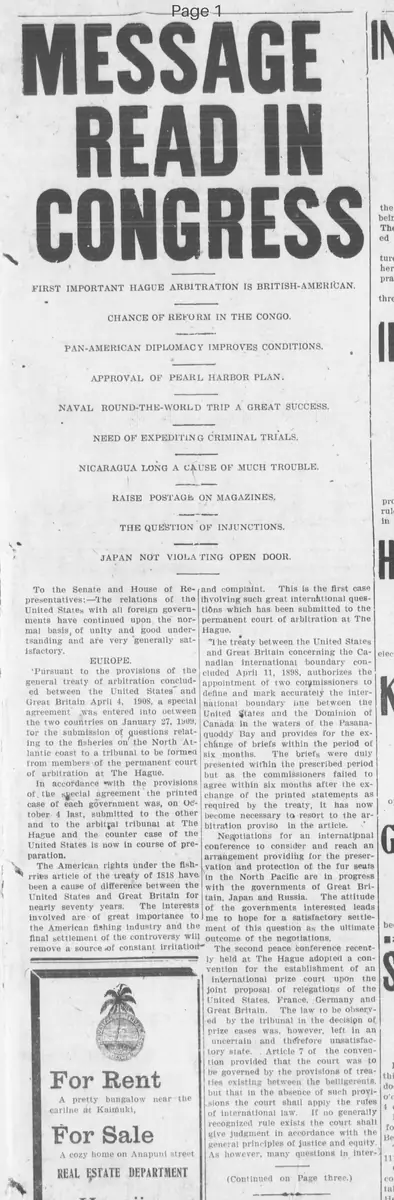
READ IN
CONGRESS
FIRST IMPORTANT HAGUE ARBITRATION IS BRITISH-AMERICAN.
CHANCE OF REFORM IN THE CONGO.
PAN-AMERICAN DIPLOMACY IMPROVES CONDITIONS.
APPROVAL OF PEARL HARBOR PLAN.
NAVAL ROUND-THE-WORLD TRIP A GREAT SUCCESS.
NEED OF EXPEDITING CRIMINAL TRIALS.
NICARAGUA LONG A CAUSE OF MUCH TROUBLE.
RAISE POSTAGE ON MAGAZINES,
THE QUESTION OF INJUNCTIONS.
JAPAN NOT VIOLATING OPEN DOOR.
To the Senate and House of Representatives:-
The relations of the United States with all foreign governments have continued upon the normal basis, of unity and good understanding and are very generally satisfactory.
EUROPE.
Pursuant to the provisions of the general treaty of arbitration concluded between the United States and Great Britain April 4, 1908, a special agreement was entered into between the two countries on January 27, 1909, for the submission of questions relating to the fisheries on the North Atlantic coast to a tribunal to be formed from members of the permanent court of arbitration at The Hague.
In accordance with the provisions of the special agreement the printed case of each government was, on October 4 last, submitted to the other and to the arbitral tribunal at The Hague and the counter case of the United States is now in course of preparation.
The American rights under the fisheries article of the treaty of 1818 have been a cause of difference between the United States and Great Britain for nearly seventy years.
The interests involved are of great importance to the American fishing industry and the final settlement of the controversy will remove a source of constant irritation and complaint.
This is the first case involving such great international questions which has been submitted to the permanent court of arbitration at The Hague.
The treaty between the United States and Great Britain concerning the Canadian international boundary concluded April 11, 1898, authorizes the appointment of two commissioners to define and mark accurately the international boundary line between the United States and the Dominion of Canada in the waters of the Passamaquoddy Bay and provides for the exchange of briefs within the period of six months.
The briefs were duly presented within the prescribed period but as the commissioners failed to agree within six months after the exchange of the printed statements as required by the treaty, it has now become necessary to resort to the arbitration proviso in the article.
Negotiations for an international conference to consider and reach an arrangement providing for the preservation and protection of the fur seals in the North Pacific are in progress with the governments of Great Britain, Japan and Russia.
The attitude of the governments interested leads me to hope for a satisfactory settlement of this question as the ultimate outcome of the negotiations.
The second peace conference recently held at The Hague adopted a convention for the establishment of an international prize court upon the joint proposal of delegations of the United States, France, Germany and Great Britain.
The law to be observed by the tribunal in the decision of prize cases was, however, left in an uncertain and therefore unsatisfactory state.
Article 7 of the convention provided that the court was to be governed by the provisions of treaties existing between the belligerents, but that in the absence of such provisions the court shall apply the rules of international law.
If no generally recognized rule exists the court shall give judgment in accordance with the general principles of justice and equity.
As however, many questions in international law are not yet settled by treaty or otherwise,
(Continued on Page three.)
MESSAGE
(Continued from Page One.)
national maritime law are understood differently and therefore Interpreted differently in various countries, it was deemed advisable not to intrust legislative powers to the proposed court, but to determine the rules of law properly applicable in a conference of the representative maritime nations.
Pursuant to an invitation of Great Britain, a conference was held at London from December 2, 1908, to February 26, 1909, in which the following powers participated:
The United States, Austria-Hungary, France, Germany, Great Britain, Italy, Japan, The Netherlands, Russia and Spain.
The conference resulted in the declaration of London, unanimously agreed to and signed by the participating powers, concerning among other matters, the highly important subjects of blockade, contraband, the destruction of neutral prizes and continuous voyages.
The declaration of London is an eminently satisfactory codification of the international maritime law and it is hoped that its reasonableness and fairness will secure its general adoption, as well as remove one of the difficulties standing in the way of the establishment of an international prize court.
The question arising out of the Belgian annexation of the Independent State of the Congo which has so long and earnestly preoccupied the attention of this government and enlisted the sympathy of our best citizens is still open, but in a more hopeful stage.
This government was among the foremost in the great work of uplifting the uncivilized regions of Africa and urging the extension of the benefits of civilization, education and fruitful, open commerce to that vast domain, and is a party to treaty engagements of all the interested powers designed to carry out that great duty to humanity.
The way to better the original and adventitious conditions, so burdensome to the natives and so destructive to their development, has been pointed out by observations and experience, not alone of American representatives, but by cumulative evidence from all quarters and by the investigations of Belgian agents. The announced programs of reform, striking at many of the evils known to exist, are an augury of better things.
The attitude of the United States is one of benevolent encouragement, coupled with a hopeful trust that the good work responsibly undertaken and zealously perfected to the accomplishment of the results so ardently desired, will soon justify the wisdom that inspires them and satisfy the demands of human sentiment throughout the world.
LATIN-AMERICA.
One of the happiest events in recent Pan-American diplomacy was the pacific, independent settlement by the governments of Bolivia and Peru of a boundary difference between them which for some weeks threatened to cause war and even to entail embitterments affecting other republics less directly concerned. From various quarters directly or indirectly concerned, the intermediation of the United States was sought to assist in a solution of the controversy. Desiring at all times to abstain from any undue mingling in the affairs of sister republics and having faith in the ability of the governments of Peru and Bolivia themselves to settle their differences in a manner satisfactory to themselves, which, viewed with magnanimity, would assuage all embitterment, this government steadily abstained from being drawn into the controversy and was much gratified to find its confidence justified by events.
On the 9th of July next there will open at Buenos Ayres the fourth Pan-American conference.
This conference will have a special meaning to the hearts of all Americans because around its date are clustered the anniversaries of the independence of so many of the American republics. It is not necessary for me to remind the Congress of the political, social and commercial importance of these gatherings. You are asked to make liberal appropriation for our participation. If this be granted, it is my purpose to appoint a distinguished and representative delegation, qualified fittingly to represent this country and to deal with the problems of intercontinental interest which will there be discussed.
The Argentine Republic will also hold from May to November, 1910, at Buenos Ayres, a great international agricultural exhibition in which the United States has been invited to participate. Considering the rapid growth of the trade of the United States with the Argentine Republic and the cordial relations existing between the two nations, together with the fact that it provides an opportunity to show deference to a sister republic on the occasion of the celebration of its national independence, the proper departments of this government are taking steps to apprise the interests concerned of the opportunity afforded by this exhibition, in which appropriate participation by this country is desirable.
The designation of an official representative is also receiving consideration.
Today, more than ever before, American capital is seeking investment in foreign countries and American products are more and more generally seeking foreign markets. As a consequence, in all countries there are American citizens and American interests to be protected, on occasion, by their government.
These movements of men, of capital and of commodities bring people and governments closer together and so form bonds of peace and mutual dependency, as they must also naturally sometimes make passing points of friction.
The resultant situation inevitably imposes upon this government vastly increased responsibilities.
This administration, through the Department of State and the foreign service is lending all proper support to legitimate and beneficial American enterprises in foreign countries, the degree of such support being measured by the national advantages to be expected. A citizen himself cannot, by contract or otherwise, divest himself of the right, nor can this government escape the obligations of his protection in his personal and property rights when these are unjustly infringed in a foreign country.
To avoid ceaseless vexation, it is proper that in considering whether American enterprises should be encouraged or supported in a particular country, the government should give full weight not only to the national, as opposed to the individual, benefits to accrue, but also to the fact whether or not the government of the country in question is in its administration and its diplomacy faithful to the principles of moderation, equity and justice upon which alone depend international credit in diplomacy as well as in finance.
The Pan-American policy of this government has long been fixed in its principles and remains unchanged.
With the advanced circumstances of the United States and of the republics to the south of us, most of which have great natural resources, stable government and progressive ideals, the apprehension which gave rise to the Monroe doctrine may be said to have nearly disappeared, and neither the doctrine as it exists nor any other doctrine of American policy should be permitted to operate for the perpetuation of irresponsible government, the escape of just obligation, or the insidious allegation of dominating ambitions on the part of the United States.
Beside the fundamental doctrines of our Pan-American policy there have grown up a realization of political interests, community of institutions and ideals, and a flourishing commerce. All these bonds will be greatly strengthened as time goes on and increased facilities, such as the great bank soon to be established in Latin-America, supply the means for building up the colossal intercontinental commerce of the future.
My meeting with President Diaz and the greeting exchanged on both American and Mexican soil served, I hope, to signalize the close and cordial relations which so well bind together this republic and the great republic immediately to the south, between which there is so vast a network of material interests.
I am happy to say that all but one of the cases which for so long vexed our relations with Venezuela have been settled within the past few months and that, under the enlightened regime now directing the government of Venezuela, provision has been made for arbitration of the remaining case before The Hague tribunal.
On July 30, 1909, the Government of Panama agreed, after considerable negotiations, to indemnify the relatives of the American officers and sailors who were brutally treated, one of them having, indeed, been killed by the Panaman police this year.
The sincere desire of the Panaman government to do away with a situation where such an accident could occur is manifest in the recent request in compliance with which this government has lent the service of an officer of the army to be employed by the government of Panama as instructor of police.
The sanitary improvement and public works undertaken in Cuba prior to the present administration of that government, in the success of which the United States is interested under the treaty, are reported to be making good progress and since the Congress provided for the continuance of the reciprocal commercial arrangement between Cuba and the United States assurance has been received that no negotiations injuriously affecting the situation will be undertaken without consultation.
Since the Washington convention of 1907 were communicated to the government of the United States as a consulting and advising party, this government has been almost continuously called upon by one or another, and in turn by all of the five Central American republics to exert itself for the maintenance of the conventions.
Nearly every complaint has been against the Zelaya government of Nicaragua, which has kept Central America in constant tension or turmoil.
The responses made to the representations of Central American republics, as due from the United States on account of its relation to the Washington convention, have been at all times conservative and have avoided, so far as possible any semblance of interference although it is very apparent that the consideration of geographic proximity to the canal zone and of the very substantial American interests in Central America give to the United States a special position in the zone of these republics, and the Caribbean Sea.
I need not rehearse here the patient efforts of this government to promote peace and welfare among these republics, efforts which are fully appreciated by the majority of them who are loyal to their true interests. It would be no less unnecessary to rehearse here the sad tale of unspeakable barbarities and oppression alleged to have been committed by the Zelaya government.
Recently two Americans were put to death by order of President Zelaya himself. They were officers in the organized forces of a revolution which had continued many weeks and was in control of about half of the republic, and as such according to the modern enlightened practice of civilized nations, they were entitled to be dealt with as prisoners of war.
At the date when this message is printed this government has terminated diplomatic relations with the Zelaya government, for reasons made public in a communication to the former Nicaraguan Charge d'Affaires, and is intending to take such future steps as may be found most consistent with its dignity, its duty to American interests and its moral obligations to Central America and to civilization. It may be necessary for me to bring this subject to the attention of the Congress in a special message.
THE FAR EAST.
In the Far East this government preserves unchanged its policy of supporting the principle of equality of opportunity and scrupulous respect for the integrity of the Chinese Empire, to which policy are pledged the interested powers of both East and West.
By the treaty of 1903 China has undertaken the abolition of Likin with a moderate and proportionate raising of the customs tariff along with currency reforms.
These reforms being of manifest advantage to foreign commerce as well as to the interests of China, this government is endeavoring to facilitate these measures and the needful acquiescence of the treaty powers.
When it appeared that Chinese likin revenues were to be hypothecated to foreign bankers in connection with a great railway project, it was obvious that the government bankers held this loan would have a certain direct interest in the question of the carrying out by China of the reforms in question.
Because this railroad loan represented a practical and real application of the open door policy through co-operation with China by interested powers as well as because of its relations to the reforms referred to above, the administration deemed American participation to be of great national interest.
Happily, when it was as a matter of broad policy urgent that this opportunity should not be lost, the indispensable instrumentality presented itself then a group of American bankers of international reputation and great resources, agreed at once to share in the loan upon precisely such terms as this government should approve.
The chief of those terms was that American railway material should be upon an exact equality with that of the other nations joining in the loan in the placing of orders for this whole railroad system. After months of negotiations the equal participation of Americans seems at last assured.
It is gratifying that Americans will thus take their share in this extension of these great highways of trade, and to believe that such activities will give a real impetus to our commerce and will prove a practical corollary to our historic policy in the Far East.
The Imperial Chinese government in pursuance of its decision to devote funds from the portion of the indemnity remitted by the United States to the sending of students to this country has already completed arrangements for carrying out this purpose and a considerable body of students have arrived to take up their work in our schools and universities.
No one can doubt the happy effect that the associations formed by these representative young men will have when they return to take up their work in the progressive development of their country.
In one of the Chinese-Japanese conventions of September 4 of this year there was a provision which caused considerable public apprehension in that upon its face it was believed in some quarters to seek to establish a monopoly of mining privileges along the South Manchurian and Antung-Mukden railroads and thus to exclude Americans from a wide field of enterprise, to take part in which they were entitled by treaty with China.
After a thorough examination of the convention and of the several contextual documents, the Secretary of State reached the conclusion that no such monopoly was intended or accomplished.
However, in view of the widespread discussion of this question, to confirm the view it had reached, this government made inquiry of the Imperial Chinese and Japanese governments, and received from each official assurance that the provision had no purpose inconsistent with the policy of equality of opportunity to which the signatories, in common with the United States are pledged.
Our traditional relations with the Japanese Empire continued cordial as
(Continued on Page Six.)
MESSAGE (Continued from page 5.)
usual. As the representative of Japan, His Imperial Highness Prince Kuni visited the Hudson-Fulton celebration. The recent visit of a delegation of prominent business men as guests of the Chambers of Commerce of the Pacific Coast slope whose representatives had been so agreeably received in Japan will doubtless contribute to the growing trade across the Pacific as well as to that mutual understanding which leads to mutual appreciation.
The arrangements of 1906 for co-operative control of the coming of laborers to the United States has proved to work satisfactorily. The matter of a revision of the existing treaty between the United States and Japan which is terminable in 1912 is already receiving the study of both countries. The Department of State is considering the revision in whole or in part of the existing treaty with Siam, which was concluded in 1856 and is now, in respect to many of its provisions, out of date.
Most of the great industrial organizations and many of the well-conducted railways, of this country, are coming to the conclusion that a system of pensions for old employees, and the substitution therefor of younger and more energetic servants, promotes both economy and efficiency of administration.
I am aware that there is a strong feeling in both houses of Congress, and possibly in the country, against the establishment of civil pensions and that this has naturally grown out of the heavy burden of military pensions, which it has always been the policy of our government to assume; but I am strongly convinced that no other practical solution of the difficulties presented by the superannuation of civil servants can be found than that of a system of civil pensions.
FRAUDS IN THE COLLECTION OF CUSTOMS.
I regret to refer to the fact of the discovery of extensive frauds in the collection of the customs revenue at New York city in which a number of subordinate employees in the weighing and other departments were directly concerned, and in which the beneficiaries were the American Sugar Refining Company and others. The frauds consisted in the payment of duty on underweights of sugar.
The government has recovered from the American Sugar Refining Company all that it is shown to have been defrauded of. The sum was received in full of the amount due, which might have been recovered by civil suit against the beneficiary of the fraud, but there was an express reservation in the contract of settlement by which the settlement should not interfere with, or prevent the criminal prosecution of everyone who was found to be subject to the same.
Criminal prosecutions are now proceeding against a number of the government officers. The Treasury Department and the Department of Justice are exerting every effort to discover all the wrongdoers, including the officers and employees of the companies who may have been privy to the fraud. It would seem to me that an investigation of the frauds by Congress at present, pending the probing by the Treasury Department and the Department of Justice as proposed, might, by giving immunity and otherwise prove an embarrassment in securing conviction of the guilty parties.
MAXIMUM AND MINIMUM CLAUSE IN TARIFF ACT.
Two features of the new tariff act call for special reference. By virtue of the clause known as the "maximum and minimum" clause, it is the duty of the executive to consider the laws and practices of other countries with reference to the importation into those countries of the products and merchandise of the United States and if the executive finds such laws and practices not to be unduly discriminatory against the United States, the minimum duties provided in the bill are to go into force. Unless the President makes such a finding then the maximum duties provided in the bill, that is, an increase of twenty-five per cent ad valorem over the minimum duties, are to be in force.
Fear has been expressed that this power conferred and duty imposed on the executive is likely to lead to a tariff war. I beg to express the hope and belief that no such result need be anticipated.
The discretion granted to the executive by the terms "unduly discriminatory" is wide. In order that the maximum duty shall be charged against the imports from a country it is necessary that he shall find on the part of that country not only discriminations in its laws or the practice under them against the trade of the United States, but that the discriminations found shall be undue; that is, without good and fair reason. I conceive that this power was reposed in the President with the hope that the maximum duties might never be applied in any case, but that the power to apply them would enable the President and the State Department through friendly negotiation to secure the elimination from the laws and the practice under them of any foreign country of that which is unduly discriminatory. No one is seeking a tariff war or a condition in which the spirit of retaliation shall be aroused.
MESSAGE
(Continued from Page six.)
...banks are furnished they will be productive of the utmost good.
The postal savings banks are not constituted for the purpose of creating competition with other banks. The rate of interest upon deposits to which they would be limited would be so small as to prevent their drawing deposits away from other banks.
I believe them to be necessary in order to offer a proper inducement to thrift and saving to a great many people of small means who don't now have banking facilities, and to whom such a system would offer an opportunity for the accumulation of capital. They will furnish a satisfactory substitute based on sound principle and actual successful trial in nearly all the countries of the world, for the system of government guaranty of deposits now being adopted in several western states which with deference to those who advocate it seems to me to have in it the seeds of demoralization to conservative banking and certain financial disaster.
The question of how the money deposited in postal savings bank shall be invested is not free from difficulty, but I believe that a satisfactory provision for this purpose was inserted as an amendment to the bill considered by the Senate at its last session. It has been proposed to delay the consideration of legislation establishing a postal savings bank until after the report of the monetary commission. This report is likely to be delayed, and properly so, because of the necessity for careful deliberation and close investigation. I don't see why the one should be tied up with the other. It is understood that the monetary commission has looked into the systems of banking which now prevail abroad and have found that by a control there exercised in respect to reserves and the rates of exchange by some central authority, panics are avoided. It is not apparent that a system of postal savings banks would in any way interfere with a change to such a system here. Certainly in most of the countries in Europe where control is thus exercised by a controlling [authority] inconsistent with a proper financial and banking system.
SHIP SUBSIDY
Following the course of my distinguished predecessor, I earnestly recommend to Congress the consideration and passage of a ship subsidy bill, looking to the establishment of lines between our Atlantic seaboard and the eastern coast of South America, as well as lines from the west coast of the United States to South America, China, Japan and the Philippines. The profits on foreign mails are perhaps a sufficient measure of the expenditures which might first be tentatively applied to this method of inducing American capital to undertake the establishment of American lines of steamships in those directions in which we now feel it most important that we should have means of transportation controlled in the interest of expansion of our trade. A bill of this character has once passed the house and more than once passed the Senate and I hope that at this session a bill framed on the same lines and with the same purposes may become a law.
ALASKA.
With respect to the territory of Alaska, I recommend legislation which shall provide for the appointment by the President of a governor and also of an executive council, the members of which shall during their term of office reside in the territory and which shall have executive powers sufficient to enable it to give to the territory local laws adapted to its present growth. I strongly deprecate legislation looking to the election of a territorial legislature in that vast district. The lack of permanence of residence of a large part of the present population and the small number of the people who either permanently or temporarily reside in the district as compared with its vast expanse and the variety of the interests that have to be subserved, make it altogether unfitting, in my judgment, to provide for a popular election of a legislative body. The present system is not adequate and does not furnish the character of local control that ought to be there. The only compromise it seems to me which may give needed local legislation and secure a conservative government is the one I propose.
THE WHITE SLAVE TRADE.
I greatly regret to have to say that the investigations made in the bureau of immigration and other sources of investigation lead to the view that there is urgent necessity for additional legislation and greater executive activity to suppress the recruiting of the ranks of prostitutes from the streams of immigration into this country—an evil which, for want of a better name, has been called the "White Slave Trade." I believe it to be constitutional to forbid, under penalty, the transportation of persons for purposes of prostitution across national and state lines and by appropriating a fund of $50,000 to be used by the secretary of commerce and labor for the employment of special inspectors, it will be possible to bring those responsible for this trade to indictment and conviction under a Federal law.
CONCLUSION.
I have thus, in a message compressed as much as the subjects will permit, referred to many of the legislative needs of the country, with the exceptions already noted. Speaking generally the country is in a high state of prosperity. There is every reason to believe that we are on the eve of a substantial business expansion, and we have just garnered a harvest unexampled in the market value of our agricultural products.
The high prices which such products bring mean great prosperity for the farming community, but on the other hand they mean a very considerably increased burden upon those classes in the community whose yearly compensation does not expand with the improvement in business and the general prosperity. Various reasons are given for the high prices. The proportionate increase in the output of gold, which today is the chief medium of exchange and is in some respects a measure of value, furnishes a substantial explanation of at least part of the increase in prices. The increase in population and the more expensive mode of living of the people, which have not been accomplished by a proportionate increase in acreage production, may furnish a further reason.
It is well to note that the increase in the protective tariff must meet the fact that the cost of living is not confined to this country, but prevails the world over, and that the rise in prices has taken place almost wholly in those products of the factory and farm in respect to which has been either no increase in the tariff or in many instances a very considerable reduction.
WILLIAM H. TAFT.
What sub-type of article is it?
What themes does it cover?
What keywords are associated?
What entities or persons were involved?
Where did it happen?
Story Details
Key Persons
Location
United States, Europe, Latin America, Far East
Event Date
1909
Story Details
President Taft reports on satisfactory foreign relations, including Hague arbitration on fisheries with Britain, Congo reforms, Pan-American diplomacy resolving Bolivia-Peru boundary, Nicaragua tensions leading to broken relations with Zelaya government, support for open door in China, and domestic recommendations on civil pensions, customs frauds, tariff clause, postal savings banks, ship subsidy, Alaska governance, and white slave trade suppression.