Thank you for visiting SNEWPapers!
Sign up free
Foreign News
October 16, 1817
Daily National Intelligencer
Washington, District Of Columbia
What is this article about?
Opinion piece in The Enquirer to Henry Clay advocating US recognition of South American independence, starting with southern Pacific provinces, detailing Spanish America's geography, population, and readiness for republican freedom amid struggles against Spanish rule.
Clipping
OCR Quality
98%
Excellent
Full Text
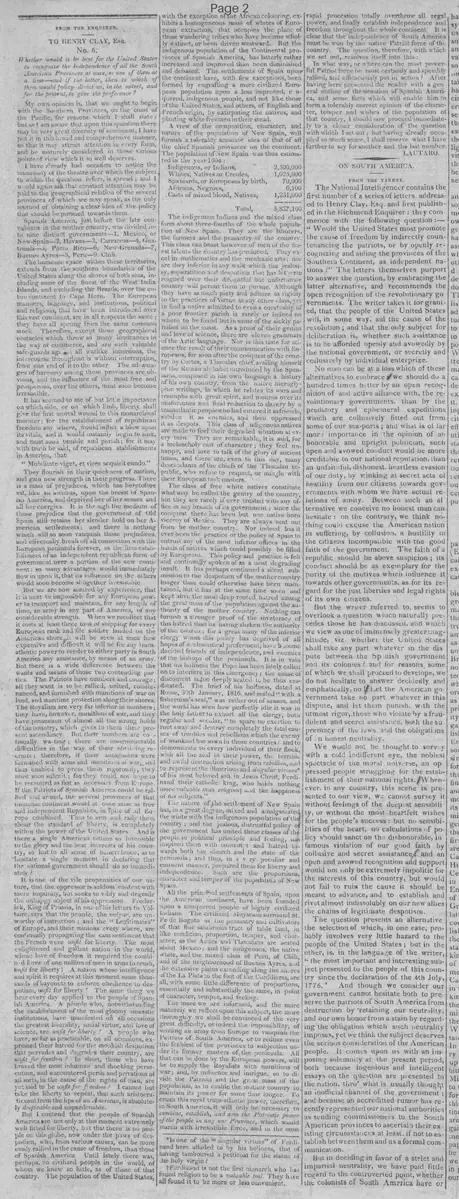
FROM THE ENQUIRER.
TO HENRY CLAY, Esq.
No. 6.
Whether would it be best for the United States to recognize the Independence of all the South American Provinces at once, or one of them at a time—and if the latter, then to which of them would policy direct us, in the outset, and for the present, to give the preference?
My own opinion is, that we ought to begin with the Southern Provinces, on the coast of the Pacific, for reasons which I shall state: but as I am aware that upon this question there may be very great diversity of sentiment, I have put it in this broad and comprehensive manner, so that it may attract attention in every form, and be maturely considered in those various points of view which it so well deserves.
I have already had occasion to notice the immensity of the theatre over which the subject to which the question refers, is spread; and I would again ask that constant attention may be paid to the geographical relation of the several provinces of which we may speak, as the only method of obtaining a clear idea of the policy that should be pursued towards them.
Spanish America, just before the late convulsions in the mother country, was divided into nine distinct governments—1, Mexico, or New-Spain—2, Havana—3, Carraccas—4, Guatemala—5, Porto Rico—6, New-Grenada—7, Buenos Ayres—8, Peru—9. Chili.
The immense space within these territories, extends from the southern boundaries of the United States along the shores of both seas, including some of the finest of the West India Islands, and excluding the Brazils, over the entire continent to Cape Horn. The European manners, language, and institutions, political and religious, that have been introduced over this vast continent, are in all respects the same; they have all sprung from the same common stock. Therefore, except those geographical obstacles which throw so many hindrances in the way of commerce, and are such valuable safe-guards against all warlike incursions, the intercourse throughout is without interruption, from one end of it to the other. The advantages of harmony among these provinces are obvious, and the influence of the most free and prosperous, over the others, must soon become irresistible.
It has seemed to me of but little importance on which side, or on which limb, liberty shall give the first mortal wound to this monarchical monster; for the establishment of republican freedom any where, would inflict a blow upon its vitals, and it would instantly begin to sink, and must soon tumble and perish; for it may with truth be said, of republican establishments in America, that
"Mobilitate viget, et vires acquirit eundo."
They flourish in their quickness of motion, and gain new strength in their progress. There is a mass of prejudices, which has heretofore sat, like an incubus, upon the breast of Spanish America, and deprived her of her senses and all her energies. It is through the medium of those prejudices that the government of Old Spain still retains her slender hold on her American settlements; and there is nothing which will so soon vanquish those prejudices, and effectually break off all connection with the European peninsula forever, as the firm establishment of an independent republican form of government over a portion of the new continent: so many advantages would immediately flow in upon it, that its influence on the others would soon become altogether irresistible.
But we are now assured by experience, that it is next to impossible for any European power to transport and maintain, for any length of time, an army in any part of America, of any considerable strength. When we recollect that it costs at least three tons of shipping for every European rank and file soldier landed on the American shore, it will be seen at once how expensive and difficult it will be for any transatlantic power to render to either party in South America any assistance, by means of an army.
But there is a wide difference between the wants and means of those two contending parties. The Patriots have numbers and courage; all they want is to be rallied, united, countenanced, and furnished with munitions of war on land, and maritime protection along their shores. The Royalists are very far inferior in numbers; they have, however, munitions of war, and they have possession of almost all the strong holds of the country, which gives to them their present ascendancy. But their numbers are continually wasting; there are insurmountable difficulties in the way of their obtaining recruits; therefore, if their antagonists were furnished with arms and munitions of war, and thus enabled to press them rigorously, they must soon submit; for they could not hope to be recruited as fast as necessary from Europe.
If the Patriots of Spanish America could be rallied and armed, the several provinces of that immense continent would at once arise as free and independent Republics, in spite of all Europe combined. Thus to arm and rally them about the standard of liberty, is completely within the power of the United States. And is there a single American citizen so insensible to the glory and the best interests of his country, so lost to all sense of benevolence, as to hesitate a single moment in declaring that the national government should do so immediately?
It is one of the vile propensities of our nature, that the oppressor is seldom content with mere impunity, but seeks to vilify and degrade the unhappy object of his oppression. Frederick, King of Prussia, in one of his letters to Voltaire, says that the people, the vulgar, are unworthy of instruction; and the "Legitimates" of Europe, and their minions every where, are continually propagating the cant sentiment that the French were unfit for liberty. The most enlightened and gallant nation in the world, whose love of freedom it required the combined force of one million of men in arms to crush, unfit for liberty! A nation whose intelligence and spirit it requires at this moment some thousands of bayonets to enforce obedience to despotism, unfit for liberty! The same thing we hear every day applied to the people of Spanish America. A people who, notwithstanding the establishment of the most gloomy monastic institutions, have manifested on all occasions the greatest liberality, social virtue, and love of science, are unfit for liberty! A people who have, as far as practicable, on all occasions, expressed their hatred for the monkish despotism that pervades and degrades their country, are unfit for freedom! In short, those who have braved the most inhuman and shocking persecution, and encountered perils and privations of all sorts, in the cause of the rights of man, are yet said to be unfit for freedom! I cannot but take the liberty to repeat, that such aristocratic cant from the lips of an American, is absolutely despicable and unpardonable.
But I contend that the people of Spanish America are not only at this moment extremely well fitted for liberty, but that there is no people on this globe, now under the paws of despotism, who, from various causes, can be more easily rallied in the cause of freedom, than those of Spanish America. Until lately there was, perhaps, no civilized people in the world, of whom we knew so little, as of those of that country. The population of the United States, with the exception of the African colouring, exhibits a homogeneous mass of whites of European extraction, that occupies the place of those wandering tribes who have become wholly extinct, or been driven westward. But the indigenous population of the Continental provinces of Spanish America, has latterly rather increased and improved than been diminished and debased. The settlements of Spain upon the continent have, with few exceptions, been formed by engrafting a more civilized European population upon a less improved, conquered, indigenous people, and not like those of the United States, and others, of English and French origin, by extirpating the natives, and planting white freemen in their stead.
A view of the composition, character, and nature of the population of New Spain, will furnish a tolerably accurate idea of that of all the chief Spanish provinces on the continent.
The population of New Spain was thus estimated in the year 1804:
Indigenous, or Indians, 2,500,000
Whites. Natives or Creoles. 1,025,000
Spaniards, or Europeans by birth, 70,000
Africans, Negroes, 6,100
Casts of mixed blood, Natives, 1,231,000
Total, 5,837,100
The indigenous Indians and the mixed class form about three-fourths of the whole population of New Spain. They are the laborers, the farmers and the peasantry of the country. This class can boast however of men of the finest talents the country has produced. They excel in mathematics and the mechanic arts; nor are they inferior in any walk which the jealousy, superstition and despotism that has hitherto reigned over their delightful but unfortunate country will permit them to pursue. Although they have as much piety and adhere as rigidly to the practices of virtue as any other class, yet to find a native admitted to even a curateship of a poor frontier parish is rarely or indeed no where to be found but in some of the sickly parishes on the coast. As a proof of their genius and love of science, there are eleven grammars of the Aztec language. Nor is this taste for science the result of their communication with Europeans, for soon after the conquest of the country by Cortes, a Tlascalan chief, availing himself of the Roman alphabet introduced by the Spaniards, composed in his own language a history of his own country, from the native hieroglyphic writings, in which he relates its wars and triumphs with great spirit, and mourns over its misfortunes and final reduction to slavery by a transatlantic people who had entered it as friends, subdue it as enemies, and then oppressed it as despots. This class of indigenous natives are made to feel their degraded situation at every turn. They are remarkable, it is said, for a melancholy cast of character; they feel unhappy, and love to talk of the glory of ancient times, and there are, even to this day, many descendants of the chiefs of the Tlascalan republic, who refuse to respect, or mingle with their European task masters.
The class of free white natives constitute what may be called the gentry of the country, but they are rarely if ever trusted with any office in any branch of its government; since the conquest there has been but one native born viceroy of Mexico. They are always sent out from the mother country. Nor indeed has it ever been the practice or the policy of Spain to entrust any of the most inferior offices in the hands of natives which could possibly be filled by Europeans. This policy and practice is felt and continually spoken of as a most degrading insult. It has perhaps continued a silent submission to the despotism of the mother country longer than could otherwise have been maintained, but it has at the same time sown and kept alive the most deep rooted hatred among the great mass of the population against the authority of the mother country. Nothing can furnish a stronger proof of the inveteracy of this hatred than its having shaken the authority of the church; for a great many of the inferior clergy whom this policy has deprived of all hopes of ecclesiastical preferment, have become decided friends of independence, and enemies of the bishops of the peninsula. It is in vain that his holiness the Pope has been lately called on to interfere in this emergency; the cause of discontent is too deeply seated to be thus eradicated. The brief of his holiness, dated at Rome, 30th January, 1816, and sealed with a fisherman's seal, was rather out of season, and the world has seen how perfectly idle it was in the holy father to exhort all the clergy, both regular and secular, "to spare no exertion to root away and destroy completely the fatal causes of troubles and rebellions which the enemy of mankind has sown in those countries: and to demonstrate to every individual of their flock, with all the zeal in their power, the terrible and awful destruction arising from rebellion, and to represent the illustrious and singular virtues of his most beloved son in Jesus Christ, Ferdinand their catholic king, who holds nothing more valuable than religion and the happiness of his subjects."
The nature of the settlement of New Spain has, in a great degree, mixed and amalgamated the white with the indigenous population of the country; and the jealous, distrustful policy of the government has united these classes of the people in political principle and feeling, has inspired them with contempt and hatred towards both the church and the state of the peninsula; and thus, in a very peculiar and eminent manner, prepared them for liberty and independence. Such are the proportions, character and temper of the population of New Spain.
All the principal settlements of Spain, upon the American continent, have been founded upon a conquered people of highly civilized Indians. The civilized Muyscans surround St. Fe de Bogota as the peasantry and cultivators of that fine salubrious tract of table land, in like condition, proportion, temper, and character, as the Aztecs and Tlascalans are seated about Mexico; and the indigenous, the native white, and the mixed class of Peru, of Chili, and of the neighborhood of Buenos Ayres, and the extensive plains extending along the shores of the La Plata to the foot of the Cordilleras, are all, with some little difference of proportions, essentially and substantially the same, in point of character, temper, and feeling.
The more we are informed, and the more maturely we reflect upon this subject, the more thoroughly we shall be convinced of the very great difficulty, or indeed the impossibility, of sending an army from Europe to vanquish the Patriots of South America, or to reduce even the feeblest of the provinces to subjection under its former masters of the peninsula. All that can be done by the European powers, will be to supply the Royalists with munitions of war; and, by influence and intrigue, so to divide the Patriots and the great mass of the population, as to enable the mother country to maintain its power for some time longer. To crush this royal transatlantic power, therefore, in South America, it will only be necessary to combine, establish, and arm the Patriotic power of the people in any one Province, which would march with irresistible force, and in the most rapid procession totally overthrow all regal power, and finally establish independence and freedom throughout the whole continent. It is clear that the independence of South America must be won by the native Patriot force of the country. The question, therefore, with which we set out, resolves itself into this:
In what way, or where can the most powerful Patriot force be most certainly and speedily rallied, and efficaciously put in action? After having here presented the reader with a general outline of the situation of Spanish America, and some facts which will enable him to form a tolerably correct opinion of the character, temper and wishes of the population of that country, I should now proceed immediately to a closer consideration of the question with which I set out: but having already occupied so much space, I shall reserve what I have further to say for another and the last number.
LAUTARO.
TO HENRY CLAY, Esq.
No. 6.
Whether would it be best for the United States to recognize the Independence of all the South American Provinces at once, or one of them at a time—and if the latter, then to which of them would policy direct us, in the outset, and for the present, to give the preference?
My own opinion is, that we ought to begin with the Southern Provinces, on the coast of the Pacific, for reasons which I shall state: but as I am aware that upon this question there may be very great diversity of sentiment, I have put it in this broad and comprehensive manner, so that it may attract attention in every form, and be maturely considered in those various points of view which it so well deserves.
I have already had occasion to notice the immensity of the theatre over which the subject to which the question refers, is spread; and I would again ask that constant attention may be paid to the geographical relation of the several provinces of which we may speak, as the only method of obtaining a clear idea of the policy that should be pursued towards them.
Spanish America, just before the late convulsions in the mother country, was divided into nine distinct governments—1, Mexico, or New-Spain—2, Havana—3, Carraccas—4, Guatemala—5, Porto Rico—6, New-Grenada—7, Buenos Ayres—8, Peru—9. Chili.
The immense space within these territories, extends from the southern boundaries of the United States along the shores of both seas, including some of the finest of the West India Islands, and excluding the Brazils, over the entire continent to Cape Horn. The European manners, language, and institutions, political and religious, that have been introduced over this vast continent, are in all respects the same; they have all sprung from the same common stock. Therefore, except those geographical obstacles which throw so many hindrances in the way of commerce, and are such valuable safe-guards against all warlike incursions, the intercourse throughout is without interruption, from one end of it to the other. The advantages of harmony among these provinces are obvious, and the influence of the most free and prosperous, over the others, must soon become irresistible.
It has seemed to me of but little importance on which side, or on which limb, liberty shall give the first mortal wound to this monarchical monster; for the establishment of republican freedom any where, would inflict a blow upon its vitals, and it would instantly begin to sink, and must soon tumble and perish; for it may with truth be said, of republican establishments in America, that
"Mobilitate viget, et vires acquirit eundo."
They flourish in their quickness of motion, and gain new strength in their progress. There is a mass of prejudices, which has heretofore sat, like an incubus, upon the breast of Spanish America, and deprived her of her senses and all her energies. It is through the medium of those prejudices that the government of Old Spain still retains her slender hold on her American settlements; and there is nothing which will so soon vanquish those prejudices, and effectually break off all connection with the European peninsula forever, as the firm establishment of an independent republican form of government over a portion of the new continent: so many advantages would immediately flow in upon it, that its influence on the others would soon become altogether irresistible.
But we are now assured by experience, that it is next to impossible for any European power to transport and maintain, for any length of time, an army in any part of America, of any considerable strength. When we recollect that it costs at least three tons of shipping for every European rank and file soldier landed on the American shore, it will be seen at once how expensive and difficult it will be for any transatlantic power to render to either party in South America any assistance, by means of an army.
But there is a wide difference between the wants and means of those two contending parties. The Patriots have numbers and courage; all they want is to be rallied, united, countenanced, and furnished with munitions of war on land, and maritime protection along their shores. The Royalists are very far inferior in numbers; they have, however, munitions of war, and they have possession of almost all the strong holds of the country, which gives to them their present ascendancy. But their numbers are continually wasting; there are insurmountable difficulties in the way of their obtaining recruits; therefore, if their antagonists were furnished with arms and munitions of war, and thus enabled to press them rigorously, they must soon submit; for they could not hope to be recruited as fast as necessary from Europe.
If the Patriots of Spanish America could be rallied and armed, the several provinces of that immense continent would at once arise as free and independent Republics, in spite of all Europe combined. Thus to arm and rally them about the standard of liberty, is completely within the power of the United States. And is there a single American citizen so insensible to the glory and the best interests of his country, so lost to all sense of benevolence, as to hesitate a single moment in declaring that the national government should do so immediately?
It is one of the vile propensities of our nature, that the oppressor is seldom content with mere impunity, but seeks to vilify and degrade the unhappy object of his oppression. Frederick, King of Prussia, in one of his letters to Voltaire, says that the people, the vulgar, are unworthy of instruction; and the "Legitimates" of Europe, and their minions every where, are continually propagating the cant sentiment that the French were unfit for liberty. The most enlightened and gallant nation in the world, whose love of freedom it required the combined force of one million of men in arms to crush, unfit for liberty! A nation whose intelligence and spirit it requires at this moment some thousands of bayonets to enforce obedience to despotism, unfit for liberty! The same thing we hear every day applied to the people of Spanish America. A people who, notwithstanding the establishment of the most gloomy monastic institutions, have manifested on all occasions the greatest liberality, social virtue, and love of science, are unfit for liberty! A people who have, as far as practicable, on all occasions, expressed their hatred for the monkish despotism that pervades and degrades their country, are unfit for freedom! In short, those who have braved the most inhuman and shocking persecution, and encountered perils and privations of all sorts, in the cause of the rights of man, are yet said to be unfit for freedom! I cannot but take the liberty to repeat, that such aristocratic cant from the lips of an American, is absolutely despicable and unpardonable.
But I contend that the people of Spanish America are not only at this moment extremely well fitted for liberty, but that there is no people on this globe, now under the paws of despotism, who, from various causes, can be more easily rallied in the cause of freedom, than those of Spanish America. Until lately there was, perhaps, no civilized people in the world, of whom we knew so little, as of those of that country. The population of the United States, with the exception of the African colouring, exhibits a homogeneous mass of whites of European extraction, that occupies the place of those wandering tribes who have become wholly extinct, or been driven westward. But the indigenous population of the Continental provinces of Spanish America, has latterly rather increased and improved than been diminished and debased. The settlements of Spain upon the continent have, with few exceptions, been formed by engrafting a more civilized European population upon a less improved, conquered, indigenous people, and not like those of the United States, and others, of English and French origin, by extirpating the natives, and planting white freemen in their stead.
A view of the composition, character, and nature of the population of New Spain, will furnish a tolerably accurate idea of that of all the chief Spanish provinces on the continent.
The population of New Spain was thus estimated in the year 1804:
Indigenous, or Indians, 2,500,000
Whites. Natives or Creoles. 1,025,000
Spaniards, or Europeans by birth, 70,000
Africans, Negroes, 6,100
Casts of mixed blood, Natives, 1,231,000
Total, 5,837,100
The indigenous Indians and the mixed class form about three-fourths of the whole population of New Spain. They are the laborers, the farmers and the peasantry of the country. This class can boast however of men of the finest talents the country has produced. They excel in mathematics and the mechanic arts; nor are they inferior in any walk which the jealousy, superstition and despotism that has hitherto reigned over their delightful but unfortunate country will permit them to pursue. Although they have as much piety and adhere as rigidly to the practices of virtue as any other class, yet to find a native admitted to even a curateship of a poor frontier parish is rarely or indeed no where to be found but in some of the sickly parishes on the coast. As a proof of their genius and love of science, there are eleven grammars of the Aztec language. Nor is this taste for science the result of their communication with Europeans, for soon after the conquest of the country by Cortes, a Tlascalan chief, availing himself of the Roman alphabet introduced by the Spaniards, composed in his own language a history of his own country, from the native hieroglyphic writings, in which he relates its wars and triumphs with great spirit, and mourns over its misfortunes and final reduction to slavery by a transatlantic people who had entered it as friends, subdue it as enemies, and then oppressed it as despots. This class of indigenous natives are made to feel their degraded situation at every turn. They are remarkable, it is said, for a melancholy cast of character; they feel unhappy, and love to talk of the glory of ancient times, and there are, even to this day, many descendants of the chiefs of the Tlascalan republic, who refuse to respect, or mingle with their European task masters.
The class of free white natives constitute what may be called the gentry of the country, but they are rarely if ever trusted with any office in any branch of its government; since the conquest there has been but one native born viceroy of Mexico. They are always sent out from the mother country. Nor indeed has it ever been the practice or the policy of Spain to entrust any of the most inferior offices in the hands of natives which could possibly be filled by Europeans. This policy and practice is felt and continually spoken of as a most degrading insult. It has perhaps continued a silent submission to the despotism of the mother country longer than could otherwise have been maintained, but it has at the same time sown and kept alive the most deep rooted hatred among the great mass of the population against the authority of the mother country. Nothing can furnish a stronger proof of the inveteracy of this hatred than its having shaken the authority of the church; for a great many of the inferior clergy whom this policy has deprived of all hopes of ecclesiastical preferment, have become decided friends of independence, and enemies of the bishops of the peninsula. It is in vain that his holiness the Pope has been lately called on to interfere in this emergency; the cause of discontent is too deeply seated to be thus eradicated. The brief of his holiness, dated at Rome, 30th January, 1816, and sealed with a fisherman's seal, was rather out of season, and the world has seen how perfectly idle it was in the holy father to exhort all the clergy, both regular and secular, "to spare no exertion to root away and destroy completely the fatal causes of troubles and rebellions which the enemy of mankind has sown in those countries: and to demonstrate to every individual of their flock, with all the zeal in their power, the terrible and awful destruction arising from rebellion, and to represent the illustrious and singular virtues of his most beloved son in Jesus Christ, Ferdinand their catholic king, who holds nothing more valuable than religion and the happiness of his subjects."
The nature of the settlement of New Spain has, in a great degree, mixed and amalgamated the white with the indigenous population of the country; and the jealous, distrustful policy of the government has united these classes of the people in political principle and feeling, has inspired them with contempt and hatred towards both the church and the state of the peninsula; and thus, in a very peculiar and eminent manner, prepared them for liberty and independence. Such are the proportions, character and temper of the population of New Spain.
All the principal settlements of Spain, upon the American continent, have been founded upon a conquered people of highly civilized Indians. The civilized Muyscans surround St. Fe de Bogota as the peasantry and cultivators of that fine salubrious tract of table land, in like condition, proportion, temper, and character, as the Aztecs and Tlascalans are seated about Mexico; and the indigenous, the native white, and the mixed class of Peru, of Chili, and of the neighborhood of Buenos Ayres, and the extensive plains extending along the shores of the La Plata to the foot of the Cordilleras, are all, with some little difference of proportions, essentially and substantially the same, in point of character, temper, and feeling.
The more we are informed, and the more maturely we reflect upon this subject, the more thoroughly we shall be convinced of the very great difficulty, or indeed the impossibility, of sending an army from Europe to vanquish the Patriots of South America, or to reduce even the feeblest of the provinces to subjection under its former masters of the peninsula. All that can be done by the European powers, will be to supply the Royalists with munitions of war; and, by influence and intrigue, so to divide the Patriots and the great mass of the population, as to enable the mother country to maintain its power for some time longer. To crush this royal transatlantic power, therefore, in South America, it will only be necessary to combine, establish, and arm the Patriotic power of the people in any one Province, which would march with irresistible force, and in the most rapid procession totally overthrow all regal power, and finally establish independence and freedom throughout the whole continent. It is clear that the independence of South America must be won by the native Patriot force of the country. The question, therefore, with which we set out, resolves itself into this:
In what way, or where can the most powerful Patriot force be most certainly and speedily rallied, and efficaciously put in action? After having here presented the reader with a general outline of the situation of Spanish America, and some facts which will enable him to form a tolerably correct opinion of the character, temper and wishes of the population of that country, I should now proceed immediately to a closer consideration of the question with which I set out: but having already occupied so much space, I shall reserve what I have further to say for another and the last number.
LAUTARO.
What sub-type of article is it?
Diplomatic
Political
Rebellion Or Revolt
What keywords are associated?
South American Independence
Us Recognition Policy
Spanish America Population
Patriot Movements
European Intervention
Republican Freedom
What entities or persons were involved?
Henry Clay
Ferdinand
Frederick, King Of Prussia
Voltaire
Cortes
Where did it happen?
Spanish America
Foreign News Details
Primary Location
Spanish America
Key Persons
Henry Clay
Ferdinand
Frederick, King Of Prussia
Voltaire
Cortes
Event Details
Opinion advocating US recognition of South American independence starting with southern Pacific provinces, analyzing geography, population composition, historical grievances, and difficulties of European intervention, arguing patriots' readiness for republican freedom.