Thank you for visiting SNEWPapers!
Sign up free
The Arkansas Advocate
Little Rock, Pulaski County, Arkansas
What is this article about?
Lt. J.L. Dawson's report details exploration of Washita and Blue Water rivers, Choctaw and Chickasaw delegation movements, a near-encounter with Pawnees, and recommendations for military posts to protect against Osages and Pawnees, favoring positions on Blue Water and Canadian rivers.
Clipping
OCR Quality
Full Text
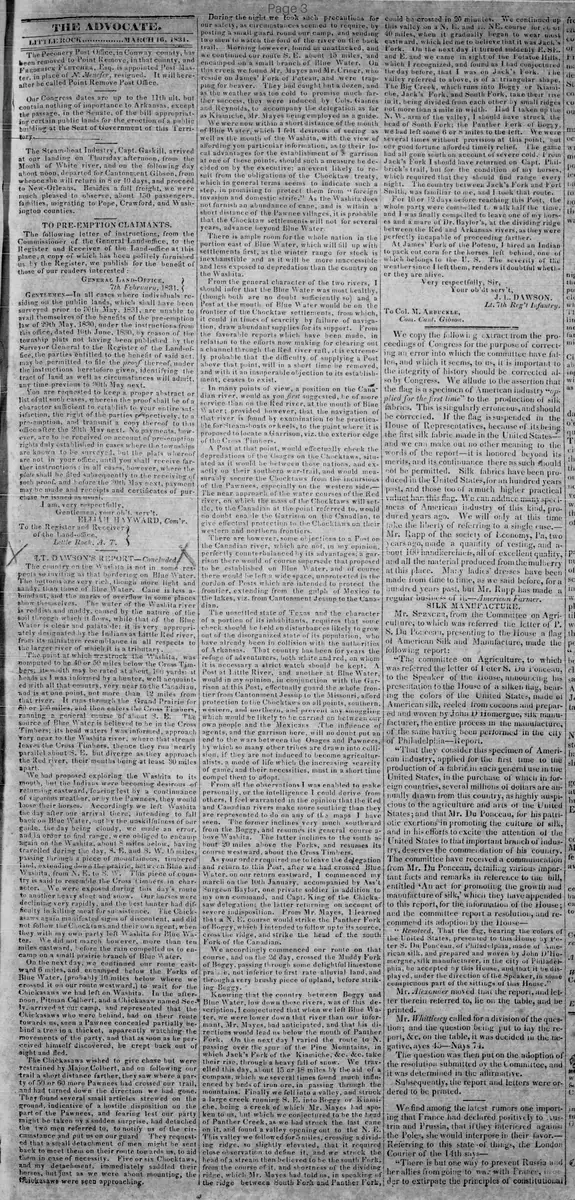
The country on the Washita is not in some respects so inviting as that bordering on Blue Water. The bottoms are very rich, though more light and sandy, than those of Blue Water. Cane is less abundant, and the marks of overflow in some places show themselves. The water of the Washita river is reddish and muddy, caused by the nature of the soil through which it flows, while that of the Blue Water is clear and palatable: it is very appropriately designated by the Indians as Little Red river, from its miniature resemblance in all respects to the larger river of which it is a tributary.
The point at which we struck the Washita, was computed to be 40 or 50 miles below the Cross Timbers: its width may be rated at about 100 yards: it heads as I was informed by a hunter, well acquainted with all that country, very near to the Canadian, and is at one point, not more than 12 miles from that river. It runs through the Grand Prairie for 80 or 100 miles, and then enters the Cross Timbers, running a general course of about S. E. The source of Blue Water is believed to be in the Cross Timbers; its head waters I was informed, approach very near to the Washita river, where that stream leaves the Cross Timbers, thence they run nearly parallel about S. E. but diverge as they approach the Red river, their mouths being at least 30 miles apart.
We had proposed exploring the Washita to its mouth, but the Indians were becoming desirous of returning eastward, fearing lest by a continuance of rigorous weather, or by the Pawnees, they would lose their horses. Accordingly we left Washita the day after our arrival there, intending to fall back on Blue Water, but by the unskilfulness of our guide, the day being cloudy, we made an error, and in order to find range, were obliged to encamp again on the Washita, about 8 miles below, having travelled during the day, S. E. and S. W. 15 miles, passing through a piece of mountainous, timbered land, extending down the prairie, between Blue and Washita, from N. E. to S. W. This piece of country is said to resemble the Cross Timbers in character. We were exposed during this day's route to another heavy sleet and snow. Our horses were declining very rapidly, and the best hunter had difficulty in killing meat for subsistence. The Chickasaws again manifested signs of discontent, and did not follow the Choctaws and their own agent, when they with my own party left Washita for Blue Water. We did not march however, more than ten miles eastward, before the rain compelled us to encamp on a small prairie branch of Blue Water.
On the next day, we continued our route eastward 6 miles, and encamped below the Forks of Blue Water, (probably 10 miles below where we crossed it on our route westward,) to wait for the Chickasaws we had left on Washita. In the afternoon, Pitman Calvert, and a Chickasaw named See-ly, arrived at our camp, and represented that the Chickasaws who were behind, had on their route towards us, seen a Pawnee concealed partially behind a tree in a thicket, apparently watching the movements of the party, and that as soon as he perceived himself discovered, he crept back out of sight and fled.
The Chickasaws wished to give chase but were restrained by Major Colbert, and on following our trail a short distance farther, they saw where a party of 50 or 60 more Pawnees had crossed our trail, and had turned down the direction we had gone. They found several small articles strewed on the ground, indicative of a hostile disposition on the part of the Pawnees, and fearing lest our party might be taken by a sudden surprise, had detached the two men referred to, to notify us of the circumstance and put us on our guard. They requested that a small detachment of men might be sent back to meet them on their route towards us, to aid them in case of necessity. Five or six Choctaws, and my detachment, immediately saddled their horses, but just as we were about mounting, the Chickasaws were seen approaching.
During the night we took such precautions for our safety, as circumstances seemed to require, by posting a small guard round our camp, and sending two men to watch the ford of the river on the back trail. Morning however, found us unattacked, and we continued our route S. E. about 15 miles, and encamped on a small branch of Blue Water. On this creek we found Mr. Mayes and Mr. Criner, who reside on James' Fork of Poteau, and were trapping for beaver. They had caught but a dozen, and as the weather was too cold to promise much further success, they were induced by Cols. Gaines and Reynolds, to accompany the delegation as far as Kiamiche, Mr. Mayes being employed as a guide.
We were now within a short distance of the mouth of Blue Water, which I felt desirous of seeing as well as the mouth of the Washita, with the view of affording you particular information, as to their local advantages for the establishment of a garrison at one of these points, should such a measure be decided on by the executive; an event likely to result from the obligations of the Choctaw treaty, which in general terms seems to indicate such a step, in promising to protect them from "foreign invasion and domestic strife." As the Washita does not furnish an abundance of cane, and is within a short distance of the Pawnee villages, it is probable that the Choctaw settlements will not for several years, advance beyond Blue Water.
There is ample room for the whole nation in the portion east of Blue Water, which will fill up with settlements first, as the winter range for stock is inexhaustible and as it will be more inaccessible and less exposed to depredation than the country on the Washita.
From the general character of the two rivers, I should infer that the Blue Water was most healthy, (though both are no doubt sufficiently so) and a Post at the mouth of Blue Water would be on the frontier of the Choctaw settlements, from which, it could in times of scarcity by failure of navigation, draw abundant supplies for its support. From the favorable reports which have been made, in relation to the efforts now making for clearing out a channel through the Red river raft, it is extremely probable that the difficulty of supplying a Post above that point, will in a short time be removed, and with it an insuperable objection to its establishment, ceases to exist.
In many points of view, a position on the Canadian river, would as you first suggested, be of more service than on the Red river, at the mouth of Blue Water; provided however, that the navigation of that river is found by examination to be practicable for Steam-boats or keels, to the point where it is proposed to locate a Garrison, viz. the exterior edge of the Cross Timbers.
A Post at that point, would effectually check the depredations of the Osages on the Choctaws, situated as it would be between those nations, and exactly on their southern war-trail, and would measurably secure the Choctaws from the incursions of the Pawnees, especially on the western side. The near approach of the water courses of the Red river, on which the mass of the Choctaws will settle, to the Canadian at the point referred to, would no doubt enable the Garrison on the Canadian, to give effectual protection to the Choctaws on their western and northern frontiers.
There are however, some objections to a Post on the Canadian river, which are not, in my opinion, perfectly counterbalanced by its advantages; a garrison there would of course supersede that proposed to be established on Blue Water, and of course there would be left a wide space, unprotected in the cordon of Posts which are intended to protect the frontier, extending from the gulph of Mexico to the lakes, viz. from Cantonment Jessup to the Canadian.
The unsettled state of Texas and the character of a portion of its inhabitants, requires that some check should be held on disturbances likely to grow out of the disorganized state of its population, who have already been in collision with the authorities of Arkansas. That country has been for years the refuge of adventurers, both white and red, on whom it is necessary a strict watch should be kept. A Post at Little River, and another at Blue Water, would in my opinion, in conjunction with the Garrison at this Post, effectually guard the whole frontier from Cantonment Jessup to the Missouri, afford protection to the Choctaws on all points, southern, western, and northern, and prevent any smuggling which would be likely to be carried on between our own people and the Mexicans. The influence of agents, and the garrison here, will no doubt put an end to the wars between the Osages and Pawnees, by which so many other tribes are drawn into collision, if they are not induced to become agriculturalists, a mode of life which the increasing scarcity of game, and their necessities, must in a short time compel them to adopt.
From all the observations I was enabled to make personally, or the intelligence I could derive from others, I feel warranted in the opinion that the Red and Canadian rivers make more southing than they are represented to do on any of the maps I have seen. The former inclines very much southward from the Boggy, and resumes its general course above Washita. The latter inclines to the south about 20 miles above the Forks, and resumes its course westward, about the Cross Timbers.
As your order required me to leave the delegation and return to this Post, after we had crossed Blue Water, on our return eastward, I commenced my march on the 10th January, accompanied by Ass't Surgeon Baylor, one private soldier in addition to my own command, and Capt. King of the Chickasaw delegation; the latter returning on account of severe indisposition. From Mr. Mayes, I learned that a N. E. course would strike the Panther Fork of Boggy, which I intended to follow up to its source, cross the ridge, and strike the head of the south Fork of the Canadian.
We accordingly commenced our route on that course, and on the 2d day, crossed the Muddy Fork of Boggy, passing through some delightful limestone prairie, not inferior to first rate alluvial land, and through a very brushy piece of upland, before striking Boggy. Knowing that the country between Boggy and Blue Water, low down those rivers, was of this description, I conjectured that when we left Blue Water, we were lower down that river than our informant, Mr. Mayes, had anticipated, and that his directions would lead us below the mouth of Panther Fork. On the next day I varied the route to N. passing over the spur of the Pine Mountains, in which Jack's Fork of the Kiamiche, &c. &c. take their rise, through a heavy fall of snow. We travelled this day, about 15 or 18 miles by the aid of a compass, which we several times found much influenced by beds of iron ore, in passing through the mountains. Finally we fell into a valley, and struck a large creek running S. E. into Boggy or Kiamiche, being a creek of which Mr. Mayes had spoken to us, but which we conjectured to be the head of Panther Creek, as we had struck the last cane on it, and found a valley opening out to the N. E.
This valley we followed for 8 miles, crossing a dividing ridge, so slightly elevated, that it required close observation to descry it, and we struck the head of a stream then believed to be the south Fork, from the course of it, and shortness of the dividing ridge, which Mr. Mayes had told us, in speaking of the ridge between South Fork and Panther Fork, could be crossed in 0 minutes. We continued up this valley on a N. E. and N. NE. course for 16 or 40 miles, when it gradually began to wear most eastward, which led me to believe that it was Jack's Fork. On the next day it turned suddenly E. SE. and E. and we came in sight of the Poteau Hills, which I recognized, and found as I had conjectured the day before, that I was on Jack's Fork. The valley referred to above, is of a triangular shape. The Big Creek, which runs into Boggy or Kiamiche, Jack's Fork, and South Fork, take their rise in it, being divided from each other by small ridges not more than a mile in width. Had I taken up the N. W. arm of the valley, I should have struck the head of South Fork; the Panther Fork of Boggy, we had left some 6 or 8 miles to the left. We were several times without provision at this point, but our good fortune afforded timely relief. The game had all gone south on account of severe cold. From Jack's Fork I should have returned on Capt. Philbrick's trail, but for the condition of my horses, which required that they should find range every night. The country between Jack's Fork and Fort Smith, was familiar to me, and I took that route.
For 10 or 12 days before reaching this Post, the whole party were compelled to walk half the time, and I was finally compelled to leave one of my horses and a mare of Dr. Baylor's, at the dividing ridge between the Red and Arkansas rivers, as they were perfectly incapable of proceeding farther.
At James' Fork of the Poteau, I hired an Indian to pack out corn for the horses left behind, one of which belongs to the U. S. The severity of the weather since I left them, renders it doubtful whether they are alive.
Very respectfully, Sir,
Your ob'dt serv't,
J. L. DAWSON.
Lt. 7th Reg't Infantry.
To Col. M. ARBUCKLE,
Com. Cant. Gibson.
What sub-type of article is it?
What keywords are associated?
What entities or persons were involved?
Where did it happen?
Domestic News Details
Primary Location
Washita River And Blue Water Regions
Event Date
10th January
Key Persons
Outcome
no human casualties; horses declined rapidly, some left behind due to weather and exhaustion; recommendations for military posts at blue water, canadian river, and little river to protect choctaws from osages and pawnees.
Event Details
Lt. Dawson reports on expedition exploring Washita and Blue Water rivers with Choctaw and Chickasaw delegations; describes terrain, water quality, and routes; notes near-encounter with Pawnees showing hostile intent; discusses advantages of sites for garrisons to fulfill Choctaw treaty protections; details return journey challenges including weather, navigation errors, and provisioning issues.