Thank you for visiting SNEWPapers!
Sign up free
Story
July 1, 1865
Sunbury American
Sunbury, Northumberland County, Pennsylvania
What is this article about?
General Grant discusses his policy of government retrenchment in Chicago, emphasizing reducing army expenses by selling excess horses and mules, discharging personnel, and shrinking the army to 100,000 troops by January, while retaining some for frontier and garrison duties.
Clipping
OCR Quality
95%
Excellent
Full Text
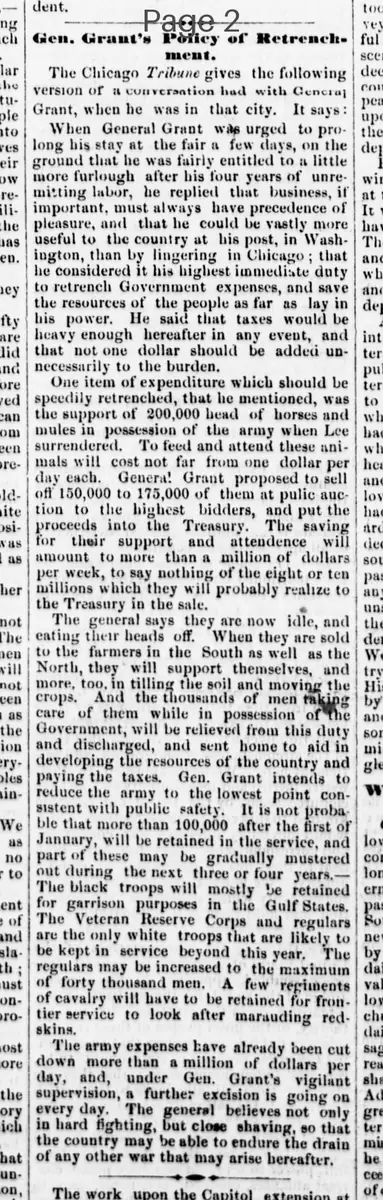
Gen. Grant's Policy of Retrenchment.
The Chicago Tribune gives the following version of a conversation had with General Grant, when he was in that city. It says:
When General Grant was urged to prolong his stay at the fair a few days, on the ground that he was fairly entitled to a little more furlough after his four years of unremitting labor, he replied that business, if important, must always have precedence of pleasure, and that he could be vastly more useful to the country at his post, in Washington, than by lingering in Chicago; that he considered it his highest immediate duty to retrench Government expenses, and save the resources of the people as far as lay in his power. He said that taxes would be heavy enough hereafter in any event, and that not one dollar should be added unnecessarily to the burden.
One item of expenditure which should be speedily retrenched, that he mentioned, was the support of 200,000 head of horses and mules in possession of the army when Lee surrendered. To feed and attend these animals will cost not far from one dollar per day each. General Grant proposed to sell off 150,000 to 175,000 of them at public auction to the highest bidders, and put the proceeds into the Treasury. The saving for their support and attendance will amount to more than a million of dollars per week, to say nothing of the eight or ten millions which they will probably realize to the Treasury in the sale.
The general says they are now idle, and eating their heads off. When they are sold to the farmers in the South as well as the North, they will support themselves, and more, too, in tilling the soil and moving the crops. And the thousands of men taking care of them while in possession of the Government, will be relieved from this duty and discharged, and sent home to aid in developing the resources of the country and paying the taxes. Gen. Grant intends to reduce the army to the lowest point consistent with public safety. It is not probable that more than 100,000 after the first of January, will be retained in the service, and part of these may be gradually mustered out during the next three or four years. The black troops will mostly be retained for garrison purposes in the Gulf States. The Veteran Reserve Corps and regulars are the only white troops that are likely to be kept in service beyond this year. The regulars may be increased to the maximum of forty thousand men. A few regiments of cavalry will have to be retained for frontier service to look after marauding red-skins.
The army expenses have already been cut down more than a million of dollars per day, and, under Gen. Grant's vigilant supervision, a further excision is going on every day. The general believes not only in hard fighting, but close shaving, so that the country may be able to endure the drain of any other war that may arise hereafter.
The Chicago Tribune gives the following version of a conversation had with General Grant, when he was in that city. It says:
When General Grant was urged to prolong his stay at the fair a few days, on the ground that he was fairly entitled to a little more furlough after his four years of unremitting labor, he replied that business, if important, must always have precedence of pleasure, and that he could be vastly more useful to the country at his post, in Washington, than by lingering in Chicago; that he considered it his highest immediate duty to retrench Government expenses, and save the resources of the people as far as lay in his power. He said that taxes would be heavy enough hereafter in any event, and that not one dollar should be added unnecessarily to the burden.
One item of expenditure which should be speedily retrenched, that he mentioned, was the support of 200,000 head of horses and mules in possession of the army when Lee surrendered. To feed and attend these animals will cost not far from one dollar per day each. General Grant proposed to sell off 150,000 to 175,000 of them at public auction to the highest bidders, and put the proceeds into the Treasury. The saving for their support and attendance will amount to more than a million of dollars per week, to say nothing of the eight or ten millions which they will probably realize to the Treasury in the sale.
The general says they are now idle, and eating their heads off. When they are sold to the farmers in the South as well as the North, they will support themselves, and more, too, in tilling the soil and moving the crops. And the thousands of men taking care of them while in possession of the Government, will be relieved from this duty and discharged, and sent home to aid in developing the resources of the country and paying the taxes. Gen. Grant intends to reduce the army to the lowest point consistent with public safety. It is not probable that more than 100,000 after the first of January, will be retained in the service, and part of these may be gradually mustered out during the next three or four years. The black troops will mostly be retained for garrison purposes in the Gulf States. The Veteran Reserve Corps and regulars are the only white troops that are likely to be kept in service beyond this year. The regulars may be increased to the maximum of forty thousand men. A few regiments of cavalry will have to be retained for frontier service to look after marauding red-skins.
The army expenses have already been cut down more than a million of dollars per day, and, under Gen. Grant's vigilant supervision, a further excision is going on every day. The general believes not only in hard fighting, but close shaving, so that the country may be able to endure the drain of any other war that may arise hereafter.
What sub-type of article is it?
Historical Event
Biography
What themes does it cover?
Triumph
Justice
What keywords are associated?
Grant Retrenchment
Army Reduction
Post Civil War Policy
Horse Sale
Troop Discharge
What entities or persons were involved?
Gen. Grant
Lee
Where did it happen?
Chicago, Washington
Story Details
Key Persons
Gen. Grant
Lee
Location
Chicago, Washington
Event Date
After The First Of January
Story Details
General Grant outlines his retrenchment policy, including selling excess army horses and mules, reducing troop numbers to 100,000 by January, retaining black troops for Gulf garrisons and cavalry for frontier, to cut expenses and aid national recovery.