Thank you for visiting SNEWPapers!
Sign up free
Pioche Daily Record
Pioche, Lincoln County, Nevada
What is this article about?
Mining review for Pioche district week ending Feb. 15, 1873: bullion and ore accumulate due to horse disease and bad roads hindering shipments and hauling; optimistic prospects with new deposits and improvements in mines like Silver Peak, Pioche, Excelsior; operations continue vigorously.
Clipping
OCR Quality
Full Text
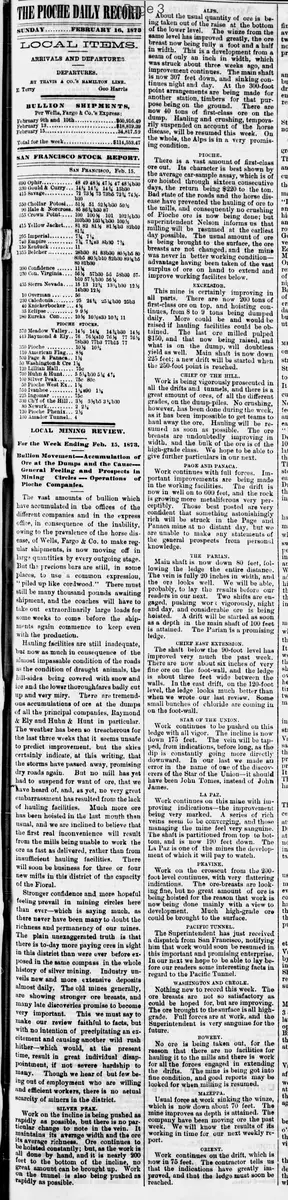
For the Week Ending Feb. 15, 1873.
Bullion Movement—Accumulation of Ore at the Dumps and the Cause.—General Feeling and Prospects in Mining Circles—Operations of Pioche Companies.
The vast amounts of bullion which have accumulated in the offices of the different companies and in the express office, in consequence of the inability, owing to the prevalence of the horse disease, of Wells, Fargo & Co. to make regular shipments, is now moving off in large quantities by every outgoing stage. But the precious bars are still, in some places, to use a common expression, "piled up like cordwood." There must still be many thousand pounds awaiting shipment, and the coaches will have to take out extraordinarily large loads for some weeks to come before the shipments again commence to keep even with the production.
Hauling facilities are still inadequate, but now as much in consequence of the almost impassable condition of the roads as the condition of draught animals, the hill-sides being covered with snow and ice and the lower thoroughfares badly cut up and very miry. There are tremendous accumulations of ore at the dumps of all the principal companies, Raymond & Ely and Huhn & Hunt in particular.
The weather has been so treacherous for the last three weeks that it seems unsafe to predict improvement, but the skies certainly indicate, at this writing, that the storms have passed away, promising dry roads again. But no mill has yet had to suspend for want of ore, that we have heard of, and, as yet, no very great embarrassment has resulted from the lack of hauling facilities. Much more ore has been hoisted in the last month than usual, and we are inclined to believe that the first real inconvenience will result from the mills being unable to work the ore as fast as delivered, rather than from insufficient hauling facilities.
There will soon be business for three or four new mills in this district of the capacity of the Floral.
Stronger confidence and more hopeful feeling prevail in mining circles here than ever—which is saying much, as there never have been many to doubt the richness and permanency of our mines. The plain unexaggerated truth is that there is to-day more paying ores in sight in this district than were ever before exposed in the same compass in the whole history of silver mining. Industry unveils new and more extensive deposits almost daily. The old mines generally, are showing stronger ore breasts, and many late discoveries promise to become very important.
This we must say to make our review faithful to facts, but with no intention of precipitating an excitement and causing another wild rush hither—which would, at the present time, result in great individual disappointment, if not severe hardship to many. Though we hear of but few being out of employment who are willing and efficient workers, there is no actual scarcity of miners in the district.
SILVER PEAK.
Work on the incline is being pushed as rapidly as possible, but there is no particular change to note in the vein. It maintains its average width and the ore its average richness. Ore continues to be hoisted constantly; but, as the work is all done by hand, and it is nearly 200 feet to the bottom of the incline, no great amount can be brought up. Work on the tunnel is also being pushed as rapidly as possible.
About the usual quantity of ore is being taken out of the raise at the bottom of the lower level. The winze from the same level has improved greatly, the ore breast now being fully a foot and a half in width. This is a development from a seam of only an inch in width, which was struck about three weeks ago, and improvement continues. The main shaft is now 307 feet down, and sinking continues night and day. At the 300-foot point arrangements are being made for another station, timbers for that purpose being on the ground. There are now 40 tons of first-class ore on the dump. Hauling and crushing, temporarily suspended on account of the horse disease, will be resumed this week. On the whole, the Alps is in a very promising condition.
PIOCHE.
There is a vast amount of first-class ore out. Its character is best shown by the average car-sample assay, which is of ore hoisted through sixteen consecutive days, the return being $220 to the ton.
Bad state of the roads and the horse disease have prevented the hauling of ore to the mills, and consequently no crushing of Pioche ore is now being done; but superintendent Nelson informs us that milling will be resumed at the earliest day possible. The usual amount of ore is being brought to the surface, the ore breasts are not changed, and the mine was never in better working condition—advantage having been taken of the vast surplus of ore on hand to extend and improve working facilities below.
EXCELSIOR.
This mine is certainly improving in all parts. There are now 200 tons of first-class ore on top, and hoisting continues, from 8 to 9 tons being dumped daily. More could be and would be raised if hauling facilities could be obtained. The last ore milled pulped $150, and that now being raised, and what is on the dump, will doubtless yield as well. Main shaft is now down 225 feet; a new drift will be started when the 250-foot point is reached.
CHIEF OF THE HILL.
Work is being vigorously prosecuted in all the drifts and tunnels, and there is a great amount of ores, of all the different grades, on the dump-piles. No crushing, however, has been done during the week, as it has been impossible to get teams to haul away the ore. Hauling will be resumed as soon as possible. The ore breasts are undoubtedly improving in width, and the bulk of the ore is of the high-grade class. We hope to be able to give further particulars in our next.
PAGE AND PANACA.
Work continues with full forces. Important improvements are being made in the working facilities. The drift is now in well on to 600 feet, and the rock is growing more metalliferous very perceptibly. Those best posted are very confident that something astonishingly rich will be struck in the Page and Panaca mine at no distant day, but we are unable to make any statements of the general prospects from personal knowledge.
THE PARIAN.
Main shaft is now down 80 feet, following the ledge the entire distance. The vein is fully 20 inches in width, and the ore looks well. We will be able, probably, to lay the results before our readers in our next. Two shifts are engaged, pushing work vigorously, night and day, and considerable ore is being hoisted. A drift will be started as soon as a depth in the main shaft of 100 feet is attained. The Parian is a promising ledge.
CHIEF EAST EXTENSION.
The shaft below the 90-foot level has improved very much the past week. There are now about six inches of very fine ore on the foot-wall, and the ledge is about three feet wide between the walls. In the east drift, on the 120-foot level, the ledge looks much better than when we wrote our last review. Some small bunches of chloride are coming in on the foot-wall.
STAR OF THE UNION.
Work continues to be pushed on this ledge with all vigor. The incline is now down 175 feet. The vein will be tapped, from indications, before long, as the dip is constantly going more directly downward. In our last we made an error in the name of one of the discoverers of the Star of the Union—it should have been John Tomes, instead of John James.
LA PAZ.
Work continues on this mine with improving indications—the improvement being very marked. A series of rich veins seem to be converging, and those managing the mine feel very sanguine. The shaft is partitioned from top to bottom, and is now 190 feet down. The La Paz is one of the mines the development of which it will pay to watch.
PEAVINE.
Work on the crosscut from the 200-foot level continues, with very flattering indications.
The ore-breasts are looking fine, but no great amount of ore is being hoisted for the reason that work is now being done mainly with a view to development. Much high-grade ore could be brought to the surface.
PACIFIC TUNNEL.
The Superintendent has just received a dispatch from San Francisco, notifying him that work would soon be resumed in this important and promising enterprise. In our next we hope to be able to lay before our readers some interesting facts in regard to the Pacific Tunnel.
WASHINGTON AND CREOLE.
Nothing new to record this week. The ore breasts are not so satisfactory as could be hoped for, but are improving. The ore brought to the surface is all high-grade. Full forces are at work, and the Superintendent is very sanguine for the future.
BOWERY.
No ore is being taken out, for the reason that there are no facilities for hauling it to the mills and there is work for all the forces engaged in extending the drifts. The mine is being got into fine condition, and good reports may be looked for when milling is resumed.
MAZEPPA.
Usual force at work sinking the winze, which is now down about 70 feet. The mine improves as depth is attained. The company have been moving ore the past week. We will know the results of its working in time for our next weekly report.
ORIENT.
Work continues on the drift, which is now in 75 feet. The contractor tells us that the indications have greatly improved, and that the ledge must soon be reached.
What sub-type of article is it?
What themes does it cover?
What keywords are associated?
What entities or persons were involved?
Where did it happen?
Story Details
Key Persons
Location
Pioche Mining District
Event Date
Week Ending Feb. 15, 1873
Story Details
Bullion and ore accumulate due to horse disease and poor roads delaying shipments and hauling; no mills suspend operations; strong confidence in district's rich mines with daily new deposits; updates on Silver Peak (improved winze, 40 tons ore), Pioche (vast ore, $220/ton assay), Excelsior (200 tons ore, improving), and other mines showing progress and promising indications.