Thank you for visiting SNEWPapers!
Sign up free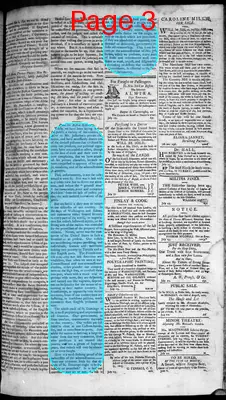
Editorial
July 23, 1805
Alexandria Daily Advertiser
Alexandria, Virginia
What is this article about?
Editorial from Boston Repertory criticizes Jefferson's administration for neglecting American commerce, contrasting it with protections under Washington and Adams; highlights plundering by French and issues with St. Domingo trade, calling it weak and unjust.
Clipping
OCR Quality
98%
Excellent
Full Text
From the Boston Repertory.
While we have been laying before the public a variety of documents, relative to Mr. Jefferson's private character, and have necessarily drawn one of the darkest pictures that civilized society can produce, our political opponents have not ceased to assert, though in the face of truth and their own recent complaints, that we have attacked his private character, because we were compelled to approve of his public measures, and of the administration in general.
This, unfortunately, is not the case; would it were so. Nor was it said with any other view but to divert our attention, and rescue the "greatest man" "the immaculate, pious and exemplary President" from the lash of public justice, the well merited lacerations of the press.
But we feel it a duty now to return to the distresses of our country. In the days of Washington and Adams, our commerce either floated securely to every part of the world, or negotiation for redress followed injury, or the strong arm of the nation was extended for the protection of the property of its citizens. Never, never was the commerce of the United States in such a situation as at present. Our vessels are mouldering, cargoes perishing, and individuals, seamen and merchants sinking into poverty in Tortola and other English ports. The French exercise a rapacity not less ferocious and vindictive than when we were at war. Commissioned and non-commissioned cruisers, either plunder our countrymen on the high seas, or conduct them into port, where with a mock trial or perhaps with none, they are despoiled, and turned out like vagrants, dependent on hospitality for the means of returning to their native country. In Guadaloupe, as appears by very recent accounts, some of our countrymen are suffering, in loathsome prisons, worse treatment than English prisoners of war.
The whole trade of St. Domingo is in a most perplexing and unprecedented situation. Our government, in some measure, countenances the trade to that country. Our vessels are suffered to clear at our Custom-houses, for, and to enter from its ports. And while the nation is deriving a large income from that very commerce, those who prosecute it are treated like pirates, and not a gleam of hope appears, that redress will ever be obtained or even sought.
Here is a most striking proof of the imbecility of the administration. Does not common sense say that the trade of St. Domingo ought to be forbidden or protected? It is said our merchants may go or not; the risk is of their own choosing. And pray is not this the very state of a people without government. These vessels go to St. Domingo; if they return, government exacts duties on the cargo, as well as on those which are protected; if they are plundered or captured, condemned or destroyed, government refuses all relationship. This is one feature in the administration of Mr. Jefferson, which we presume, every man of sense and information must condemn as weak, unjust, and disgraceful; and tending to destroy that confidence in government, so essential to the happiness of the country.
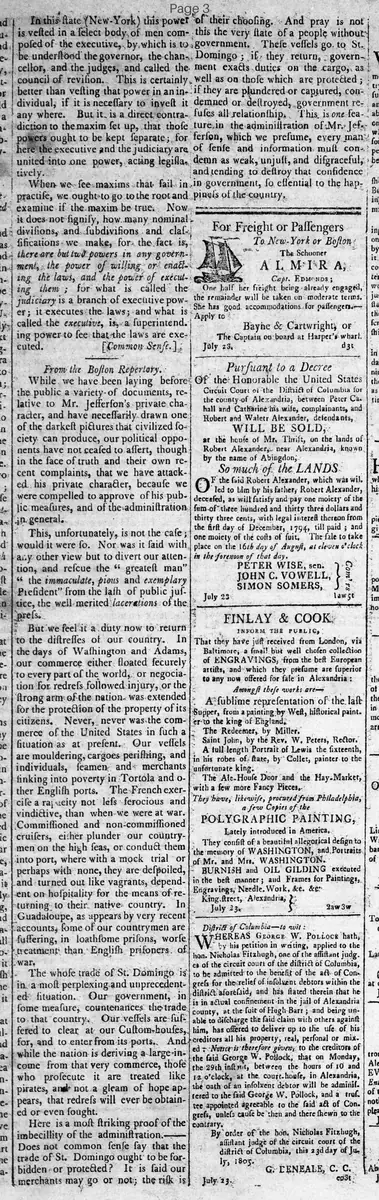
While we have been laying before the public a variety of documents, relative to Mr. Jefferson's private character, and have necessarily drawn one of the darkest pictures that civilized society can produce, our political opponents have not ceased to assert, though in the face of truth and their own recent complaints, that we have attacked his private character, because we were compelled to approve of his public measures, and of the administration in general.
This, unfortunately, is not the case; would it were so. Nor was it said with any other view but to divert our attention, and rescue the "greatest man" "the immaculate, pious and exemplary President" from the lash of public justice, the well merited lacerations of the press.
But we feel it a duty now to return to the distresses of our country. In the days of Washington and Adams, our commerce either floated securely to every part of the world, or negotiation for redress followed injury, or the strong arm of the nation was extended for the protection of the property of its citizens. Never, never was the commerce of the United States in such a situation as at present. Our vessels are mouldering, cargoes perishing, and individuals, seamen and merchants sinking into poverty in Tortola and other English ports. The French exercise a rapacity not less ferocious and vindictive than when we were at war. Commissioned and non-commissioned cruisers, either plunder our countrymen on the high seas, or conduct them into port, where with a mock trial or perhaps with none, they are despoiled, and turned out like vagrants, dependent on hospitality for the means of returning to their native country. In Guadaloupe, as appears by very recent accounts, some of our countrymen are suffering, in loathsome prisons, worse treatment than English prisoners of war.
The whole trade of St. Domingo is in a most perplexing and unprecedented situation. Our government, in some measure, countenances the trade to that country. Our vessels are suffered to clear at our Custom-houses, for, and to enter from its ports. And while the nation is deriving a large income from that very commerce, those who prosecute it are treated like pirates, and not a gleam of hope appears, that redress will ever be obtained or even sought.
Here is a most striking proof of the imbecility of the administration. Does not common sense say that the trade of St. Domingo ought to be forbidden or protected? It is said our merchants may go or not; the risk is of their own choosing. And pray is not this the very state of a people without government. These vessels go to St. Domingo; if they return, government exacts duties on the cargo, as well as on those which are protected; if they are plundered or captured, condemned or destroyed, government refuses all relationship. This is one feature in the administration of Mr. Jefferson, which we presume, every man of sense and information must condemn as weak, unjust, and disgraceful; and tending to destroy that confidence in government, so essential to the happiness of the country.
What sub-type of article is it?
Trade Or Commerce
Foreign Affairs
Partisan Politics
What keywords are associated?
Jefferson Administration
American Commerce
St Domingo Trade
French Plundering
Political Criticism
What entities or persons were involved?
Mr. Jefferson
Washington
Adams
French
St. Domingo
Editorial Details
Primary Topic
Critique Of Jefferson's Commerce Policies
Stance / Tone
Strongly Critical Of Administration's Imbecility
Key Figures
Mr. Jefferson
Washington
Adams
French
St. Domingo
Key Arguments
Commerce Unprotected Unlike Under Washington And Adams
Vessels Plundered By French Cruisers
Trade To St. Domingo Countenanced But Not Protected
Government Collects Duties But Denies Responsibility For Losses
Administration Weak, Unjust, And Disgraceful