Thank you for visiting SNEWPapers!
Sign up free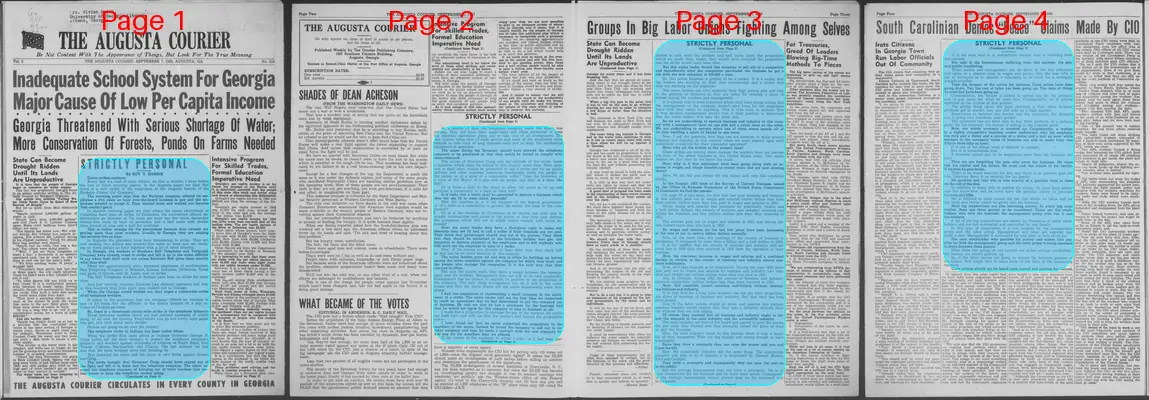
The Augusta Courier
Augusta, Richmond County, Georgia
What is this article about?
Editorial by Roy V. Harris criticizes ongoing union strikes across industries like cotton oil, electricians, plumbers, and telephone workers, highlighting demands exceeding offers, government intervention in Indiana, and economic pressures on businesses and owners from rising wages and declining profits, arguing unions create hatred and rackets that harm the economy.
Merged-components note: Multi-page continuation of the 'STRICTLY PERSONAL' editorial by Roy V. Harris spanning pages 1, 2, 3, and 4.
Clippings
1 of 4
OCR Quality
Full Text
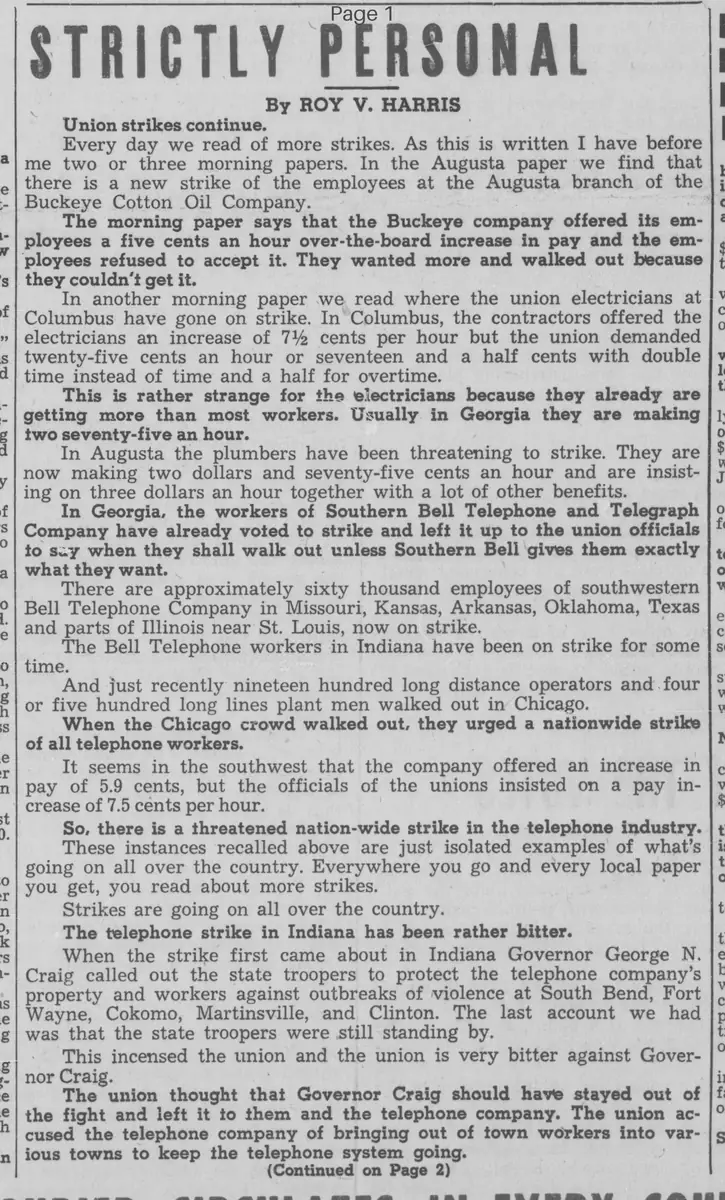
By ROY V. HARRIS
Union strikes continue.
Every day we read of more strikes. As this is written I have before me two or three morning papers. In the Augusta paper we find that there is a new strike of the employees at the Augusta branch of the Buckeye Cotton Oil Company.
The morning paper says that the Buckeye company offered its employees a five cents an hour over-the-board increase in pay and the employees refused to accept it. They wanted more and walked out because they couldn't get it.
In another morning paper we read where the union electricians at Columbus have gone on strike. In Columbus, the contractors offered the electricians an increase of 7 1/2 cents per hour but the union demanded twenty-five cents an hour or seventeen and a half cents with double time instead of time and a half for overtime.
This is rather strange for the electricians because they already are getting more than most workers. Usually in Georgia they are making two seventy-five an hour.
In Augusta the plumbers have been threatening to strike. They are now making two dollars and seventy-five cents an hour and are insisting on three dollars an hour together with a lot of other benefits.
In Georgia, the workers of Southern Bell Telephone and Telegraph Company have already voted to strike and left it up to the union officials to say when they shall walk out unless Southern Bell gives them exactly what they want.
There are approximately sixty thousand employees of Southwestern Bell Telephone Company in Missouri, Kansas, Arkansas, Oklahoma, Texas and parts of Illinois near St. Louis, now on strike.
The Bell Telephone workers in Indiana have been on strike for some time.
And just recently nineteen hundred long distance operators and four or five hundred long lines plant men walked out in Chicago.
When the Chicago crowd walked out, they urged a nationwide strike of all telephone workers.
It seems in the southwest that the company offered an increase in pay of 5.9 cents, but the officials of the unions insisted on a pay increase of 7.5 cents per hour.
So, there is a threatened nation-wide strike in the telephone industry.
These instances recalled above are just isolated examples of what's going on all over the country. Everywhere you go and every local paper you get, you read about more strikes.
Strikes are going on all over the country.
The telephone strike in Indiana has been rather bitter.
When the strike first came about in Indiana Governor George N. Craig called out the state troopers to protect the telephone company's property and workers against outbreaks of violence at South Bend, Fort Wayne, Kokomo, Martinsville, and Clinton.
The last account we had was that the state troopers were still standing by.
This incensed the union and the union is very bitter against Governor Craig.
The union thought that Governor Craig should have stayed out of the fight and left it to them and the telephone company. The union accused the telephone company of bringing out of town workers into various towns to keep the telephone system going.
As a matter of fact, the telephone company knew the strike was coming. They did train their supervisory and office personnel to keep the essential operations going and to take care of all emergencies. The dial system takes care of local service and most of the employees were trained to take care of long distance calls and to keep the mechanical equipment in operation.
The union thinks the Governor should have allowed the telephone company to be paralyzed so that they would be forced to comply with union demands.
The action of Governor Craig and the attitude of the union raises a question which must be settled in this country some time. That question is shall labor unions be permitted to call a strike and tie up public utilities and other essential industries indefinitely while the people of the nation or of a state or a community suffer? Does the Governor of a state or the Mayor of a city owe his people any duty at a time like this?
Or is there a duty to the union to allow the union to tie up and paralyze a community or a state at their will?
Is it right that a union shall be permitted to destroy a business which does not see fit to meet union demands?
Now the question is, is it the business of the federal government or of a state or a community to protect the nation, the state or the community?
Or is it the business of Governors to let unions run wild and to cripple communities and states or the nation so that they may destroy the companies which will not or which cannot comply with union demands?
Now, the union thinks they have a God-given right to make any demands they see fit and to call a strike if their demands are not met.
They think that government should stay out of the picture. They think that they should be permitted to use brickbats, bullets, tear gas, and dynamite to destroy property of the employers and to kill anybody who will work for the employer in time of a strike.
Now, if the unions are allowed to have their way, then there will be and can be no more business in this country.
The union leaders grow fat and stay in office by building up hatred among the union members against the company for which they work and the people who manage the companies. It is the only way that they can stay in office.
The way the unions work, they drive a wedge between the management and the workers. Management dare not talk to its own employees.
Management has no chance to explain its position to the employees of the company. The only thing management can do is talk to the union bosses and then the union bosses tell the union membership what they please.
I had one experience in representing a small company in the settlement of a strike. The union leader told me the first time we undertook to reach an agreement that he had determined to put the company out of business. He told me that he had a purchaser for the business and that he would not agree for this company to stay in business at all.
I made him a proposition to increase the pay of the workers. He called me back later and told me that the workers had turned the proposition down.
I later found out that he never submitted the proposition to the members of the union. Instead he forced the company to sell out to another company and then he made a contract with the new company for less pay for his members than we offered.
If the owner of the company to which I refer, or I, had been permitted to talk directly to the employees, the strike would have been averted and the employees would have received more pay than they finally got.
mitted to talk with the strikers and had made them the proposition which we made their leader, they would have accepted the proposition and the strike would have been over.
But this union leader forced this company to sell out to a competitor and immediately after the competitor purchased the business he got a job with the new company at $10,000 a year.
So, this union business is getting to be a racket. It is a racket that the leaders are working on their own membership and a racket that they are working on the employer.
The union leaders can only maintain their high paying jobs and stay in the position of directors as they are today by creating a spirit of hatred among the workers and management.
It is already true in most industries where they have strong unions that the management of the company doesn't dare even let the employees know how they stand on anything. This is true even in politics. This is true because management knows that if their position is discovered that the union leaders will take the other side.
So we are undertaking to operate business and industry in this country with a management team on one side and a union team on the other.
We are undertaking to operate when one of these teams spends all of its time building a spirit of hatred in one team.
Now, I ask the question, how long can we continue to build private business and industry in this country when we must depend upon such intolerable conditions for their successful operation?
Now, why all the strikes at the present time?
These strikes are coming about because the workers have not learned the facts of life about business in the United States today. The union leaders see that they do not know the truth.
Now, why is it that employers have been going along with an increase in wages and fringe benefits in recent years and are now slowing down?
Now, let me tell you where the rub comes and why this condition exists.
In the August, 1953 issue of the Survey of Current Business, issued by the Office of Business Economics of the United States Department of Commerce, we find the answer.
On page 15 of this issue, we find that last year business and industry in this country paid out in wages and salaries twelve billion four hundred million dollars more than was paid in wages and salaries in 1951.
While wages and salaries had increased by practically twelve and a half billion dollars, the owners of business and industry received one billion six hundred and five million dollars less than they received in 1951.
The amount paid out in wages and salaries in 1951 was eleven billion dollars more than was paid in 1950.
So, wages and salaries for the last few years have been increasing at the rate of ten to twelve billion dollars annually.
Now, at the same time, the earnings of the owners of business is decreasing. It decreased by more than a billion and a half dollars in 1952.
It is my opinion that the owners of business and industry will receive less in 1953 than they received in 1952 from the operation of their business.
Now, the continual increase in wages and salaries and a continual decline in returns to the owners of business and industry cannot continue indefinitely.
Now, let's take Georgia as an illustration. During the year 1952 there was paid out in wages and salaries by business and industry two hundred and twenty-one million dollars more than was paid in 1951.
Yet, in Georgia, during 1952 the owners of business and industry received eighty-four million dollars less than they received in 1951.
Now, this condition cannot continue indefinitely without destroying business and industry.
It is true that for a long time, workers did not get their proportionate share of earnings of business and industry. But that time has long since passed.
Now if the labor unions would sit down and analyze this picture, common honesty would require that they take a different attitude from the attitude they are now taking.
Of course, they contend that all business and industry ought to follow the example of the steel industry and the automobile industry.
The steel industry sat around the board and agreed to give the unions the pay scale they wanted and then promptly raised the price of steel to pay the increase.
Now, the steel industry could do this because there is only a handful of steel companies. They are big enough and strong enough to have a monopoly.
Since they have a monopoly they can raise the money and you and I foot the bill.
Now, the automobile industry did the same thing. The automobile industry was able to do it because it is dominated by General Motors, Ford and Chrysler.
They have a monopoly and consequently they can pass the cost on to the public.
But the average businessman does not have a monopoly. He is in keen competition for his business and he must meet prices. Consequently the average businessman cannot always pass on his increased cost to the public.
It is the man who is in competitive market who is suffering from this squeeze.
Not only is the businessman suffering from this squeeze, the general public is suffering.
When unions and management can sit down in the key industries and agree on a general raise in wages and prices, then the man who is not so fortunate as to operate a monopoly or to work for a monopoly is made to suffer.
Take the farmers of the nation for instance. Farm prices have been going down. Yet, the cost of labor has been going up. The costs of things he must buy have been going up.
Consequently, the farmer is forced to accept less for his products and to pay more for what he must buy. Consequently, he is getting squeezed in the middle of this picture.
The pitiful thing about the farm situation is that when farmers' products get to market they are still sold on a high market.
Somewhere in between the farmer and the consumer, the farmer's loss is going into somebody else's pocket.
The consumer has not been able to buy farm products at a reduced price. On the contrary, the farmer is selling at the reduced price.
Now, our whole economy is screwed up. Consequently, a worker in a highly competitive business cannot understand why his employer can only pay a dollar and a quarter or a dollar and a half an hour while workers in the monopoly types of business are able to make from two fifty to three fifty an hour.
It is one of the things what is difficult to explain.
But it is nevertheless true.
A business cannot pay to its employees more than the business can earn.
Then we are forgetting by the man who owns the business. He must risk his capital and his future. He must risk the future of his family.
If he loses he goes broke.
There is no social security for him and there is no pension plan for him. Likewise there is no security for his family.
He gambles and may win or lose exactly as a gambler wins or loses on the roll of the dice.
In addition to being able to gamble his money, he must have ability and the know-how and he must have the peculiar ability to generate business and jobs.
He is entitled to some return for his risk which he takes and for the work and brains which he plows into his business.
Most big corporations are also becoming screwy. In every big corporation there are three groups to be considered. There are the stockholders who own the business, the management group who run it and the workers.
A lot of the big corporations are owned by thousands of small stockholders and are not dominated and controlled by one family.
In this type of corporation it is run entirely by the management group and the labor group. Management and labor get together and make a deal. Management is well-cared for and labor is well-cared for.
The poor stockholder who gambles his money and makes jobs possible for both the management group and the labor group is being squeezed to death between these groups.
What these two groups do not squeeze out of the average stockholder, the income tax crowd gathers up.
So, if the labor unions are going to dictate the business policies of the nation, they ought first to learn some of the facts of life concerning business.
Their actions should not be based upon hatred and nothing but hatred.
What sub-type of article is it?
What keywords are associated?
What entities or persons were involved?
Editorial Details
Primary Topic
Criticism Of Union Strikes And Economic Impacts On Business
Stance / Tone
Anti Union And Pro Business
Key Figures
Key Arguments