Thank you for visiting SNEWPapers!
Sign up free
Story
November 29, 1841
New York Tribune
New York, New York County, New York
What is this article about?
Jared Sparks' lecture details the evolution of colonial paper money, from Massachusetts' innovations to the Continental bills issued during the Revolution, their rapid depreciation, and the patriotic endurance of the populace amid economic hardships.
Clipping
OCR Quality
98%
Excellent
Full Text
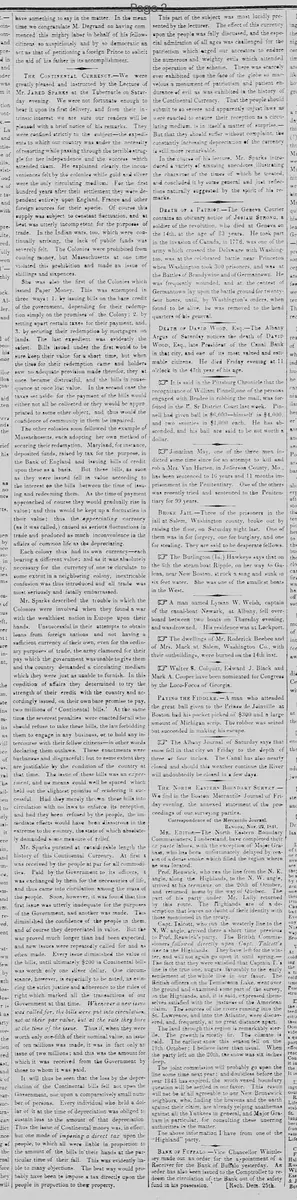
The Continental Currency.—We were greatly pleased and instructed by the Lecture of Mr. Jared Sparks at the Tabernacle on Saturday evening. We were not fortunate enough to hear it upon its first delivery, and from their intrinsic interest we are sure our readers will be pleased with a brief notice of his remarks. They were confined strictly to the subject—the expedients to which our country was under the necessity of resorting while passing through the terrible struggle for her independence and the success which attended them. He explained clearly the inconveniences felt by the colonies while gold and silver were the only circulating medium. For the first hundred years after their settlement they were dependent entirely upon England, France and other foreign sources for their specie. Of course this supply was subject to constant fluctuation, and at best was utterly incompetent for the purposes of trade. In the Indian wars, too, which were continually arising, the lack of public funds was severely felt. The Colonies were prohibited from coining money, but Massachusetts at one time violated this prohibition and made an issue of shillings and sixpences.
She was also the first of the Colonies which issued Paper Money. This was attempted in three ways; 1. by issuing bills on the bare credit of the government, depending for their redemption simply on the promises of the Colony: 2. by setting apart certain taxes for their payment, and, 3. by securing their redemption by mortgages on lands. The last expedient was evidently the safest. Bills issued under the first would to be sure keep their value for a short time, but when the time for their redemption came and holders saw no adequate provision made therefor, they at once became distrustful, and the bills in consequence at once lost value. In the second case the taxes set aside for the payment of the bills would either not all be collected or they would be appropriated to some other object, and thus would the confidence of community in them be impaired.
The other colonies soon followed the example of Massachusetts, each adopting her own method of securing their redemption. Maryland, for instance, deposited funds, raised by tax for the purpose, in the Bank of England and issuing bills of credit upon these as a basis. But these bills, as soon as they were issued fell in value according to the interest on the bills between the time of issuing and redeeming them. As the time of payment approached of course they would gradually rise in value; and thus would be kept up a fluctuation in their value; thus the appreciating currency (as it was called,) caused as serious fluctuations in trade and produced as much inconvenience in the affairs of common life as the depreciating.
Each colony thus had its own currency—each bearing a different value; and as it was absolutely necessary for the currency of one to circulate to some extent in a neighboring colony, inextricable confusion was thus introduced and all trade was most seriously and fatally embarrassed.
Mr. Sparks described the trouble in which the Colonies were involved when they found a war with the wealthiest nation in Europe upon their hands. Unsuccessful in their attempts to obtain loans from foreign nations and not having a sufficient currency of their own, even for the ordinary purposes of trade, the army clamored for their pay which the government was unable to give them and the country demanded a circulating medium which they were just as unable to furnish. In this condition of affairs they determined to try the strength of their credit with the country and accordingly issued, on their own bare promise to pay, two millions of 'Continental bills.' At the same time the severest penalties were enacted for all who should refuse to take these bills, the law forbidding them to engage in any business, or to hold any intercourse with their fellow citizens—in other words declaring them outlaws. These enactments were barbarous and disgraceful; but to some extent they are justifiable by the condition of the country at that time. The issue of these bills was an experiment, and no means could well be spared which held out the slightest promise of rendering it successful. Had they merely thrown these bills into circulation with no laws to enforce its reception, and had they been refused by the people, the immediate effects would have been disastrous in the extreme to the country, the state of which absolutely demanded some measure of relief.
Mr. Sparks pursued at considerable length the history of this Continental Currency. At first it was received by the people at par for all commodities. Paid by the Government to its officers, it was exchanged by them for the necessaries of life, and thus came into circulation among the mass of the people. Soon, however, it was found that this first issue was utterly inadequate for the purposes of the Government, and another was made. This diminished the confidence of the people in them, and of course they depreciated in value. But the war proved much longer than had been expected, and new issues were repeatedly called for and as often made. Every issue diminished the value of the bills, until ultimately $200 in Continental bills was worth only one silver dollar. One circumstance, however, is especially to be noted, as evincing the strict justice and adherence to the rules of right which marked all the transactions of our Government at that time. Whenever a new issue was called for, the bills were put into circulation, not at their par value, but at the rate they bore at the time of the issue. Thus if, when they were worth only one-fifth of their nominal value, an issue of ten millions was made, it was in fact only an issue of two millions; and this was the amount for which it was received from the Government by those to whom it was paid.
It will thus be seen that the loss by the depreciation of the Continental bills fell not upon the Government, nor upon a comparatively small number of persons. Every individual who held a dollar of it at the time of depreciation was obliged to sustain loss to the amount of that depreciation. Thus the issue of Continental money was, in effect, but one mode of imposing a direct tax upon the people, to which all were liable in proportion to the amount of the bills in their hands at the particular time of their fall. This was evidently liable to many objections. The best way would probably have been to impose a tax directly upon the people in proportion to their property.
This part of the subject was most lucidly presented by the lecturer. The effect of this currency upon the people was fully discussed, and the especial admiration of all ages was challenged for the patriotism which urged our ancestors to endure the numerous and weighty evils which attended the operation of the scheme. There was scarcely ever exhibited upon the face of the globe so marvelous a monument of patriotism and patient endurance of evil as was exhibited in the history of the Continental Currency. That the people should submit to so severe and apparently unjust laws as were enacted to ensure their reception as a circulating medium, is in itself a matter of surprise.—But that they should suffer without complaint, the constantly increasing depreciation of the currency is still more remarkable.
In the course of his lecture, Mr. Sparks introduced a variety of amusing anecdotes illustrating the character of the times of which he treated, and concluded it by some general and just reflections naturally suggested by the spirit of his remarks.
She was also the first of the Colonies which issued Paper Money. This was attempted in three ways; 1. by issuing bills on the bare credit of the government, depending for their redemption simply on the promises of the Colony: 2. by setting apart certain taxes for their payment, and, 3. by securing their redemption by mortgages on lands. The last expedient was evidently the safest. Bills issued under the first would to be sure keep their value for a short time, but when the time for their redemption came and holders saw no adequate provision made therefor, they at once became distrustful, and the bills in consequence at once lost value. In the second case the taxes set aside for the payment of the bills would either not all be collected or they would be appropriated to some other object, and thus would the confidence of community in them be impaired.
The other colonies soon followed the example of Massachusetts, each adopting her own method of securing their redemption. Maryland, for instance, deposited funds, raised by tax for the purpose, in the Bank of England and issuing bills of credit upon these as a basis. But these bills, as soon as they were issued fell in value according to the interest on the bills between the time of issuing and redeeming them. As the time of payment approached of course they would gradually rise in value; and thus would be kept up a fluctuation in their value; thus the appreciating currency (as it was called,) caused as serious fluctuations in trade and produced as much inconvenience in the affairs of common life as the depreciating.
Each colony thus had its own currency—each bearing a different value; and as it was absolutely necessary for the currency of one to circulate to some extent in a neighboring colony, inextricable confusion was thus introduced and all trade was most seriously and fatally embarrassed.
Mr. Sparks described the trouble in which the Colonies were involved when they found a war with the wealthiest nation in Europe upon their hands. Unsuccessful in their attempts to obtain loans from foreign nations and not having a sufficient currency of their own, even for the ordinary purposes of trade, the army clamored for their pay which the government was unable to give them and the country demanded a circulating medium which they were just as unable to furnish. In this condition of affairs they determined to try the strength of their credit with the country and accordingly issued, on their own bare promise to pay, two millions of 'Continental bills.' At the same time the severest penalties were enacted for all who should refuse to take these bills, the law forbidding them to engage in any business, or to hold any intercourse with their fellow citizens—in other words declaring them outlaws. These enactments were barbarous and disgraceful; but to some extent they are justifiable by the condition of the country at that time. The issue of these bills was an experiment, and no means could well be spared which held out the slightest promise of rendering it successful. Had they merely thrown these bills into circulation with no laws to enforce its reception, and had they been refused by the people, the immediate effects would have been disastrous in the extreme to the country, the state of which absolutely demanded some measure of relief.
Mr. Sparks pursued at considerable length the history of this Continental Currency. At first it was received by the people at par for all commodities. Paid by the Government to its officers, it was exchanged by them for the necessaries of life, and thus came into circulation among the mass of the people. Soon, however, it was found that this first issue was utterly inadequate for the purposes of the Government, and another was made. This diminished the confidence of the people in them, and of course they depreciated in value. But the war proved much longer than had been expected, and new issues were repeatedly called for and as often made. Every issue diminished the value of the bills, until ultimately $200 in Continental bills was worth only one silver dollar. One circumstance, however, is especially to be noted, as evincing the strict justice and adherence to the rules of right which marked all the transactions of our Government at that time. Whenever a new issue was called for, the bills were put into circulation, not at their par value, but at the rate they bore at the time of the issue. Thus if, when they were worth only one-fifth of their nominal value, an issue of ten millions was made, it was in fact only an issue of two millions; and this was the amount for which it was received from the Government by those to whom it was paid.
It will thus be seen that the loss by the depreciation of the Continental bills fell not upon the Government, nor upon a comparatively small number of persons. Every individual who held a dollar of it at the time of depreciation was obliged to sustain loss to the amount of that depreciation. Thus the issue of Continental money was, in effect, but one mode of imposing a direct tax upon the people, to which all were liable in proportion to the amount of the bills in their hands at the particular time of their fall. This was evidently liable to many objections. The best way would probably have been to impose a tax directly upon the people in proportion to their property.
This part of the subject was most lucidly presented by the lecturer. The effect of this currency upon the people was fully discussed, and the especial admiration of all ages was challenged for the patriotism which urged our ancestors to endure the numerous and weighty evils which attended the operation of the scheme. There was scarcely ever exhibited upon the face of the globe so marvelous a monument of patriotism and patient endurance of evil as was exhibited in the history of the Continental Currency. That the people should submit to so severe and apparently unjust laws as were enacted to ensure their reception as a circulating medium, is in itself a matter of surprise.—But that they should suffer without complaint, the constantly increasing depreciation of the currency is still more remarkable.
In the course of his lecture, Mr. Sparks introduced a variety of amusing anecdotes illustrating the character of the times of which he treated, and concluded it by some general and just reflections naturally suggested by the spirit of his remarks.
What sub-type of article is it?
Historical Event
Curiosity
What themes does it cover?
Misfortune
Bravery Heroism
Triumph
What keywords are associated?
Continental Currency
Paper Money
American Revolution
Currency Depreciation
Colonial Finance
What entities or persons were involved?
Jared Sparks
Where did it happen?
The Colonies
Story Details
Key Persons
Jared Sparks
Location
The Colonies
Event Date
During The American Revolution
Story Details
Jared Sparks lectures on the history of colonial paper money issuance, its methods and issues, leading to the Continental bills during the Revolutionary War, their depreciation, and the patriotism endured by the people.