Thank you for visiting SNEWPapers!
Sign up free
Letter to Editor
September 8, 1950
Minneapolis Spokesman
Minneapolis, Hennepin County, Minnesota
What is this article about?
Opinion piece asserts that Supreme Court rulings on segregation and labor reflect evolving public will in a democracy, urging widespread advocacy for equality, security, and justice to influence judicial outcomes.
Clipping
OCR Quality
100%
Excellent
Full Text
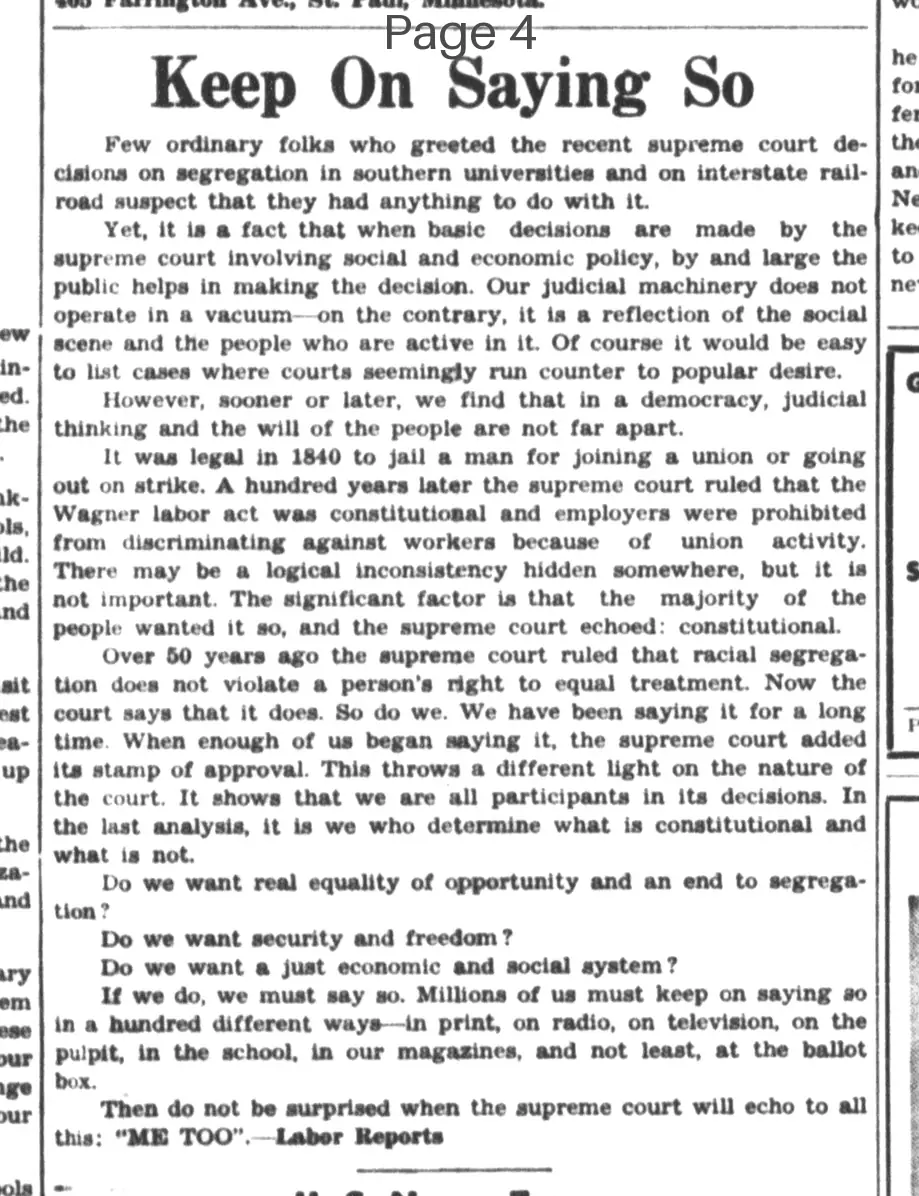
Keep On Saying So
Few ordinary folks who greeted the recent supreme court decisions on segregation in southern universities and on interstate railroad suspect that they had anything to do with it.
Yet, it is a fact that when basic decisions are made by the supreme court involving social and economic policy, by and large the public helps in making the decision. Our judicial machinery does not operate in a vacuum-on the contrary, it is a reflection of the social scene and the people who are active in it. Of course it would be easy to list cases where courts seemingly run counter to popular desire.
However, sooner or later, we find that in a democracy, judicial thinking and the will of the people are not far apart.
It was legal in 1840 to jail a man for joining a union or going out on strike. A hundred years later the supreme court ruled that the Wagner labor act was constitutional and employers were prohibited from discriminating against workers because of union activity.
There may be a logical inconsistency hidden somewhere, but it is not important. The significant factor is that the majority of the people wanted it so, and the supreme court echoed: constitutional.
Over 50 years ago the supreme court ruled that racial segregation does not violate a person's right to equal treatment. Now the court says that it does. So do we. We have been saying it for a long time. When enough of us began saying it, the supreme court added its stamp of approval. This throws a different light on the nature of the court. It shows that we are all participants in its decisions. In the last analysis, it is we who determine what is constitutional and what is not.
Do we want real equality of opportunity and an end to segregation?
Do we want security and freedom?
Do we want a just economic and social system?
If we do, we must say so. Millions of us must keep on saying so in a hundred different ways-in print, on radio, on television, on the pulpit, in the school, in our magazines, and not least, at the ballot box.
Then do not be surprised when the supreme court will echo to all this: "ME TOO" -Labor Reports
Few ordinary folks who greeted the recent supreme court decisions on segregation in southern universities and on interstate railroad suspect that they had anything to do with it.
Yet, it is a fact that when basic decisions are made by the supreme court involving social and economic policy, by and large the public helps in making the decision. Our judicial machinery does not operate in a vacuum-on the contrary, it is a reflection of the social scene and the people who are active in it. Of course it would be easy to list cases where courts seemingly run counter to popular desire.
However, sooner or later, we find that in a democracy, judicial thinking and the will of the people are not far apart.
It was legal in 1840 to jail a man for joining a union or going out on strike. A hundred years later the supreme court ruled that the Wagner labor act was constitutional and employers were prohibited from discriminating against workers because of union activity.
There may be a logical inconsistency hidden somewhere, but it is not important. The significant factor is that the majority of the people wanted it so, and the supreme court echoed: constitutional.
Over 50 years ago the supreme court ruled that racial segregation does not violate a person's right to equal treatment. Now the court says that it does. So do we. We have been saying it for a long time. When enough of us began saying it, the supreme court added its stamp of approval. This throws a different light on the nature of the court. It shows that we are all participants in its decisions. In the last analysis, it is we who determine what is constitutional and what is not.
Do we want real equality of opportunity and an end to segregation?
Do we want security and freedom?
Do we want a just economic and social system?
If we do, we must say so. Millions of us must keep on saying so in a hundred different ways-in print, on radio, on television, on the pulpit, in the school, in our magazines, and not least, at the ballot box.
Then do not be surprised when the supreme court will echo to all this: "ME TOO" -Labor Reports
What sub-type of article is it?
Persuasive
Reflective
Political
What themes does it cover?
Politics
Social Issues
Constitutional Rights
What keywords are associated?
Supreme Court
Segregation
Public Opinion
Democracy
Equality
Labor Rights
Constitutional Decisions
Social Policy
What entities or persons were involved?
Labor Reports
Letter to Editor Details
Author
Labor Reports
Main Argument
public opinion influences supreme court decisions on social and economic policies, as seen in shifts on labor rights and segregation; citizens must persistently advocate for equality, security, and justice to shape constitutional outcomes.
Notable Details
References 1840 Legality Of Jailing Union Members
Mentions Wagner Labor Act Constitutionality
Contrasts 50 Year Old Ruling Upholding Segregation With Recent Decision Overturning It