Thank you for visiting SNEWPapers!
Sign up free
The Massachusetts Spy, And Worcester County Advertiser
Worcester, Worcester County, Massachusetts
What is this article about?
The New York Observer reports on Dr. Chambers' remedy for drunkenness, detailing five cases of men who ceased drinking after taking the medicine, with effects lasting weeks to months, restoring health and family peace.
Clipping
OCR Quality
Full Text
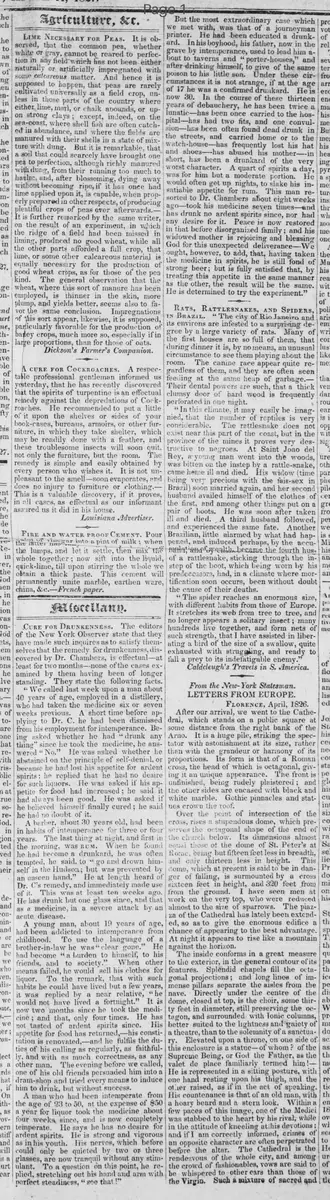
Cure for Drunkenness.
The editors of the New York Observer state that they have made such inquiries as to satisfy themselves that the remedy for drunkenness, discovered by Dr. Chambers, is effectual—at least for two months—none of the cases examined by them having been of longer standing. They state the following facts.
"We called last week upon a man about 40 years of age, employed in a distillery, who had taken the medicine six or seven weeks previous. A short time before applying to Dr. C. he had been dismissed from his employment for intemperance. Being asked whether he had "drunk any thing" since he took the medicine, he answered "No." He was asked whether he abstained on the principle of self-denial, or because he had lost his appetite for ardent spirits: he replied that he had no desire for such liquors. He was asked if his appetite for food had increased; he said it had always been good. He was asked if he believed himself finally cured; he said he had no doubt of it.
A barber, about 30 years old, had been in habits of intemperance for three or four years. The last thing at night, and first in the morning, was Rum. When he found he had become a drunkard, he was often tempted, he said, to "go and drown himself in the Hudson; but was prevented by an unseen hand." He at length heard of Dr. C's remedy, and immediately made use of it. This was at least ten weeks ago. He has drunk but one glass since, and that as a medicine, in a severe attack by an acute disease.
A young man, about 19 years of age, had been addicted to intemperance from childhood. To use the language of a brother-in-law he was "clear gone." He had become "a burden to himself, to his friends, and to society." When other means failed, he would sell his clothes for liquor. To the remark, that with such habits he could have lived but a few years, it was replied by a near relative, "he would not have lived a fortnight." It is now two months since he took the medicine; and that, only four times. He has not tasted of ardent spirits since. His appetite for food has returned,—his constitution is renovated,—and he fulfils the duties of his calling as regularly, as faithfully, and with as much correctness, as any other man. The evening before we called, one of his old friends persuaded him into a dram-shop and tried every means to induce him to drink, but without success.
A man who had been intemperate from the age of 23 to 50, at the expense of $50 a year for liquor took the medicine about four weeks since, and is now completely temperate. He says he has no desire for ardent spirits. He is strong and vigorous as in his youth. His nerves, which before could only be quieted by two or three glasses, are now tranquil without any stimulant. To a question on this point, he replied, stretching out his hand and arm with perfect steadiness, "see that!"
But the most extraordinary case which we met with, was that of a journeyman printer. He had been educated a drunkard. In his boyhood, his father, now in the grave by intemperance, used to lead him about to taverns and "porter-houses," and after drinking himself, to give of the same poison to his little son. Under these circumstances it is not strange, if at the age of 17 he was a confirmed drunkard. He is now 30. In the course of these thirteen years of debauchery, he has been twice a lunatic—has been once carried to the hospital—has had two fits, and one convulsion—has been often found dead drunk in the streets, and carried home or to the watch-house—has frequently lost his hat and shoes—has abused his mother—in short, has been a drunkard of the very worst character. A quart of spirits a day, was for him but a moderate portion. He would often get up nights, to slake his insatiable appetite for rum. This man resorted to Dr. Chambers about eight weeks ago—took his medicine seven times—and has drunk no ardent spirits since, nor had any desire for it. Peace is now restored in that before disorganized family; and his widowed mother is rejoicing and blessing God for this unexpected deliverance—We ought, however, to add, that, having taken the medicine in spirits, he is still fond of strong beer; but is fully satisfied that, by treating this appetite in the same manner as the other, the result will be the same. He is determined to try the experiment."
What sub-type of article is it?
What keywords are associated?
What entities or persons were involved?
Where did it happen?
Domestic News Details
Primary Location
New York
Key Persons
Outcome
multiple individuals reported cured of drunkenness, with restored health, appetite, and family stability; no relapses except one medicinal drink; effects lasting 4-10 weeks in examined cases.
Event Details
Editors of the New York Observer investigated Dr. Chambers' remedy for drunkenness and found it effective in five cases: a 40-year-old distillery worker, a 30-year-old barber, a 19-year-old youth, a man intemperate from 23 to 50, and a 30-year-old journeyman printer, all of whom lost desire for ardent spirits after taking the medicine.