Thank you for visiting SNEWPapers!
Sign up free
The New York Journal, And Weekly Register
New York, New York County, New York
What is this article about?
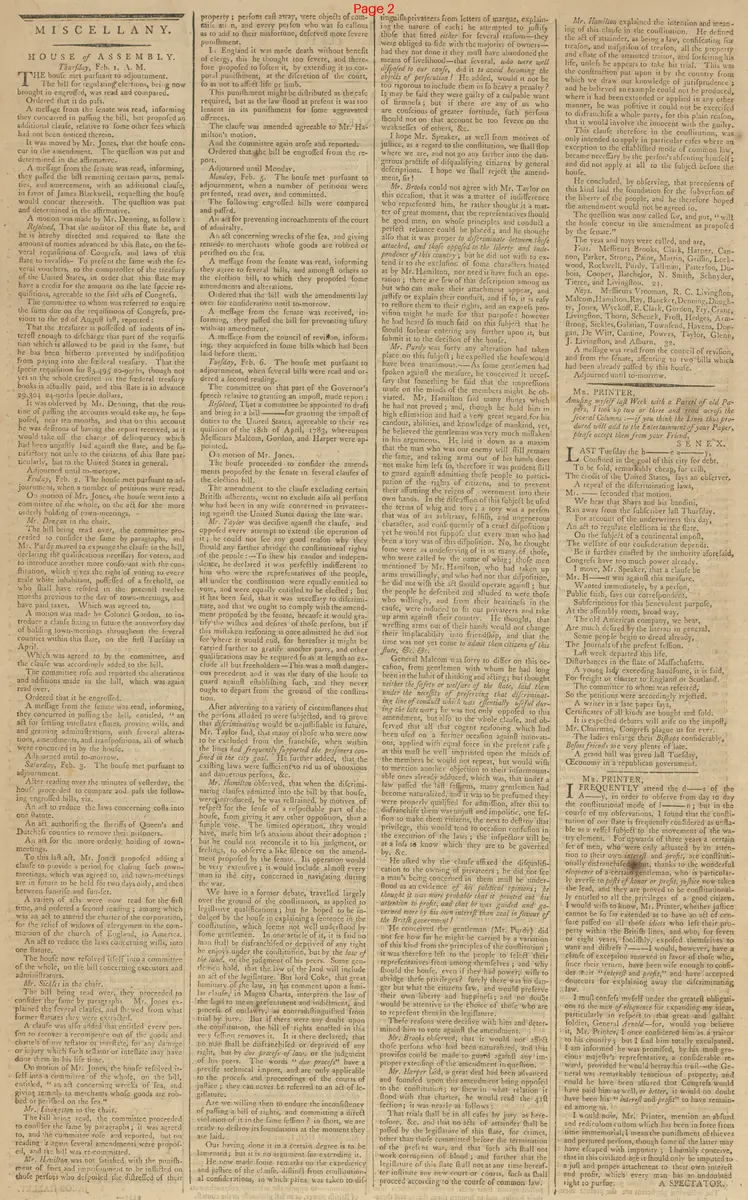
Detailed proceedings of the New York House of Assembly from February 1 to 6, covering bills on elections, town meetings, wrecks, intestates' estates, costs, and debates on amendments excluding certain persons from voting, with resolutions on congressional requisitions.
Clipping
OCR Quality
Full Text
HOUSE OF ASSEMBLY.
Thursday, Feb. 1, A. M.
The house met pursuant to adjournment.
The bill for regulating elections, being now brought in engrossed, was read and compared.
Ordered that it do pass.
A message from the senate was read, informing they concurred in passing the bill, but proposed an additional clause, relative to some other fees which had not been noticed therein.
It was moved by Mr. Jones, that the house concur in the amendment. The question was put and determined in the affirmative.
A message from the senate was read, informing, they passed the bill remitting certain pains, penalties, and amercement, with an additional clause, in favor of James Blackwell, requesting the house would concur therewith. The question was put and determined in the affirmative.
A motion was made by Mr. Denning, as follows:
Resolved, That the auditor of this state be, and he is hereby directed and required to state the amount of monies advanced by this state, on the several requisitions of Congress, and laws of this state to invalids—To present the same with the several vouchers, to the comptroller of the treasury of the United States, in order that this state may have a credit for the amount on the late specie requisitions, agreeable to the said acts of Congress.
The committee to whom was referred to enquire the sums due on the requisitions of Congress, previous to the 2d of August last, reported:
That the treasurer is possessed of indents of interest enough to discharge that part of the requisition which is allowed to be paid in the same, but he has been hitherto prevented by indisposition from paying into the federal treasury. That the specie requisition for 85,495 20-90ths, though not yet in the whole credited in the federal treasury books is actually paid, and this state is in advance 29,304 24-90ths specie dollars.
It was observed by Mr. Denning, that the routine of passing the accounts would take up, he supposed, near ten months, and that on this account he was desirous of having the report received, as it would take off the charge of delinquency which had been unjustly laid against the state, and be satisfactory not only to the citizens of this state particularly, but to the United States in general.
Adjourned until to-morrow.
Friday, Feb. 2. The house met pursuant to adjournment, when a number of petitions were read.
On motion of Mr. Jones, the house went into a committee of the whole, on the act for the more orderly holding of town-meetings.
Mr. Dongan in the chair.
The bill being read over, the committee proceeded to consider the same by paragraphs, and Mr. Purdy moved to expunge the clause in the bill, declaring the qualifications necessary for voters, and to introduce another more consonant with the constitution, which gives the right of voting to every male white inhabitant, possessed of a freehold, or who shall have resided in the precinct twelve months previous to the day of town-meetings, and have paid taxes. Which was agreed to.
A motion was made by Colonel Gordon, to introduce a clause fixing in future the anniversary day of holding town-meetings throughout the several counties within this state, on the first Tuesday in April.
Which was agreed to by the committee, and the clause was accordingly added to the bill.
The committee rose and reported the alterations and additions made in the bill, which was again read over.
Ordered that it be engrossed.
A message from the senate was read, informing they concurred in passing the bill, entitled, "an act for settling intestates estates, proving wills, and granting administrations," with several alterations, amendments, and transpositions, all of which were concurred in by the house.
Adjourned until to-morrow.
Saturday, Feb. 3.
The house met pursuant to adjournment.
After reading over the minutes of yesterday, the house proceeded to compare and pass the following engrossed bills, viz.
An act to reduce the laws concerning costs into one statute.
An act authorizing the sheriffs of Queen's and Dutchess counties to remove their prisoners.
An act for the more orderly holding of town-meetings.
To this last act, Mr. Jones proposed adding a clause to provide a period for closing such town-meetings, which was agreed to, and town-meetings are in future to be held for two days only, and then between sun-rise and sun-set.
A variety of acts were now read for the first time, and ordered a second reading; among which was an act to amend the charter of the corporation, for the relief of widows of clergymen in the communion of the church of England, in America.
An act to reduce the laws concerning wills, into one statute.
The house now resolved itself into a committee of the whole, on the bill concerning executors and administrators.
Mr. Sickles in the chair.
The bill being read over, they proceeded to consider the same by paragraphs. Mr. Jones explained the several clauses, and showed from what former statutes they were extracted.
A clause was also added that entitled every person to recover a recompence out of the goods and chattels of any testator or intestate, for any damage or injury which such testator or intestate may have done them in his life time.
On motion of Mr. Jones, the house resolved itself into a committee of the whole, on the bill, entitled, "an act concerning wrecks of sea, and giving remedy to merchants whose goods are robbed or perished on the sea."
Mr. Livingston in the chair.
The bill being read, the committee proceeded to consider the same by paragraphs; it was agreed to, and the committee rose and reported, but on reading it again several amendments were proposed, and the bill was re-committed.
Mr. Hamilton was not satisfied with the punishment of fines and imprisonment to be inflicted on those persons who despoiled the distressed of their property: persons cast away, were objects of commiseration, and every person who was so callous as to add to their misfortune, deserved more severe punishment.
In England it was made death without benefit of clergy, this he thought too severe, and therefore proposed to soften it, by extending it to corporal punishment, at the discretion of the court, so as not to affect life or limb.
This punishment might be distributed as the case required, but as the law stood at present it was too lenient in its punishment for some aggravated offences.
The clause was amended agreeable to Mr. Hamilton's motion.
And the committee again rose and reported.
Ordered that the bill be engrossed from the report.
Adjourned until Monday.
Monday, Feb. 5. The house met pursuant to adjournment, when a number of petitions were presented, read over, and committed.
The following engrossed bills were compared and passed.
An act for preventing encroachments of the court of admiralty.
An act concerning wrecks of the sea, and giving remedy to merchants whose goods are robbed or perished on the sea.
A message from the senate was read, informing they agree to several bills, and amongst others to the election bill, to which they proposed some amendments and alterations.
Ordered that the bill with the amendments lay over for consideration until to-morrow.
A message from the senate was received, informing, they passed the bill for preventing usury without amendment.
A message from the council of revision, informing, they acquiesced in some bills which had been laid before them.
Tuesday, Feb. 6. The house met pursuant to adjournment, when several bills were read and ordered a second reading.
The committee on that part of the Governor's speech relative to granting an impost, made report:
Resolved, That a committee be appointed to draft and bring in a bill—for granting the impost of duties to the United States, agreeable to their requisition of the 18th of April, 1783, whereupon Messieurs Malcom, Gordon, and Harper were appointed.
On motion of Mr. Jones.
The house proceeded to consider the amendments proposed by the senate in several clauses of the election bill.
The amendment to the clause excluding certain British adherents, went to exclude also all persons who had been in any wise concerned in privateering against the United States during the late war.
Mr. Taylor was decisive against the clause, and opposed every attempt to extend the operation of it; he could not see any good reason why they should any farther abridge the constitutional rights of the people:—To show his candor and independence, he declared it was perfectly indifferent to him who were the representatives of the people, all under the constitution were equally entitled to vote, and were equally entitled to be elected; but it has been said, that it was necessary to discriminate, and that we ought to comply with the amendment proposed by the senate, because it would gratify the wishes and desires of those persons, but if this mistaken reasoning is once admitted he did not see where it would end, for hereafter it might be carried further to gratify another party, and other qualifications may be required so as at length to exclude all but freeholders This was a most dangerous precedent and it was the duty of the house to guard against establishing such, and they never ought to depart from the ground of the constitution.
After adverting to a variety of circumstances that the persons alluded to were subjected, and to prove that discriminating would be unjustifiable in future, Mr. Taylor said, that many of those who were now to be excluded from the franchise, when within the lines had frequently supported the prisoners confined in the city goal. He further added, that the existing laws were sufficient to rid us of obnoxious and dangerous persons, &c.
Mr. Hamilton observed, that when the discriminating clauses admitted into the bill by that house, were introduced, he was restrained, by motives of respect for the sense of a respectable part of the house, from giving it any other opposition, than a simple vote. The limited operation, they would have, made him less anxious about their adoption : but he could not reconcile it to his judgment, or feelings, to observe a like silence on the amendment proposed by the senate. Its operation would be very extensive; it would include almost every man in the city, concerned in navigating during the war.
We have in a former debate, travelled largely over the ground of the constitution, as applied to legislative qualifications ; but he hoped to be indulged by the house in explaining a sentence in the constitution, which seems not well understood by some gentlemen. In one article of it, it is said no man shall be disfranchised or deprived of any right he enjoys under the constitution, but by the law of the land, or the judgment of his peers. Some gentlemen hold, that the law of the land will include an act of the legislature. But lord Coke, that great luminary of the law, in his comment upon a similar clause, in Magna Charta, interprets the law of the land to mean presentment and indictment, and process of outlawry, as contradistinguished from trial by jury. But if there were any doubt upon the constitution, the bill of rights enacted in this very session removes it. It is there declared, that no man shall be disfranchised or deprived of any right, but by due process of law, or the judgment of his peers. The words "due process" have a precise technical import, and are only applicable to the process and proceedings of the courts of justice ; they can never be referred to an act of legislature.
Are we willing then to endure the inconsistency of passing a bill of rights, and committing a direct violation of it in the same session ? in short, we are ready to destroy its foundations at the moment they are laid.
Our having done it in a certain degree is to be lamented; but it is no argument for extending it.
He now made some remarks on the expediency and justice of the clause, distinct from constitutional considerations, in which pains was taken to distinguish privateers from letters of marque, explaining the nature of each: he attempted to justify those that fitted either for several reasons—they were obliged to side with the majority of owners—had they not done it they must have abandoned the means of livelihood—that several, who were well disposed to our cause, did it to avoid becoming the objects of persecution ! He added, would it not be too rigorous to include them in so heavy a penalty ?
It may be said they were guilty of a culpable want of firmness; but if there are any of us who are conscious of greater fortitude, such persons should not on that account be too severe on the weakness of others, &c.
I hope Mr. Speaker, as well from motives of justice, as a regard to the constitution, we shall stop where we are, and not go any farther into the dangerous practice of disqualifying citizens by general descriptions. I hope we shall reject the amendment, sir!
Mr. Brooks could not agree with Mr. Taylor on this occasion, that it was a matter of indifference who represented him, he rather thought it a matter of great moment, that the representatives should be good men, on whose principles and conduct a perfect reliance could be placed; and he thought also that it was proper to discriminate between those attached, and those opposed to the liberty and independence of this country; but he did not wish to extend it to the exclusion of some characters hinted at by Mr. Hamilton, nor need it have such an operation; there are few of that description among us but who can make their attachment appear, and justify or explain their conduct, and if so, it is easy to restore them to their rights, and an express provision might be made for that purpose: however he had heard so much said on this subject that he should forbear entering any further upon it, but submit it to the decision of the house.
Mr. Purdy was sorry any alteration had taken place on this subject ; he expected the house would have been unanimous.—As some gentlemen had spoken against the measure, he conceived it necessary that something be said that the impressions made on the minds of the members might be obviated. Mr. Hamilton said many things which he had not proved; and, though he held him in high estimation and had a very great regard for his candour, abilities, and knowledge of mankind, yet, he believed the gentleman was very much mistaken in his arguments. He laid it down as a maxim that the man who was our enemy will still remain the same, and taking arms out of his hands does not make him less so, therefore it was prudent still to guard against admitting these people to participation of the rights of citizens, and to prevent their assuming the reins of government into their own hands. In the discussion of this subject he used the terms of whig and tory; a tory was a person that was of an arbitrary, selfish, and ungenerous character, and consequently of a cruel disposition ; yet he would not suppose that every man who had been a tory was of this disposition. No, he thought some were as undeserving of it as many of those, who were called by the name of whig; those men mentioned by Mr. Hamilton, who had taken up arms unwillingly, and who had not that disposition, he did not wish the act should operate against; but the people he described and alluded to were those who willingly, and from their heartiness in the cause, were induced to fit out privateers and take up arms against their country. He thought, that wresting arms out of their hands would not change their implacability into friendship, and that the time was not yet come to admit them citizens of this state, &c. &c.
General Malcom was sorry to differ on this occasion, from gentlemen with whom he had long been in the habit of thinking and acting; but thought neither the safety or welfare of the state, laid them under the necessity of preserving that discriminating line of conduct which was essentially useful during the late war; he was not only opposed to this amendment, but also to the whole clause, and observed that all that cogent reasoning which had been used on a former occasion against innovations, applied with equal force in the present case; as this must be well imprinted upon the minds of the members he would not repeat, but would wish to mention another objection to their insurmountable ones already adduced, which was, that under a law passed the last session, many gentlemen had become naturalized, and it was to be presumed they were properly qualified for admission, after this to disfranchise them was unjust and impolitic, one session to make them citizens, the next to destroy that privilege, this would tend to occasion confusion in the execution of the laws ; the inspectors will be at a loss to know which they are to be governed by, &c.
He asked why the clause affixed the disqualification to the owning of privateers ; he did not see a man's being concerned in them must be understood as an evidence of his political opinions; he thought it was more probable that it pointed out his attention to profit, and that he was guided and governed more by his own interest than zeal in favour of the British government!
He conceived the gentleman (Mr. Purdy) did not see how far he might be carried by a variation of this kind from the principles of the constitution ; it was therefore left to the people to elect their representatives from among themselves ; and why should the house, even if they had power, wish to abridge these privileges? Surely there was no danger but what the citizens saw, and would preserve their own liberty and happiness; and no doubt would be attentive in the choice of those who are to represent them in the legislature.
These reasons were decisive with him and determined him to vote against the amendment.
Mr. Brooks observed, that it would not affect those persons who had been naturalized, and that provisos could be made to guard against any improper extension of the amendment in question.
Mr. Harper said, a great deal had been advanced and founded upon this amendment being opposed to the constitution; to show in what relation it stood with that charter, he would read the 41st section: it was nearly as follows:
That trials shall be in all cases by jury as heretofore, &c. and that no acts of attainder shall be passed by the legislature of this state, or crimes, other than those committed before the termination of the present war, and that such acts shall not work corruption of blood ; and further that the legislature of this state shall not at any time hereafter institute any new court or courts, such as shall proceed according to the course of common law.
Mr. Hamilton explained the intention and meaning of this clause in the constitution. He defined the act of attainder, as being a law, confiscating for treason, and misprision of treason, all the property and estate of the attainted traitor, and forfeiting his life, unless he appears to take his trial. This was the construction put upon it by the country from which we draw our knowledge of jurisprudence ; and he believed an example could not be produced, where it had been extended or applied in any other manner, he was positive it could not be exercised to disfranchise a whole party, for this plain reason, that it would involve the innocent with the guilty.
This clause therefore in the constitution, was only intended to apply in particular cases where an exception to the established mode of common law, became necessary by the person's absenting himself; and did not apply at all to the subject before the house.
He concluded, by observing, that precedents of this kind laid the foundation for the subversion of the liberty of the people, and he therefore hoped the amendment would not be agreed to.
The question was now called for, and put, "will the house concur in the amendment as proposed by the senate."
The yeas and nays were called, and are,
Yeas. Messieurs Brooks, Clark, Harper, Cannon, Parker, Strong, Paine, Martin, Griffin, Lockwood, Rockwell, Purdy, Tallman, Patterson, Dubois, Cooper, Batchelor, N. Smith, Schnyder, Tierce, and Livingston. 21.
Nays. Messieurs Vrooman, R. C. Livingston, Malcom, Hamilton, Ray, Bancker, Denning, Dougherty, Jones, Wyckoff, E. Clark, Gordon, Fry, Crane, Livingston, Thorn, Schenck, Frost, Hedges, Armstrong, Sickles, Galatian, Townend, Havens, Dongan, De Witt, Cantine, Powers, Taylor, Glenn, J. Livingston, and Auburn. 32.
A message was read from the council of revision, and from the senate, assenting to two bills which had been already passed by this house.
Adjourned until to-morrow.
What sub-type of article is it?
What keywords are associated?
What entities or persons were involved?
Where did it happen?
Domestic News Details
Primary Location
New York
Event Date
Thursday, Feb. 1 To Tuesday, Feb. 6
Key Persons
Outcome
multiple bills passed or amended, including election regulations, town meetings, wrecks of the sea, intestates' estates, costs, wills, usury prevention, and admiralty encroachments. senate amendment on excluding privateers from voting rejected 32-21. report on state advances to congress accepted. committee appointed for impost duties bill.
Event Details
The House of Assembly met daily from February 1 to 6, processing bills on elections (with amendments concurred), remitting penalties (favoring James Blackwell), congressional requisitions (state in advance), town meetings (voter qualifications aligned with constitution, fixed to first Tuesday in April, limited to two days), intestates' estates, costs consolidation, sheriffs' prisoner removal, widows' relief charter amendment, wills consolidation, executors and administrators (added recompense clause), wrecks of the sea (amended to include corporal punishment), admiralty encroachments, usury prevention. Debated and rejected senate amendment to election bill excluding privateering participants, citing constitutional rights and due process.