Thank you for visiting SNEWPapers!
Sign up free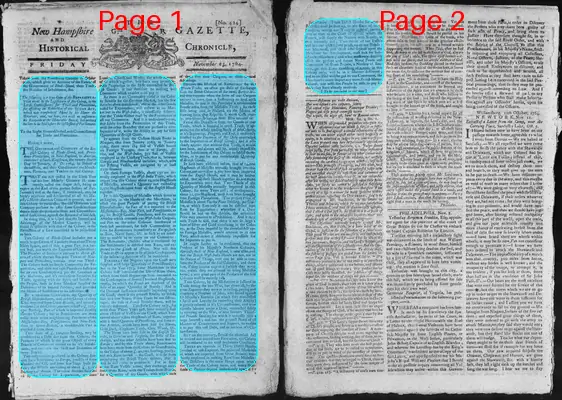
The New Hampshire Gazette And Historical Chronicle
Portsmouth, Greenland, Rockingham County, New Hampshire
What is this article about?
The Rhode-Island legislature petitions the Lords Commissioners for Trade and Plantations against renewing the Sugar Act of 1764, arguing it would devastate the colony's economy reliant on molasses imports for rum distillation and trade with West Indies and Africa to fund British goods imports.
Merged-components note: This is a continuation of the reprinted article from the Providence Gazette about the Rhode-Island representation against the Sugar Act, spanning page 1 to page 2, ending mid-serialization with 'To be concluded in our next.' The content is a full narrative article, best labeled as 'story' despite the original 'editorial' label on the second part.
Clippings
1 of 2
OCR Quality
Full Text
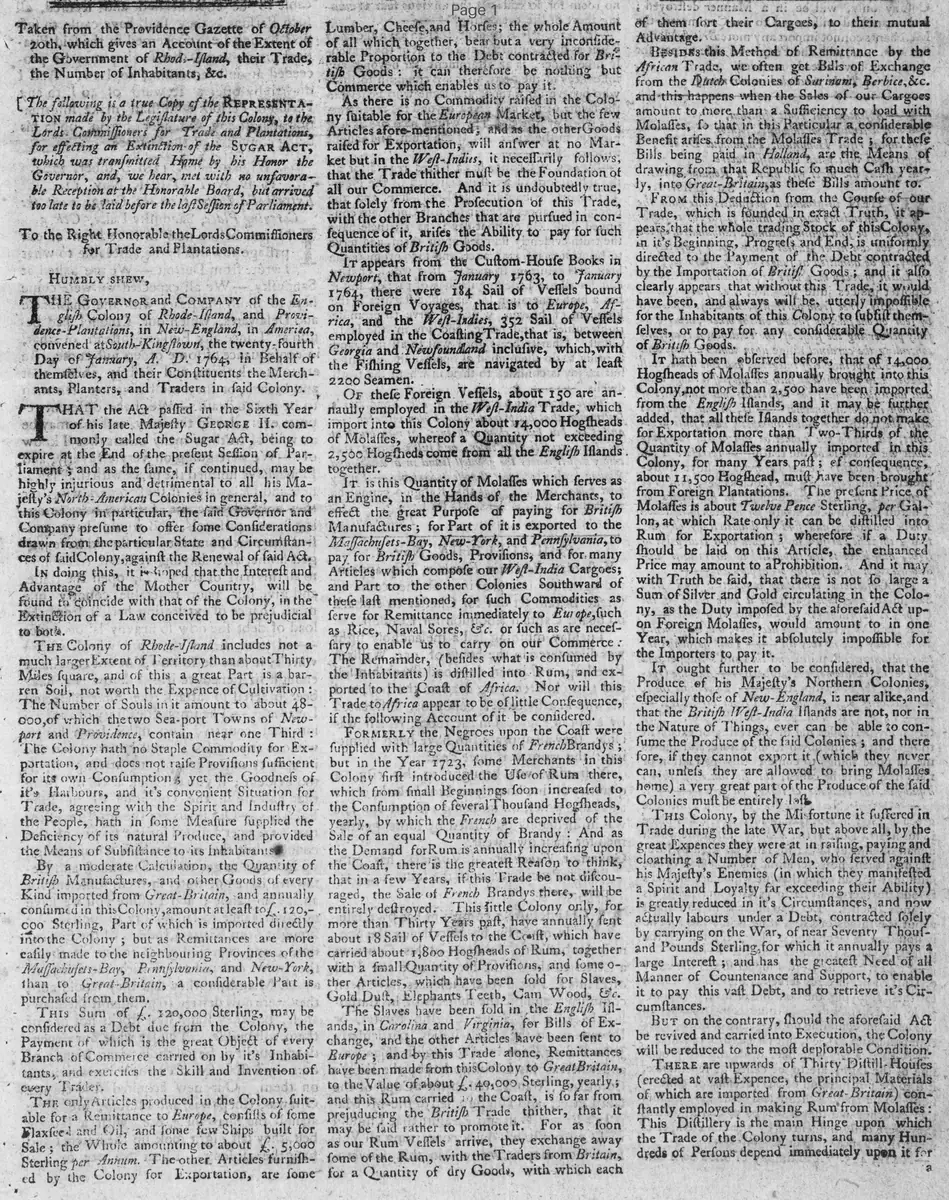
The following is a true Copy of the Representation made by the Legislature of this Colony, to the Lords Commissioners for Trade and Plantations, for effecting an Extinction of the Sugar Act, which was transmitted Home by his Honor the Governor, and, we hear, met with no unfavorable Reception at the Honorable Board, but arrived too late to be laid before the last Session of Parliament.
To the Right Honorable the Lords Commissioners for Trade and Plantations.
HUMBLY SHEWETH,
That the Governor and Company of the English Colony of Rhode-Island, and Providence Plantations, in New-England, in America, convened at South-Kingstown, the twenty-fourth Day of January, A. D. 1764, in Behalf of themselves and their Constituents the Merchants, Planters, and Traders in said Colony.
That the Act passed in the Sixth Year of his late Majesty George II. commonly called the Sugar Act, being to expire at the End of the present Session of Parliament—and as the same, if continued, may be highly injurious and detrimental to all his Majesty's North-American Colonies in general, and to this Colony in particular, the said Governor and Company presume to offer some Considerations drawn from the particular State and Circumstances of said Colony, against the Renewal of said Act.
In doing this, it is hoped that the Interest and Advantage of the Mother Country, will be found to coincide with that of the Colony, in the Extinction of a Law conceived to be prejudicial to both.
The Colony of Rhode-Island includes not a much larger Extent of Territory than about Thirty Miles square, and of this a great Part is a barren Soil, not worth the Expense of Cultivation.
The Number of Souls in it amount to about 48,000, of which the two Sea-port Towns of Newport and Providence, contain near one Third.
The Colony hath no Staple Commodity for Exportation, and does not raise Provisions sufficient for its own Consumption; yet the Goodness of its Harbours, and its convenient Situation for Trade, agreeing with the Spirit and Industry of the People, hath in some Measure supplied the Deficiency of its natural Produce, and provided the Means of Subsistence to its Inhabitants.
By a moderate Calculation, the Quantity of British Manufactures, and other Goods of every Kind imported from Great-Britain, and annually consumed in this Colony, amount at least to £120,000 Sterling, Part of which is imported directly into the Colony; but as Remittances are more easily made to the neighbouring Provinces of the Massachusetts-Bay, Pennsylvania, and New-York, than to Great-Britain, a considerable Part is purchased from them.
This Sum of £120,000 Sterling, may be considered as a Debt due from the Colony, the Payment of which is the great Object of every Branch of Commerce carried on by its Inhabitants, and exercises the Skill and Invention of every Trader.
The only Articles produced in the Colony, suitable for a Remittance to Europe, consists of some Flaxseed and Oil, and now and then a few Ships built for Sale: the Whole amounting to about £5,000 Sterling per Annum. The other Articles furnished by the Colony for Exportation, are some Lumber, Cheese, and Horses; the whole Amount of all which together, bear but a very inconsiderable Proportion to the Debt contracted for British Goods: it can therefore be nothing but Commerce which enables us to pay it.
As there is no Commodity raised in the Colony suitable for the European Market, but the few Articles afore-mentioned; and as the other Goods raised for Exportation, will answer at no Market but in the West-Indies, it necessarily follows, that the Trade thither must be the Foundation of all our Commerce. And it is undoubtedly true, that solely from the Prosecution of this Trade, with the other Branches that are pursued in consequence of it, arises the Ability to pay for such Quantities of British Goods.
It appears from the Custom-House Books in Newport, that from January 1763, to January 1764, there were 184 Sail of Vessels bound on Foreign Voyages, that is to Europe, Africa, and the West-Indies, 352 Sail of Vessels employed in the Coasting Trade, that is, between Georgia and Newfoundland inclusive, which, with the Fishing Vessels, are navigated by at least 2200 Seamen.
Of these Foreign Vessels, about 150 are annually employed in the West-India Trade, which import into this Colony about 14,000 Hogsheads of Molasses, whereof a Quantity not exceeding 2,500 Hogsheads come from all the English Islands together.
It is this Quantity of Molasses which serves as an Engine, in the Hands of the Merchants, to effect the great Purpose of paying for British Manufactures; for Part of it is exported to the Massachusetts-Bay, New-York, and Pennsylvania, to pay for British Goods, Provisions; and for many Articles which compose our West-India Cargoes; and Part to the other Colonies Southward of these last mentioned, for such Commodities as serve for Remittance immediately to Europe, such as Rice, Naval Stores, &c. or such as are necessary to enable us to carry on our Commerce.
The Remainder, (besides what is consumed by the Inhabitants) is distilled into Rum, and exported to the Coast of Africa. Nor will this Trade to Africa appear to be of little Consequence, if the following Account of it be considered.
Formerly the Negroes upon the Coast were supplied with large Quantities of French Brandys: but in the Year 1723, some Merchants in this Colony first introduced the Use of Rum there, which from small Beginnings soon increased to the Consumption of several Thousand Hogsheads, yearly, by which the French are deprived of the Sale of an equal Quantity of Brandy: And as the Demand for Rum is annually increasing upon the Coast, there is the greatest Reason to think, that in a few Years, if this Trade be not discouraged, the Sale of French Brandys there, will be entirely destroyed. This little Colony only, for more than Thirty Years past, have annually sent about 18 Sail of Vessels to the Coast, which have carried about 1800 Hogsheads of Rum, together with a small Quantity of Provisions, and some other Articles, which have been sold for Slaves, Gold Dust, Elephants Teeth, Cam Wood, &c.
The Slaves have been sold in the English Islands, in Carolina and Virginia, for Bills of Exchange, and the other Articles have been sent to Europe; and by this Trade alone, Remittances have been made from this Colony to Great Britain, to the Value of about £40,000 Sterling, yearly; and this Rum carried to the Coast, is so far from prejudicing the British Trade thither, that it may be said rather to promote it. For as soon as our Rum Vessels arrive, they exchange away some of the Rum, with the Traders from Britain, for a Quantity of dry Goods, with which each of them fortify their Cargoes to their mutual Advantage.
Besides this Method of Remittance by the African Trade, we often get Bills of Exchange from the Dutch Colonies of Surinam, Berbice, &c. and this happens when the Sales of our Cargoes amount to more than a Sufficiency to load with Molasses. So that in this Particular a considerable Benefit arises from the Molasses Trade; for these Bills, being paid in Holland, are the Means of drawing from that Republic so much Cash yearly, into Great-Britain, as these Bills amount to.
From this Deduction from the Course of our Trade, which is founded in exact Truth, it appears, that the whole trading Stock of this Colony, in its Beginning, Progress and End, is uniformly directed to the Payment of the Debt contracted by the Importation of British Goods; and it also clearly appears that without this Trade, it would have been, and always will be, utterly impossible for the Inhabitants of this Colony to subsist themselves, or to pay for any considerable Quantity of British Goods.
It hath been observed before, that of 14,000 Hogsheads of Molasses annually brought into this Colony, not more than 2,500 have been imported from the English Islands, and it may be further added, that all these Islands together do not make for Exportation more than Two-Thirds of the Quantity of Molasses annually imported in this Colony, for many Years past; of consequence, about 11,500 Hogsheads, must have been brought from Foreign Plantations. The present Price of Molasses is about Twelve Pence Sterling, per Gallon, at which Rate only it can be distilled into Rum for Exportation; wherefore if a Duty should be laid on this Article, the enhanced Price may amount to a Prohibition. And it may with Truth be said, that there is not so large a Sum of Silver and Gold circulating in the Colony, as the Duty imposed by the aforesaid Act upon Foreign Molasses, would amount to in one Year, which makes it absolutely impossible for the Importers to pay it.
It ought further to be considered, that the Produce of his Majesty's Northern Colonies, especially those of New-England, is near alike, and that the British West-India Islands are not, nor in the Nature of Things, ever can be able to consume the Produce of the said Colonies; and therefore, if they cannot export it (which they never can, unless they are allowed to bring Molasses home) a very great part of the Produce of the said Colonies must be entirely lost.
This Colony, by the Misfortune it suffered in Trade during the late War, but above all, by the great Expences they were at in raising, paying and cloathing a Number of Men, who served against his Majesty's Enemies (in which they manifested a Spirit and Loyalty far exceeding their Ability) is greatly reduced in its Circumstances, and now actually labours under a Debt, contracted solely by carrying on the War, of near Seventy Thousand Pounds Sterling, for which it annually pays a large Interest; and has the greatest Need of all Manner of Countenance and Support, to enable it to pay this vast Debt, and to retrieve its Circumstances.
But on the contrary, should the aforesaid Act be revived and carried into Execution, the Colony will be reduced to the most deplorable Condition.
There are upwards of Thirty Distill-Houses (erected at vast Expense, the principal Materials of, which are imported from Great-Britain) constantly employed in making Rum from Molasses: This Distillery is the main Hinge upon which the Trade of the Colony turns, and many Hundreds of Persons depend immediately upon it for Subsistence: These Distill Houses for want of Molasses must be Shut up, to the Ruin of many Families, and of our Trade in general, particularly of that to the Coast of Africa, where the French will supply the Natives with Brandy, as they formerly did; Two-thirds of our Vessels will become useless, and perish upon our Hands; our Mechanics, and those who depend upon the Merchant for Employment, must seek for Subsistence elsewhere; and what must very sensibly affect the present and future Naval Power and Commerce of Great-Britain, a Nursery of Seamen, at this Time consisting of 2200, in this Colony only, will be in a Manner destroyed; and as an End will be put to our Commerce, the Merchants cannot import any more British Manufactures, nor will the People be able to pay for those they have already received.
To be concluded in our next.
What sub-type of article is it?
What themes does it cover?
What keywords are associated?
What entities or persons were involved?
Where did it happen?
Story Details
Key Persons
Location
Rhode Island
Event Date
Twenty Fourth Day Of January, A. D. 1764
Story Details
The Rhode-Island legislature represents the colony's economic dependence on foreign molasses for rum production and trade with West Indies and Africa, arguing that the Sugar Act's duties would prohibit this trade, ruin distilleries, destroy commerce, and prevent payment for British goods, leading to economic collapse.