Thank you for visiting SNEWPapers!
Sign up free
Literary
September 8, 1827
The Ladies' Garland
Harpers Ferry, Jefferson County, West Virginia
What is this article about?
A reflective prose narrative describes a serene January morning walk in Louisiana's Red River forest, where the author encounters a somber Native American funeral procession for a young Appalachian warrior, evoking personal memories of loss and the universality of grief.
Clipping
OCR Quality
98%
Excellent
Full Text
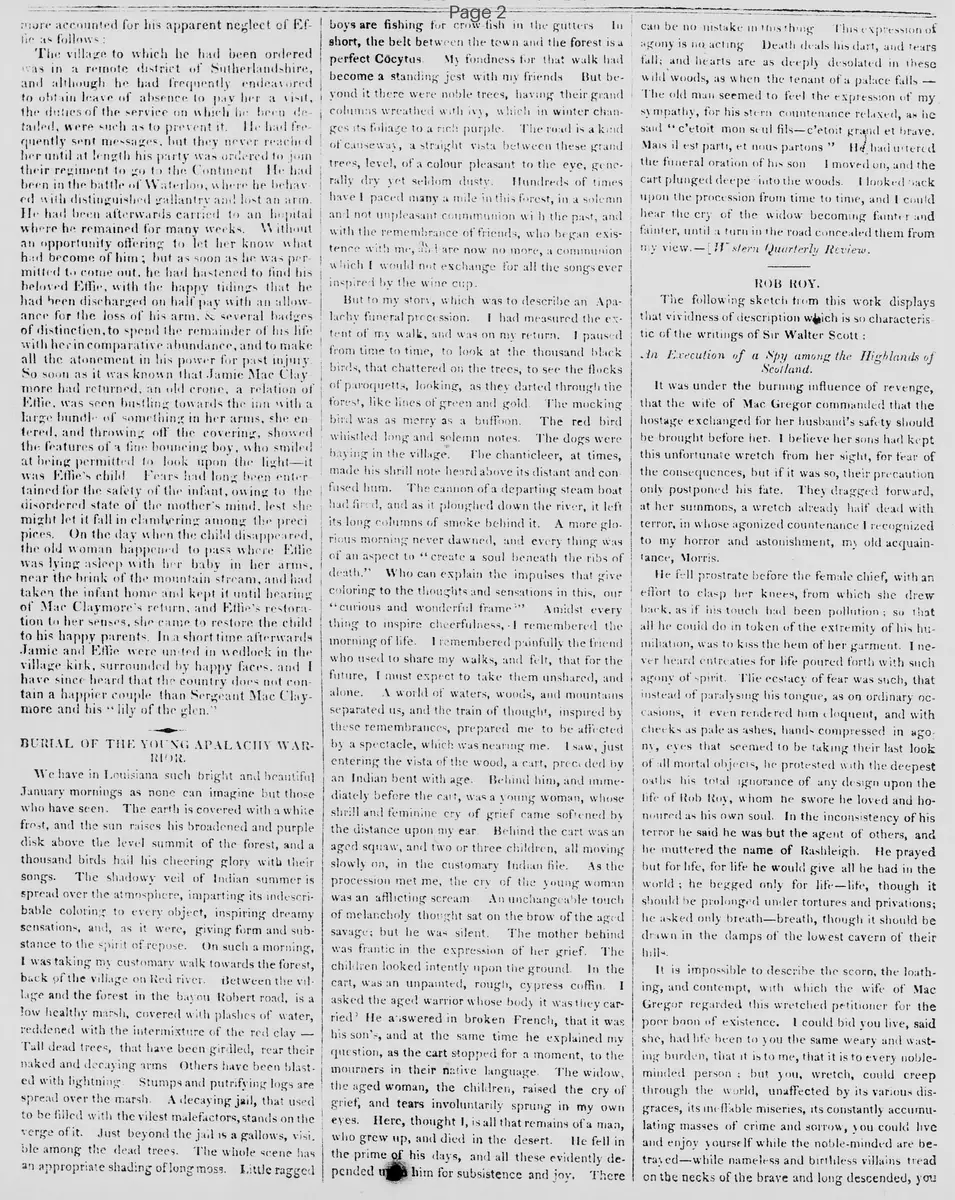
BURIAL OF THE YOUNG APPALACHIAN WARRIOR.
We have in Louisiana such bright and beautiful January mornings as none can imagine but those who have seen. The earth is covered with a white frost, and the sun raises his broad disc and purple disk above the level summit of the forest, and a thousand birds hail his cheering glory with their songs.
The shadowy veil of Indian summer is spread over the atmosphere, imparting its indescribable coloring to every object, inspiring dreamy sensations, and, as it were, giving form and substance to the spirit of repose. On such a morning, I was taking my customary walk towards the forest, back of the village on Red river. Between the village and the forest in the bayou Robert road, is a low healthy marsh, covered with splashes of water, reddened with the intermixture of the red clay -- Tall dead trees, that have been girdled, rear their naked and decaying arms. Others have been blasted with lightning. Stumps and putrifying logs are spread over the marsh. A decaying jail, that used to be filled with the vilest malefactors, stands on the verge of it. Just beyond the jail is a gallows, visible among the dead trees. The whole scene has an appropriate shading of long moss. Little ragged boys are fishing for crow fish in the gutters. In short, the belt between the town and the forest is a perfect Cocytus. My fondness for that walk had become a standing jest with my friends. But beyond it there were noble trees, having their grand columns wreathed with ivy, which in winter changes its foliage to a rich purple. The road is a kind of causeway, a straight vista between these grand trees, level, of a colour pleasant to the eye, generally dry yet seldom dusty. Hundreds of times have I paced many a mile in this forest, in a solemn and not unpleasant communion with the past, and with the remembrance of friends, who began existence with me, ah! are now no more, a communion which I would not exchange for all the songs ever inspired by the wine cup.
But to my story, which was to describe an Apalachy funeral procession. I had measured the extent of my walk, and was on my return. I paused from time to time, to look at the thousand black birds, that chattered on the trees, to see the flocks of paroquets, looking, as they darted through the forest, like lines of green and gold. The mocking bird was as merry as a buffoon. The red bird whistled long and solemn notes. The dogs were baying in the village. The chanticleer, at times, made his shrill note heard above its distant and confused hum. The cannon of a departing steam boat had fired, and as it ploughed down the river, it left its long columns of smoke behind it. A more glorious morning never dawned, and every thing was of an aspect to "create a soul beneath the ribs of death." Who can explain the impulses that give coloring to the thoughts and sensations in this, our "curious and wonderful frame"
Amidst every thing to inspire cheerfulness, --I remembered the morning of life. I remembered painfully the friend who used to share my walks, and felt, that for the future, I must expect to take them unshared, and alone. A world of waters, woods, and mountains separated us, and the train of thought, inspired by these remembrances, prepared me to be affected by a spectacle, which was nearing me. I saw, just entering the vista of the wood, a cart, preceded by an Indian bent with age. Behind him, and immediately before the cart, was a young woman, whose shrill and feminine cry of grief came softened by the distance upon my ear. Behind the cart was an aged squaw, and two or three children, all moving slowly on, in the customary Indian file. As the procession met me, the cry of the young woman was an afflicting scream. An unchangeable touch of melancholy thought sat on the brow of the aged savage: but he was silent. The mother behind was frantic in the expression of her grief. The children looked intently upon the ground. In the cart, was an unpainted, rough, cypress coffin.
I asked the aged warrior whose body it was they carried. He answered in broken French, that it was his son's, and at the same time he explained my question, as the cart stopped for a moment, to the mourners in their native language. The widow, the aged woman, the children, raised the cry of grief, and tears involuntarily sprung in my own eyes. Here, thought I, is all that remains of a man, who grew up, and died in the desert. He fell in the prime of his days, and all these evidently depended upon him for subsistence and joy. There can be no mistake in this thing. This expression of agony is no acting. Death deals his dart, and tears fall; and hearts are as deeply desolated in these wild woods, as when the tenant of a palace falls --
The old man seemed to feel the expression of my sympathy, for his stern countenance relaxed, as he said "c'etoit mon seul fils -- c'etoit grand et brave. Mais il est parti, et nous partons"
He had uttered the funeral oration of his son. I moved on, and the cart plunged deeper into the woods. I looked back upon the procession from time to time, and I could hear the cry of the widow becoming fainter and fainter, until a turn in the road concealed them from my view. -- [Western Quarterly Review.]
We have in Louisiana such bright and beautiful January mornings as none can imagine but those who have seen. The earth is covered with a white frost, and the sun raises his broad disc and purple disk above the level summit of the forest, and a thousand birds hail his cheering glory with their songs.
The shadowy veil of Indian summer is spread over the atmosphere, imparting its indescribable coloring to every object, inspiring dreamy sensations, and, as it were, giving form and substance to the spirit of repose. On such a morning, I was taking my customary walk towards the forest, back of the village on Red river. Between the village and the forest in the bayou Robert road, is a low healthy marsh, covered with splashes of water, reddened with the intermixture of the red clay -- Tall dead trees, that have been girdled, rear their naked and decaying arms. Others have been blasted with lightning. Stumps and putrifying logs are spread over the marsh. A decaying jail, that used to be filled with the vilest malefactors, stands on the verge of it. Just beyond the jail is a gallows, visible among the dead trees. The whole scene has an appropriate shading of long moss. Little ragged boys are fishing for crow fish in the gutters. In short, the belt between the town and the forest is a perfect Cocytus. My fondness for that walk had become a standing jest with my friends. But beyond it there were noble trees, having their grand columns wreathed with ivy, which in winter changes its foliage to a rich purple. The road is a kind of causeway, a straight vista between these grand trees, level, of a colour pleasant to the eye, generally dry yet seldom dusty. Hundreds of times have I paced many a mile in this forest, in a solemn and not unpleasant communion with the past, and with the remembrance of friends, who began existence with me, ah! are now no more, a communion which I would not exchange for all the songs ever inspired by the wine cup.
But to my story, which was to describe an Apalachy funeral procession. I had measured the extent of my walk, and was on my return. I paused from time to time, to look at the thousand black birds, that chattered on the trees, to see the flocks of paroquets, looking, as they darted through the forest, like lines of green and gold. The mocking bird was as merry as a buffoon. The red bird whistled long and solemn notes. The dogs were baying in the village. The chanticleer, at times, made his shrill note heard above its distant and confused hum. The cannon of a departing steam boat had fired, and as it ploughed down the river, it left its long columns of smoke behind it. A more glorious morning never dawned, and every thing was of an aspect to "create a soul beneath the ribs of death." Who can explain the impulses that give coloring to the thoughts and sensations in this, our "curious and wonderful frame"
Amidst every thing to inspire cheerfulness, --I remembered the morning of life. I remembered painfully the friend who used to share my walks, and felt, that for the future, I must expect to take them unshared, and alone. A world of waters, woods, and mountains separated us, and the train of thought, inspired by these remembrances, prepared me to be affected by a spectacle, which was nearing me. I saw, just entering the vista of the wood, a cart, preceded by an Indian bent with age. Behind him, and immediately before the cart, was a young woman, whose shrill and feminine cry of grief came softened by the distance upon my ear. Behind the cart was an aged squaw, and two or three children, all moving slowly on, in the customary Indian file. As the procession met me, the cry of the young woman was an afflicting scream. An unchangeable touch of melancholy thought sat on the brow of the aged savage: but he was silent. The mother behind was frantic in the expression of her grief. The children looked intently upon the ground. In the cart, was an unpainted, rough, cypress coffin.
I asked the aged warrior whose body it was they carried. He answered in broken French, that it was his son's, and at the same time he explained my question, as the cart stopped for a moment, to the mourners in their native language. The widow, the aged woman, the children, raised the cry of grief, and tears involuntarily sprung in my own eyes. Here, thought I, is all that remains of a man, who grew up, and died in the desert. He fell in the prime of his days, and all these evidently depended upon him for subsistence and joy. There can be no mistake in this thing. This expression of agony is no acting. Death deals his dart, and tears fall; and hearts are as deeply desolated in these wild woods, as when the tenant of a palace falls --
The old man seemed to feel the expression of my sympathy, for his stern countenance relaxed, as he said "c'etoit mon seul fils -- c'etoit grand et brave. Mais il est parti, et nous partons"
He had uttered the funeral oration of his son. I moved on, and the cart plunged deeper into the woods. I looked back upon the procession from time to time, and I could hear the cry of the widow becoming fainter and fainter, until a turn in the road concealed them from my view. -- [Western Quarterly Review.]
What sub-type of article is it?
Essay
Prose Fiction
What themes does it cover?
Death Mortality
Nature
What keywords are associated?
Funeral Procession
Appalachian Warrior
Louisiana Morning
Native American Grief
Nature Reflection
Mortality
Literary Details
Title
Burial Of The Young Appalachian Warrior.
Subject
Apalachy Funeral Procession
Form / Style
Reflective Narrative Sketch
Key Lines
The Old Man Seemed To Feel The Expression Of My Sympathy, For His Stern Countenance Relaxed, As He Said "C'etoit Mon Seul Fils C'etoit Grand Et Brave. Mais Il Est Parti, Et Nous Partons"
Here, Thought I, Is All That Remains Of A Man, Who Grew Up, And Died In The Desert. He Fell In The Prime Of His Days, And All These Evidently Depended Upon Him For Subsistence And Joy.
A More Glorious Morning Never Dawned, And Every Thing Was Of An Aspect To "Create A Soul Beneath The Ribs Of Death."