Thank you for visiting SNEWPapers!
Sign up free
The Rock Island Argus And Daily Union
Rock Island, Rock Island County County, Illinois
What is this article about?
In 1921, the US Senate struggles with inefficiency from filibusters and minority blocs delaying key bills like tariff and bonus. Senator Watson leads efforts to amend rules for limited debate and majority action, building on failed cloture attempts and 1917 precedents under Harding's administration.
Clipping
OCR Quality
Full Text
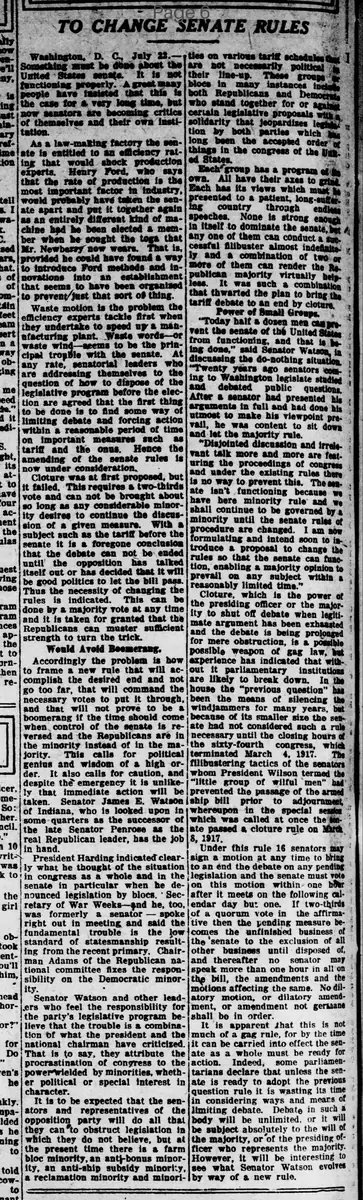
Washington, D. C., July 24.--Something must be done about the United States senate. It is not functioning properly. A great many people have insisted that this is the case for a very long time, but now senators are becoming critics of themselves and their own institution.
As a law-making factory the senate is entitled to an efficiency rating that would shock production experts. Henry Ford, who says that the rate of production is the most important factor in industry would probably have taken the senate apart and put it together again as an entirely different kind of machine had he been elected a member when he sought the toga that Mr. Newberry now wears. That is, provided he could have found a way to introduce Ford methods and innovations into an establishment that seems to have been organized to prevent just that sort of thing.
Waste motion is the problem the efficiency experts tackle first when they undertake to speed up a manufacturing plant. Waste words--or waste wind--seems to be the principal trouble with the senate. At any rate, senatorial leaders who are addressing themselves to the question of how to dispose of the legislative program before the election are agreed that the first thing to be done is to find some way of limiting debate and forcing action within a reasonable period of time on important measures such as the tariff and the bonus. Hence the amending of the senate rules is now under consideration.
Cloture was at first proposed, but it failed. This requires a two-thirds vote and can not be brought about so long as any considerable minority desires to continue the discussion of a given measure. With a subject such as the tariff before the senate it is a foregone conclusion that the debate can not be ended until the opposition has talked itself out or has decided that it will be good politics to let the bill pass. Thus the necessity of changing the rules is indicated. This can be done by a majority vote at any time and it is taken for granted that the Republicans can muster sufficient strength to turn the trick.
Would Avoid Boomerang.
Accordingly the problem is how to frame a new rule that will accomplish the desired end and not go too far, that will command the necessary votes to put it through, and that will not prove to be a boomerang if the time should come when control of the senate is reversed and the Republicans are in the minority instead of in the majority. This calls for political genius and wisdom of a high order. It also calls for caution, and despite the emergency it is unlikely that immediate action will be taken. Senator James E. Watson of Indiana, who is looked upon in some quarters as the successor of the late Senator Penrose as the real Republican leader, has the job in hand.
President Harding indicated clearly what he thought of the situation in congress as a whole and in the senate in particular when he denounced legislation by blocs. Secretary of War Weeks--and he, too, was formerly a senator--spoke right out in meeting and said the fundamental trouble is the low standard of statesmanship resulting from the recent primary. Chairman Adams of the Republican national committee fixes the responsibility on the Democratic minority.
Senator Watson and other leaders who feel the responsibility for the party's legislative program believe that the trouble is a combination of what the president and the national chairman have criticized. That is to say, they attribute the procrastination of congress to the power wielded by minorities, whether political or special interest in character.
It is to be expected that the senators and representatives of the opposition party will do all that they can to obstruct legislation in which they do not believe, but at the present time there is a farm bloc minority, an anti-bonus minority, an anti-ship subsidy minority, a reclamation minority and minorities on various tariff schedules who are not necessarily political in their line-up. These group blocs in many instances include both Republicans and Democrats who stand together for or against certain legislative proposals with a solidarity that jeopardizes legislation by both parties which has long been the accepted order of things in the congress of the United States.
Each group has a program of its own. All have their axes to grind. Each has its views which must be presented to a patient, long-suffering country through endless speeches. None is strong enough in itself to dominate the senate, but any one of them can conduct a successful filibuster almost indefinitely and a combination of two or more of them can render the Republican majority virtually helpless. It was such a combination that thwarted the plan to bring the tariff debate to an end by cloture.
Power of Small Groups.
"Today half a dozen men can prevent the senate of the United States from functioning, and that is being done," said Senator Watson, in discussing the do-nothing situation. "Twenty years ago senators coming to Washington to legislate studied and debated public questions. After a senator had presented his arguments in full and had done his utmost to make his viewpoint prevail, he was content to sit down and let the majority rule.
"Disjointed discussion and irrelevant talk more and more are featuring the proceedings of congress and under the existing rules there is no way to prevent this. The senate isn't functioning because we have here minority rule and we shall continue to be governed by a minority until the senate rules of procedure are changed. I am now formulating and intend soon to introduce a proposal to change the rules so that the senate can function, enabling a majority opinion to prevail on any subject within a reasonably limited time."
Cloture, which is the power of the presiding officer or the majority to shut off debate when legitimate argument has been exhausted and the debate is being prolonged for mere obstruction, is a possible weapon of gag law, but experience has indicated that without it parliamentary institutions are likely to break down. In the house the "previous question" has been the means of silencing the windjammers for many years, but because of its smaller size the senate had not considered such a rule necessary until the closing hours of the sixty-fourth congress, which terminated March 4, 1917. The filibustering tactics of the senators whom President Wilson termed the "little group of wilful men" had prevented the passage of the armed ship bill prior to adjournment whereupon in the special session which was called at once the senate passed a cloture rule on March 8, 1917.
Under this rule 16 senators may sign a motion at any time to bring to an end the debate on any pending legislation and the senate must vote on this motion within one hour after it meets on the following calendar day but one. If two-thirds of a quorum vote in the affirmative then the pending measure becomes the unfinished business of the senate to the exclusion of all other business until disposed of, and thereafter no senator may speak more than one hour in all on the bill, the amendments and the motions affecting the same. No dilatory motion, or dilatory amendment, or amendment not germane shall be in order.
It is apparent that this is not much of a gag rule, for by the time it can be carried into effect the senate as a whole must be ready for action. Indeed, some parliamentarians declare that unless the senate is ready to adopt the previous question rule it is wasting its time in considering ways and means of limiting debate. Debate in such a body will be unlimited, or it will be subject absolutely to the will of the majority, or of the presiding officer who represents the majority.
However, it will be interesting to see what Senator Watson evolves by way of a new rule.
What sub-type of article is it?
What themes does it cover?
What keywords are associated?
What entities or persons were involved?
Where did it happen?
Story Details
Key Persons
Location
Washington, D. C.
Event Date
July 24
Story Details
The US Senate faces inefficiency due to unlimited debate, filibusters by minority blocs, and special interest groups obstructing legislation like the tariff and bonus bills. Leaders, including Senator Watson, propose amending rules to limit debate and enforce majority rule, avoiding a boomerang effect if parties switch control. Cloture failed previously, leading to considerations of new rules similar to the 1917 adoption.