Thank you for visiting SNEWPapers!
Sign up free
Delaware Journal
Wilmington, New Castle County, Delaware
What is this article about?
Natchez Ariel reports on Gen. Andrew Jackson's alleged financial support for Aaron Burr's 1806 treason plot, including disbursing funds for boats and an unpaid $2000 balance; suit threatened in 1813; notes Jackson's fortune impaired and corrects prior slave plantation claim as transport for sale to Tennessee.
Clipping
OCR Quality
Full Text
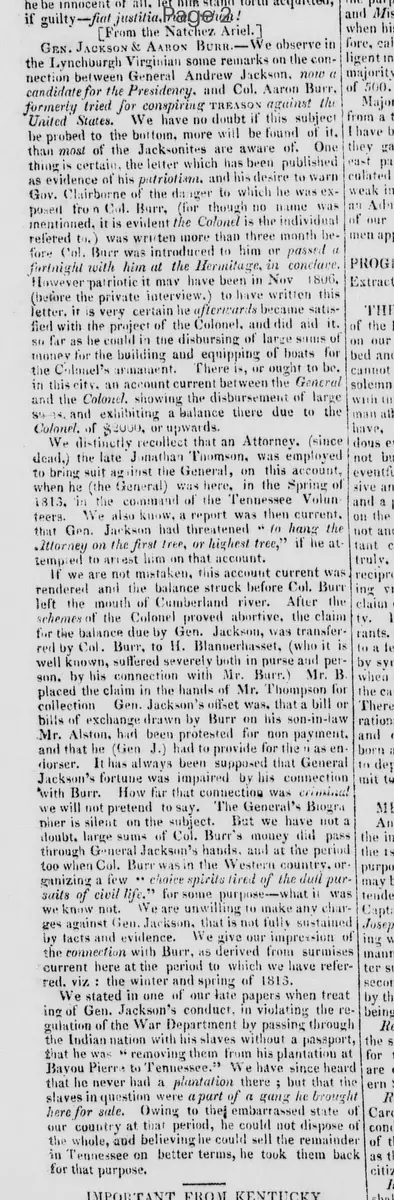
Gen. Jackson & Aaron Burr. We observe in the Lynchburgh Virginian some remarks on the connection between General Andrew Jackson, now a candidate for the Presidency, and Col. Aaron Burr, formerly tried for conspiring treason against the United States. We have no doubt if this subject be probed to the bottom, more will be found of it than most of the Jacksonites are aware of. One thing is certain, the letter which has been published as evidence of his patriotism, and his desire to warn Gov. Claiborne of the danger to which he was exposed from Col. Burr, (for though no name was mentioned, it is evident the Colonel is the individual referred to,) was written more than three months before Col. Burr was introduced to him or passed a fortnight with him at the Hermitage, in conclave. However patriotic it may have been in Nov. 1806, (before the private interview,) to have written this letter, it is very certain he afterwards became satisfied with the project of the Colonel, and did aid it, so far as he could in the disbursing of large sums of money for the building and equipping of boats for the Colonel's armament. There is, or ought to be, in this city, an account current between the General and the Colonel, showing the disbursement of large sums, and exhibiting a balance there due to the Colonel, of $2000, or upwards.
We distinctly recollect that an Attorney, (since dead,) the late Jonathan Thomson, was employed to bring suit against the General, on this account, when he (the General) was here, in the Spring of 1813, in the command of the Tennessee Volunteers. We also know, a report was then current, that Gen. Jackson had threatened "to hang the Attorney on the first tree, or highest tree," if he attempted to arrest him on that account.
If we are not mistaken, this account current was rendered and the balance struck before Col. Burr left the mouth of Cumberland river. After the schemes of the Colonel proved abortive, the claim for the balance due by Gen. Jackson, was transferred by Col. Burr, to H. Blannerhassett, (who it is well known, suffered severely both in purse and person, by his connection with Mr. Burr.) Mr. B. placed the claim in the hands of Mr. Thompson for collection. Gen. Jackson's offset was, that a bill or bills of exchange drawn by Burr on his son-in-law Mr. Alston, had been protested for non-payment, and that he (Gen J.) had to provide for the endorser. It has always been supposed that General Jackson's fortune was impaired by his connection with Burr. How far that connection was criminal we will not pretend to say. The General's Biographer is silent on the subject. But we have not a doubt, large sums of Col. Burr's money did pass through General Jackson's hands, and at the period too when Col. Burr was in the Western country, organizing a few "choice spirits tired of the dull pursuits of civil life." for some purpose—what it was we know not. We are unwilling to make any charges against Gen. Jackson, that is not fully sustained by facts and evidence. We give our impression of the connection with Burr, as derived from surmises current here at the period to which we have referred, viz: the winter and spring of 1806.
We stated in one of our late papers when treating of Gen. Jackson's conduct, in violating the regulation of the War Department by passing through the Indian nation with his slaves without a passport, that he was "removing them from his plantation at Bayou Pierre to Tennessee." We have since heard that he never had a plantation there; but that the slaves in question were a part of a gang he brought here for sale. Owing to the embarrassed state of our country at that period, he could not dispose of the whole, and believing he could sell the remainder in Tennessee on better terms, he took them back for that purpose.
What sub-type of article is it?
What themes does it cover?
What keywords are associated?
What entities or persons were involved?
Where did it happen?
Story Details
Key Persons
Location
Natchez, Hermitage, Mouth Of Cumberland River, Bayou Pierre, Tennessee
Event Date
Nov. 1806, Winter And Spring Of 1806, Spring Of 1813
Story Details
Article alleges Gen. Jackson aided Aaron Burr's treasonous project by disbursing money for boats, with an unsettled account of $2000 due to Burr, later transferred to Blannerhassett; suit threatened in 1813; Jackson's fortune impaired; additional note corrects prior report, stating Jackson transported slaves for sale from Natchez to Tennessee.