Thank you for visiting SNEWPapers!
Sign up free
Foreign News
September 28, 1796
Gazette Of The United States, & Philadelphia Daily Advertiser
Philadelphia, Philadelphia County, Pennsylvania
What is this article about?
An essay from a French representative, published in a London paper, argues for restoring respect for the dead in post-Revolutionary France. It critiques the Revolution's neglect of funeral customs, draws on global historical examples, and urges legislators to uphold moral decency and societal bonds through proper burial practices.
Clipping
OCR Quality
98%
Excellent
Full Text
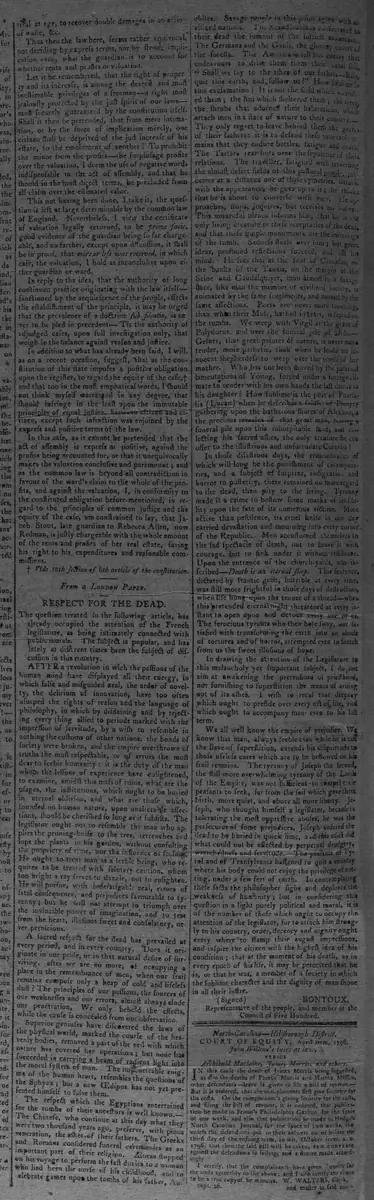
From a London Paper.
RESPECT FOR THE DEAD.
The question treated in the following article, has already occupied the attention of the French legislature, as being intimately connected with public morals. The subject is popular, and has lately at different times been the subject of discussion in this country.
AFTER a revolution in which the passions of the human mind have displayed all their energy, in which false and misguided zeal, the ardor of novelty, the delirium of innovation, have too often usurped the rights of reason and the language of philosophy, in which by disdaining and by rejecting every thing allied to periods marked with the impression of servitude, by a wish to resemble in nothing the customs of other nations, the bonds of society were broken, and the empire overthrown of truths the most respectable, or of errors the most dear to feeble humanity: it is the duty of the man whom the lessons of experience have enlightened, to examine, amidst this mass of ruins, what are the usages, the institutions, which ought to be buried in eternal oblivion, and what are those which, founded on human nature, upon unalterable affections, should be cherished so long as it exists. The legislator ought not to resemble the man who applies the pruning-knife to the tree, retrenches and lops the plants in his garden, without consulting the propriety of time, nor the influence of seasons. He ought to treat man as a sensible being, who requires to be treated with salutary caution, whom too bright a ray serves to dazzle, not to enlighten. He will pursue, with indefatigable zeal, errors of fatal consequence, and prejudices favourable to tyranny: but he will not attempt to triumph over the invincible power of imagination, and to tear from the heart, illusions sweet and consolatory, never pernicious.
A sacred respect for the dead has prevailed at every period, and in every country. Does it originate in our pride, or in that natural desire of surviving, after we are no more, of occupying a place in the remembrance of men, when our frail remains compose only a heap of cold and lifeless dust? The principles of our passions, the sources of our weakness and our errors, almost always elude our penetration. We only behold the effects, while the cause is concealed from our observation. Superior geniuses have discovered the laws of the physical world, marked the course of the heavenly bodies, removed a part of the veil with which nature has covered her operations; but none has succeeded in carrying a beam of radiant light into the moral system of man. The impenetrable enigma of the human heart, resembles the questions of the Sphinx; but a new Oedipus has not yet presented himself to solve them.
The respect which the Egyptians entertained for the tombs of their ancestors is well known. The Chinese, who continue at this day what they were two thousand years ago, preserve, with pious veneration, the ashes of their fathers. The Greeks and Romans considered funeral ceremonies as an important part of their religion. Ulysses stopped on his voyage to perform the last duties to a woman who had been the nurse of his childhood, and to celebrate games upon the tombs of his Father, Achilles—Savage people in this point agree with civilized nations. The Scandinavians consecrated to their dead the summit of the loftiest mountains. The Germans and the Gauls, the gloomy covert of the forests. The Americans tell the enemy that endeavours to drive them from their natal soil, "Shall we say to the ashes of our fathers—fie, quit this earth, and follow us?" How sublime is this exclamation! It is not the field which nourished them; the hut which sheltered them; the trees, the shrubs that adorned their habitations, which attach men in a state of nature to their country.—They only regret to leave behind them the graves of their fathers: it is to defend these venerable remains that they endure battles, fatigue and death.
The Tartars rear huts over the sepulchres of their relations. The traveller, fatigued with traversing the almost desert fields of this pastoral people, perceives at a distance one of these cemeteries. Struck with the appearance, he goes up to it; he thinks that he is about to converse with men. He approaches, stops, inquires, but receives no answer. This mournful silence informs him, that he is the only living creature in these receptacles of the dead, and that these simple monuments are the coverings of the tomb. Sadness steals over him; but great ideas, profound reflections succeed, and fill his mind. He sees that at the foot of Caucasus, on the banks of the Tanais, on the margin of the Seine and Guadalquiver, man almost in a savage state, like man the member of civilized society, is animated by the same sentiments, and moved by the same affections. Poets are never more touching, than when their Muse, bathed in tears, is seated on the tombs. We weep with Virgil at the grave of Polydorus, and over the funeral pile of Dido. Genius, that great painter of nature, is never more tender, more pathetic, than when he leads an innocent shepherdess to weep over the tomb of her mother. Who has not been moved by the paternal lamentations of Young, forced under a foreign clime to render with his own hands the last duties to his daughter? How sublime is the poet of Pompey (Lucan) when he describes Cornelia's oldists gathering upon the barbarous shores of Alexandria the precious remains of that great man, rearing a funeral pile upon this inhospitable sand, and collecting his sacred ashes, the only treasure he can offer to the illustrious and unfortunate Cornelia!
In those disastrous days, the remembrance of which will long be the punishment of contemporaries, and a subject of surprise, indignation and horror to posterity, there remained no more regard to the dead, than pity to the living. Tyranny made it a crime to bestow some marks of sensibility upon the fate of its numerous victims. More active than pestilence, its cruel knife in one day carried devastation and mourning into every corner of the Republic. Men accustomed themselves to the sad spectacle of death, not to brave it with courage, but to sink under it without resistance. Upon the entrance of the church-yards, was inscribed—Death is an eternal sleep. This sentence, dictated by frantic guilt, horrible at every time, was still more frightful in those days of destruction, when life hung upon the tenure of a thread—when this pretended eternal night threatened at every instant to open upon and devour every one of us.
The ferocious tyrants who then bore sway, not satisfied with transforming the earth into an abode of tortures and of horror, attempted even to snatch from us the sweet illusions of hope.
In drawing the attention of the Legislature to this melancholy yet important subject, I do not aim at awakening the pretensions of priesthood, nor furnishing to superstition the means of arising out of its ashes. I wish to recall that decency which ought to preside over every act of life, and which ought to accompany man even to his last term.
We all well know the empire of prejudice. We know that man, always feeble even while he is not the slave of superstition, extends his disquietude to those useless cares which are to be bestowed on his frail remains. The tyranny of Joseph the second, the still more overwhelming tyranny of the Lords of the Empire, was not sufficient to compel their peasants to seek, far from the soil which gave them birth, more quiet, and above all more liberty. Joseph, who thought himself a legislator, because in tolerating the most oppressive abuses, he was the persecutor of some prejudices, Joseph ordered the dead to be buried in quick lime, and this edict did what could not be effected by perpetual drudgery, wretchedness and Servitude. The peasants of Tyrol and of Transylvania hastened to quit a country where his body could not enjoy the privilege of rotting, under a few feet of earth. In contemplating these acts the philosopher sighs and deplores the weakness of humanity: but in considering this question in a light purely political and moral, it is of the number of those which ought to occupy the attention of the legislator, for to attach him strongly to his country, order, decency and dignity ought every where to stamp their august impressions, and inspire the citizen with the highest ideas of his condition; that at the moment of his death, as in every epoch of his life, it may be perceived that he is, or that he was, a member of a society in which the sublime character and the dignity of man shine in all their lustre.
(Signed) BONTOUX.
Representative of the people, and member of the Council of Five Hundred.
RESPECT FOR THE DEAD.
The question treated in the following article, has already occupied the attention of the French legislature, as being intimately connected with public morals. The subject is popular, and has lately at different times been the subject of discussion in this country.
AFTER a revolution in which the passions of the human mind have displayed all their energy, in which false and misguided zeal, the ardor of novelty, the delirium of innovation, have too often usurped the rights of reason and the language of philosophy, in which by disdaining and by rejecting every thing allied to periods marked with the impression of servitude, by a wish to resemble in nothing the customs of other nations, the bonds of society were broken, and the empire overthrown of truths the most respectable, or of errors the most dear to feeble humanity: it is the duty of the man whom the lessons of experience have enlightened, to examine, amidst this mass of ruins, what are the usages, the institutions, which ought to be buried in eternal oblivion, and what are those which, founded on human nature, upon unalterable affections, should be cherished so long as it exists. The legislator ought not to resemble the man who applies the pruning-knife to the tree, retrenches and lops the plants in his garden, without consulting the propriety of time, nor the influence of seasons. He ought to treat man as a sensible being, who requires to be treated with salutary caution, whom too bright a ray serves to dazzle, not to enlighten. He will pursue, with indefatigable zeal, errors of fatal consequence, and prejudices favourable to tyranny: but he will not attempt to triumph over the invincible power of imagination, and to tear from the heart, illusions sweet and consolatory, never pernicious.
A sacred respect for the dead has prevailed at every period, and in every country. Does it originate in our pride, or in that natural desire of surviving, after we are no more, of occupying a place in the remembrance of men, when our frail remains compose only a heap of cold and lifeless dust? The principles of our passions, the sources of our weakness and our errors, almost always elude our penetration. We only behold the effects, while the cause is concealed from our observation. Superior geniuses have discovered the laws of the physical world, marked the course of the heavenly bodies, removed a part of the veil with which nature has covered her operations; but none has succeeded in carrying a beam of radiant light into the moral system of man. The impenetrable enigma of the human heart, resembles the questions of the Sphinx; but a new Oedipus has not yet presented himself to solve them.
The respect which the Egyptians entertained for the tombs of their ancestors is well known. The Chinese, who continue at this day what they were two thousand years ago, preserve, with pious veneration, the ashes of their fathers. The Greeks and Romans considered funeral ceremonies as an important part of their religion. Ulysses stopped on his voyage to perform the last duties to a woman who had been the nurse of his childhood, and to celebrate games upon the tombs of his Father, Achilles—Savage people in this point agree with civilized nations. The Scandinavians consecrated to their dead the summit of the loftiest mountains. The Germans and the Gauls, the gloomy covert of the forests. The Americans tell the enemy that endeavours to drive them from their natal soil, "Shall we say to the ashes of our fathers—fie, quit this earth, and follow us?" How sublime is this exclamation! It is not the field which nourished them; the hut which sheltered them; the trees, the shrubs that adorned their habitations, which attach men in a state of nature to their country.—They only regret to leave behind them the graves of their fathers: it is to defend these venerable remains that they endure battles, fatigue and death.
The Tartars rear huts over the sepulchres of their relations. The traveller, fatigued with traversing the almost desert fields of this pastoral people, perceives at a distance one of these cemeteries. Struck with the appearance, he goes up to it; he thinks that he is about to converse with men. He approaches, stops, inquires, but receives no answer. This mournful silence informs him, that he is the only living creature in these receptacles of the dead, and that these simple monuments are the coverings of the tomb. Sadness steals over him; but great ideas, profound reflections succeed, and fill his mind. He sees that at the foot of Caucasus, on the banks of the Tanais, on the margin of the Seine and Guadalquiver, man almost in a savage state, like man the member of civilized society, is animated by the same sentiments, and moved by the same affections. Poets are never more touching, than when their Muse, bathed in tears, is seated on the tombs. We weep with Virgil at the grave of Polydorus, and over the funeral pile of Dido. Genius, that great painter of nature, is never more tender, more pathetic, than when he leads an innocent shepherdess to weep over the tomb of her mother. Who has not been moved by the paternal lamentations of Young, forced under a foreign clime to render with his own hands the last duties to his daughter? How sublime is the poet of Pompey (Lucan) when he describes Cornelia's oldists gathering upon the barbarous shores of Alexandria the precious remains of that great man, rearing a funeral pile upon this inhospitable sand, and collecting his sacred ashes, the only treasure he can offer to the illustrious and unfortunate Cornelia!
In those disastrous days, the remembrance of which will long be the punishment of contemporaries, and a subject of surprise, indignation and horror to posterity, there remained no more regard to the dead, than pity to the living. Tyranny made it a crime to bestow some marks of sensibility upon the fate of its numerous victims. More active than pestilence, its cruel knife in one day carried devastation and mourning into every corner of the Republic. Men accustomed themselves to the sad spectacle of death, not to brave it with courage, but to sink under it without resistance. Upon the entrance of the church-yards, was inscribed—Death is an eternal sleep. This sentence, dictated by frantic guilt, horrible at every time, was still more frightful in those days of destruction, when life hung upon the tenure of a thread—when this pretended eternal night threatened at every instant to open upon and devour every one of us.
The ferocious tyrants who then bore sway, not satisfied with transforming the earth into an abode of tortures and of horror, attempted even to snatch from us the sweet illusions of hope.
In drawing the attention of the Legislature to this melancholy yet important subject, I do not aim at awakening the pretensions of priesthood, nor furnishing to superstition the means of arising out of its ashes. I wish to recall that decency which ought to preside over every act of life, and which ought to accompany man even to his last term.
We all well know the empire of prejudice. We know that man, always feeble even while he is not the slave of superstition, extends his disquietude to those useless cares which are to be bestowed on his frail remains. The tyranny of Joseph the second, the still more overwhelming tyranny of the Lords of the Empire, was not sufficient to compel their peasants to seek, far from the soil which gave them birth, more quiet, and above all more liberty. Joseph, who thought himself a legislator, because in tolerating the most oppressive abuses, he was the persecutor of some prejudices, Joseph ordered the dead to be buried in quick lime, and this edict did what could not be effected by perpetual drudgery, wretchedness and Servitude. The peasants of Tyrol and of Transylvania hastened to quit a country where his body could not enjoy the privilege of rotting, under a few feet of earth. In contemplating these acts the philosopher sighs and deplores the weakness of humanity: but in considering this question in a light purely political and moral, it is of the number of those which ought to occupy the attention of the legislator, for to attach him strongly to his country, order, decency and dignity ought every where to stamp their august impressions, and inspire the citizen with the highest ideas of his condition; that at the moment of his death, as in every epoch of his life, it may be perceived that he is, or that he was, a member of a society in which the sublime character and the dignity of man shine in all their lustre.
(Signed) BONTOUX.
Representative of the people, and member of the Council of Five Hundred.
What sub-type of article is it?
Political
What keywords are associated?
French Revolution
Respect For Dead
Funeral Customs
French Legislature
Public Morals
What entities or persons were involved?
Bontoux
Where did it happen?
France
Foreign News Details
Primary Location
France
Key Persons
Bontoux
Event Details
An essay by French representative Bontoux urges the legislature to restore respect for the dead, critiquing the Revolution's disregard for funeral customs and drawing on historical and cultural examples to emphasize moral and societal importance.