Thank you for visiting SNEWPapers!
Sign up free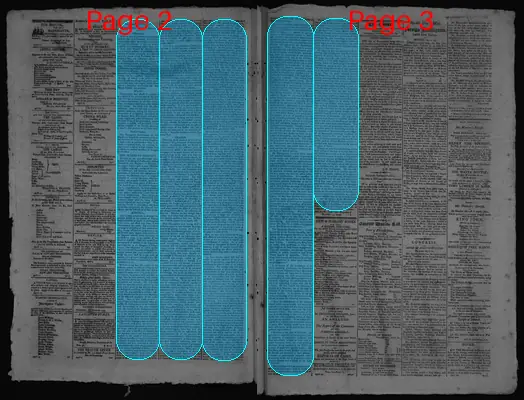
Gazette Of The United States, & Philadelphia Daily Advertiser
Philadelphia, Philadelphia County, Pennsylvania
What is this article about?
British analysis of European politics amid war with France: criticizes Prussian neutrality, Spanish subservience, Portuguese vulnerability, German divisions, Austrian inconsistencies including Swiss retreat, and French coup establishing Consulate under Sieyes and Buonaparte, assessing implications for peace and royalty restoration.
Merged-components note: Continuation of the same 'British Summary of Politics' article across pages 2 and 3.
Clippings
1 of 2
OCR Quality
Full Text
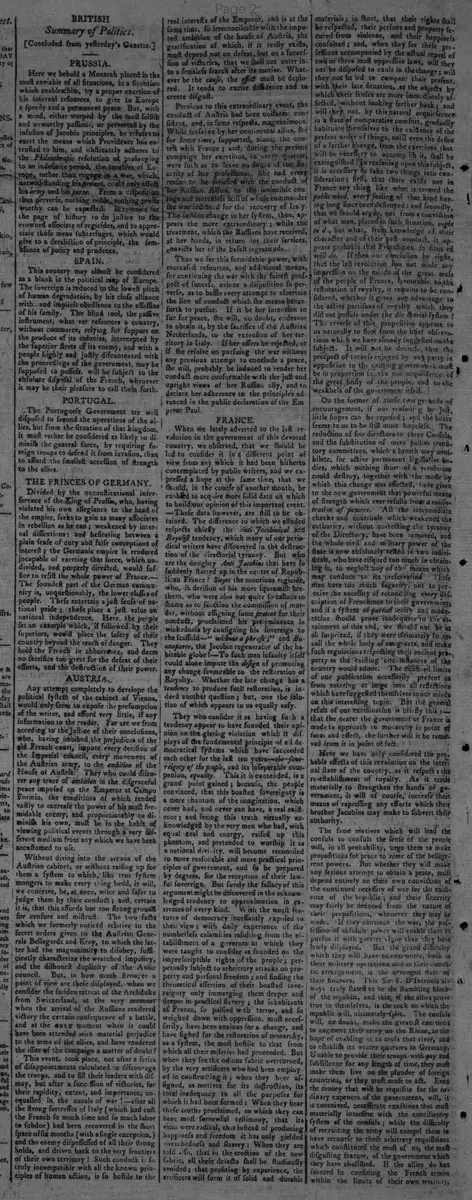
Summary of Politics.
[Concluded from yesterday's Gazette.]
PRUSSIA.
Here we behold a Monarch placed in the most enviable of all situations, in a situation which enables him, by a proper exertion of his internal resources, to give to Europe a speedy and a permanent peace. But, with a mind, either warped by the most selfish and unworthy passions, or perverted by the infusion of Jacobin principles, he refuses to exert the means which Providence has entrusted to him, and obstinately adheres to the Philanthropic resolution of prolonging to an indefinite period those troubles of Europe, rather than engage in a war, which notwithstanding his pretext, could only affect his army and his purse. From a disposition thus perverse, nothing noble, nothing praiseworthy can be expected. It remains for the page of history to do justice to the crowned associate of regicides, and to appreciate those mean subterfuges, which would give to a dereliction of principle, the semblance of policy and prudence.
SPAIN.
This country may almost be considered as a blank in the political map of Europe. The sovereign is reduced to the lowest pitch of human degradation, by his close alliance with, and implicit obedience to the assassins of his family. The blind tool, the passive instrument, whatever resources a country, without commerce, relying for support on the produce of its colonies; intercepted by the superior fleets of its enemy, and with a people highly and justly discontented with the proceedings of the government, may be supposed to possess, will be subject to the absolute disposal of the French, whenever it may be their pleasure to call them forth.
PORTUGAL.
The Portuguese Government are well disposed to second the operations of the allies, but from the situation of that kingdom, it must rather be considered as likely to diminish the general force, by requiring foreign troops to defend it from invasion, than to afford the smallest accession of strength to the allies.
THE PRINCES OF GERMANY.
Divided by the unconstitutional interference of the King of Prussia, who, having violated his own allegiance to the head of the empire, seeks to gain as many associates in rebellion as he can; weakened by internal dissensions: and hesitating between a plain sense of duty and false conceptions of interest, the Germanic empire is rendered incapable of exerting that force, which undivided, and properly directed, would suffice to resist the whole power of France. — The soundest part of the German community is, unquestionably, the lower classes of people. These entertain a just sense of national pride—they place a just value on national independence. Here, the people set an example which, if followed by their superiors, would place the safety of their country beyond the reach of danger. They hold the French in abhorrence, and deem no sacrifice too great for the defeat of their efforts, and the destruction of their power.
AUSTRIA.
Any attempt completely to develope the political system of the cabinet of Vienna, would only serve to expose the presumption of the writer, and afford very little, if any information to the reader. Far are we from acceding to the justice of their conclusions, who, having imbibed the prejudices of the old French court, impute every decision of the Imperial council, every movement of the Austrian army, to the ambition of the House of Austria. They who could discover any trace of ambition in the disgraceful peace imposed on the Emperor at Campo Formio, the conditions of which tended vastly to increase the power of his most formidable enemy, and proportionably to diminish his own, must be in the habit of viewing political events through a very different medium from any which we have been accustomed to use.
Without diving into the arcana of the Austrian cabinet, or without raising up for them a system to which, like true system mongers to make every thing fit, it will, we conceive, be, at once, wiser and safer to judge them by their conduct; and, certain it is, that this affords but too strong ground for censure and mistrust. The two facts which we formerly noticed relative to the secret orders given to the Austrian Generals Bellegarde and Kray, to which the latter had the magnanimity to disobey, sufficiently characterize the wretched impolicy, and the dishonest duplicity of the Aulic council. But, in how much stronger a point of view are these displayed, when we consider the sudden retreat of the Archduke from Switzerland, at the very moment when the arrival of the Russians rendered victory the certain consequence of a battle, and at the only moment when it could have been attended with material prejudice to the arms of the allies, and have rendered the issue of the campaign a matter of doubt?
This event, took place, not after a series of disappointments calculated to discourage the troops, and to fill their leaders with dismay, but after a succession of victories, for their rapidity, extent, and importance, unequalled in, the annals of war !-after all the strong fortresses of Italy (which had cost the French so much time and so much labor to subdue) had been recovered in the short space of six months (with single exception,) and the enemy dispossessed of all their strong holds, and driven back to the very frontiers of their own territory! Such conduct is so truly incompatible with all the known principles of human action, is so hostile to the real interests of the Emperor, and is at the same time, so irreconcileable with the imputed ambition of the house of Austria, the gratification of which, if it really exists, must depend not on defeat, but on a succession of victories, that we shall not enter into a fruitless search after its motive. Whatever be the cause, the effect must be deplored. It tends to excite diffidence and to create disgust.
Previous to this extraordinary event, the conduct of Austria had been uniform: consistent. and, in some respects, magnanimous. While forsaken by her continental allies, she for some time, supported, alone, the contest with France ; and, during the present campaign her exertions, in every quarter, were such as to leave no doubt of the sincerity of her professions.. She had every reason to -be satisfied with the conduct of her Russian Allies. to the invincible courage and matchless skill of whose commander she was indebted for the recovery of Italy.
The sudden change in her system, then, appears the more extraordinary ; while the treatment, which the Russians have received, at her hands, in return for their services, convicts her of the basest ingratitude.
Thus we see this formidable power, with increased resources, and additional means, for continuing the war with the fairest prospect of success. evince a disposition so perverse, as to baffle every attempt to ascertain the line of conduct which she means henceforth to pursue. If it be her intention to sue for peace, she will, no doubt, endeavor to obtain it, by the sacrifice of the Austrian Netherlands, to the extension of her territory in Italy. If her offers be rejected, or if she resolve on pursuing the war without any previous attempt to conclude a peace, she will, probably be induced to render her conduct more conformable with the just and upright views of her Russian ally, and to declare her adherence to the principles advanced in the public declaration of the Emperor Paul.
FRANCE.
When we lately adverted to the last revolution in the government of this devoted country, we observed, that we should be led to consider it in'a different point of view from any which it had been hitherto contemplated by public writers, and we expressed a hope at the same time, that we should, in the course of another month, be enabled to acquire more solid data on which to build our opinion of this important event. -These data however, are still to be obtained. The difference to which we alluded respects chiefly the anti-Jacobin and Royalist tendency, which many of our periodical writers have discovered in. the destruction of the directorial tyranny. But who are the doughty Anti Jacobins that have so suddenly started up in the centre of Republican France ? Sieyes the notorious regicide, who, in derision of his more squeamish brethren, who were then not quite so callous to shame as to sanction the commission of murder, without assigning some pretext for their , conduct, proclaimed his pre-eminence in wickedness by consigning his sovereign to the scaffold-" without a phrase ;" and Buonaparte, the Jacobin regenerator of the habitable globe!To such men insanity itself could alone impute the design of promoting any change favourable to the restoration of Royalty. Whether the late change· has a tendency to produce such restoration, is indeed another question; but, one the solution of which appears to us equally easy.
They who consider it as having such a tendency appear to have founded their opinion on the glaring violation which it displays of the fundamental principle of all democratical systems which have succeeded each other for the last ten years-the sovereignty of the people, and its inseparable companion, equality. . This it is contended, is a grand point gained ; because, the people convinced, that this boasted sovereignty is a mere phantom of the imagination, which never had, and never can have, a real existence; and seeing, this truth virtually acknowledged by the very men who had, with equal zeal and energy, raised up this phantom, and pretended to worship it as a national divinity, will become reconciled to more reasonable and more practical principles of government, and so be prepared by degrees, for the reception of their lawful sovereign. But surely the fallacyof this argument might be discovered in the acknowledged tendency to approximation in extremes of every·kind. With the worst features of democracy incessantly exposed to their view; with daily experience of the numberless calamities resulting from the establishment of a government which they were taught to consider as founded on the imprescriptible rights of the people ; perpetually subject to arbitrary attacks on property and personal freedom ; and finding the theoretical assertion of their boasted sovereignty only immersing them deeper and deeper in practical slavery ; the inhabitants of France, so palsied with terror, and so weighed down with oppression, must necessarily, have been anxious for a change, and have sighed for the restoration of monarchy, as a system, the most hostile to that from which all their miseries had proceeded. But when they see the odious fabric overturned, by the very artificers who had been employed in constructing it ; when they hear assigned, as motives for its destruction, its total inadequacy to all the purposes for which it had been formed : When they hear these truths proclaimed, to which they can bear most sorrowful testimony, that its vices were radical, that instead of producing happiness and freedom it has only yielded wretchedness and slavery: When they are told also, that in the erection of the new fabric, all these defects shall be. studiously avoided; that profiting/by experience, the artificers will form it of solid and durable materials; in short, that their rights shall be respected, their persons and property secured from violence, and their happiness consulted; and, when they see these professions accompanied by the actual repeal of two or three most oppressive laws, will they not be disposed to exult in thechange; will they not be led to compare their present, with their late situation, as the objects by which their senses are more immediately affected, without looking farther back; and will they not, by this natural acquiescence in a state of comparative comfort, gradually habituate themselves to the existence of the present order of things, until even the desire of a farther change, from the exertions_ that will be necessary to accomplish it, shall be extinguished ? In reasoning upon this subject, it is necessary to take two things into consideration; first, that there exists not in France any thing like what is termed the public mind, every feeling of that kind having long since been destroyed : and secondly, that we should argue, not from a conviction of what men, placed in such situation, ought to do, but what, from knowledge of their character and oftheir past conduct, it appears probable that Frenchmen so situated will do. Ifthen our conclusion be .right, that the last revolution has not made any impression on the minds of the great mass of the people of France, favourable to the restoration of royalty, it remains to be considered, whether it gives any advantage to the active partizans of royalty which they did not possess under the directorial system ?
The reverse of this proposition appears to us naturally to flow from the brief observations whi. h we have already suggested on the subject. It will_ not, be denied, that. the prospect of success enjoyed by an party in opposition to the existing g overnment must be in proportion to. the non acquiescence of the great body of the people, and to the weakness of the government itself.
On the former of these two grounds of encouragement, if our reasoning be just. little hopes can be reposed ; and the latter seems to us to be still more hopeless. The reduction of five directors to three Consuls and the substitution of mere passive transitory committees, which a breath may annihilate, for active permanent legislative bodies, which nothing short of a revolution could destroy, together with' the mode by which this change was effected, have given to the new government that powerful means of strength which ever results from a concentration of powers. All the intermediate checks and controuls which weakened the authority, without correcting the tyranny of the Directory, have been removed, and the whole civil and m ilitary power of the tate is now absolutely vested in two individuals, who have risked too much in obtaining it, to neglect any of th." means which may conduce to its preservation. These men have too much sagacity, not to perceive the necessity of reconciling every description of Frenchmen to their government; and if a system of partial lenity and moderation should prove inadequate to the attainment of this end, we 'should not be at all surprised, if they were ultimately to recall the whole body of emigrants; and make such regulations respecting their ancient pr.,operty as the existing circumstances of the country would admit. The confined limits of our publication necessarily prevent us from entering at large into all reflections which have suggested themselves to our minds on this interesting topic. Bot the general result of our examination is briefly this :-
that the nearer the government ot France is made to approach to monarchy in point of form and effect, the further will it be removed from it in point of fact.
Here we have only considered the probable effects of this revolution on the internal state of the country, as-it respects the re-establishment of royalty. As it tends materially so strengthen the hands of government, it will of course, increase their. means of repressing any efforts which their brother Jacobins may make to subvert their authority.
The same motives which will lead the consuls to consult the sense of the people will, in all probability, urge them to make propositions fof peace to some of the bellige-rent powers. But whether they will make any serious attempt to obtain a peace, must depend entirely on their own conviction of the continued necessity of war for the existence of the republic; and their sincerity may fairly be deduced from the nature of their propositions, whenever they may be made. If they continue the war, the possession of absolute power will enable them to pursue it with greater vigor than they have lately displayed. But thé grand difficulty which they will have toenecounter, both in their military operations aud in their comef-tic arraugement, is the deranged state of. their finances. This Sir F. D'Ivernois al-ways truly stated to be the stumbling block-of the republic, and this, if the allies prove true to themselves, is the rock on which the .republic will, ultimately-split. The consuls will, no doubt, make the greatest exertions to augment their army on the Rhine, in the hope of enabling it to cross that river, and to establish its winter quarters in Germany.
Unable to provide their troops with pay and subsistence for any length of time, they must make them live on the plunder of foreign countries, or they must cease to act. Even the money that will be requisite for the or-dinary expences of the government, will, it is conceived, necessitate exactions that must materially interfere with the conciliatory system of the consuls ; while the difficulty of recruiting the army will compel them to have recourse to those arbitrary requisitions which constituted the most of us, the most -disgusting feature, of the government which they have abolished. If the allies do but succeed in confining the French armies within the limits of their own territory, During the winter, they will have gained an important advantage.
As to the immediate causes of this strange revolution, accounts vary so materially that it is scarcely possible to trace them with tolerable accuracy. It appears to us, that Sieyes, in his diplomatic retreat at Berlin, had long since appreciated the defects in the republican system, and resolved, whenever an opportunity should occur, to establish a more effective and apparently less objectionable government. With this view he accepted an ostensible and responsible situation which he had invariably refused before, not doubting, from his knowledge of the men who were associated with him in the directory, that he should speedily acquire that complete ascendancy that would enable him to carry into execution his favorite plan of reform. He very soon, however, perceived his mistake; the active jacobins prevailed; every measure he proposed was rejected; and he constantly found himself, in all leading questions, in a minority. This neither suited his disposition nor squared views. But he had no other means of bringing his plan to succeed—unless he could engage in his interest some person who had an entire influence over the army. We have been assured, that this consideration led him to dispatch orders to Egypt for the return of Buonaparte, though of course he was too cautious to apprise the Corsican marauder of the scheme in the execution of which he meant to employ him. Meanwhile if our information be correct (though we beg to be understood as not vouching for the authenticity of these facts) Barras, who had played a distinguished part in all preceding revolutions, suspecting probably, that Sieyes had some project in view, resolved to anticipate him, and absolutely formed a plan for the restoration of monarchy. This plan however, was discovered, and it was then perhaps, that in order to avert the vengeance which awaited him, and farther to court the protection of Buonaparte, that Barras proposed to place the crown on his head. That a similar proposition was made we learn from one or Buonaparte's own declarations—how it was received we may collect from his conduct and from the subsequent retreat of Barras from the field of politics.
On Buonaparte's arrival at Paris, Sieyes first unfolded himself; a plan so gratifying to the vanity and ambition of the former could not fail to meet his approbation—it was accordingly resolved on, and a few hours sufficed to destroy a constitution, which every man in the country had solemnly sworn to maintain inviolate, and among the rest the very troops who were the active instruments of its destruction. It is impossible to contemplate the varied events of the French revolution without shuddering at the extreme moral turpitude of the people, as evinced in their sovereign contempt of the sacred obligation of an oath. And in this respect, and indeed in every other, the troops have an indisputable claim to pre-eminence in profligacy, for they have not only been the first to violate oaths themselves, but have employed the terror of their arms to impel their countrymen to the commission of perjury. History scarcely exhibits an example of such systematic wickedness as has marked the conduct of the French army. When they became traitors to their sovereign and shook off their allegiance to him, they seem to have shaken off all respect for religion, and moral feeling. And yet these were the men whom Mr. Fox did not blush to panegyrize in the British House of Commons!
The Executive Directory had a perfect knowledge of the Jacobin character, and if Sieyes and Buonaparte had sat for the following picture, drawn in the month of March last, the likeness could not have been more striking. "Nothing can bring back to reason those perfidious or insane men who laugh at the most solemn engagements. They are ambitious, and attempt by every method, to possess themselves once more of the bloody sceptre of despotism. They are stung with remorse and dread to be consigned to punishment in every place where they do not predominate."
In the course of this revolution, as in every preceding revolution, the French republicans have displayed extreme ingratitude to their friends and supporters in this country—by giving the most unequivocal contradiction to all their assertions and their arguments respecting the practicability and safety of concluding a peace with the Directory. On this subject the testimony of Boulay de la Meurthe, one of the most intelligent of the French legislators, will be deemed decisive. In his speech, at the last nocturnal meeting of the old councils at St. Cloud, he made the following declaration.
"Since the establishment of the constitutional system, our principles and our public characters have been still less fixed, have offered still less security, than under the revolutionary system. The continuance of the war is chiefly owing to the want of a wise, fixed, and truly republican system of diplomacy among ourselves. If we wished to establish such a system and to conclude treaties of peace, what security would there be for their observance, in the present state of our political organization?
Previous to the 18th of Fructidor, the government exhibited to foreign powers every symptom of a precarious existence, and they accordingly refused to treat with it. After that great event, the whole power of the State being centered in the Directory, treaties of peace were speedily broken; the Directory, after having stricken terror into all Europe and destroyed at their pleasure, a number of governments incapable either of carrying on the war or of making a peace, were overturned with a breath on the 30th of Prairial.
Thus judging only from notorious facts, the French government must be considered as having nothing fixed, either in respect of men or things."
What sub-type of article is it?
What keywords are associated?
What entities or persons were involved?
Where did it happen?
Foreign News Details
Primary Location
Europe
Key Persons
Outcome
austrian retreat from switzerland after victories; french directory overthrown, replaced by consulate under three consuls, strengthening government against jacobins and for potential peace negotiations; no specific casualties reported.
Event Details
British commentary on European politics: Prussia's neutral stance prolongs war; Spain subservient to France; Portugal needs defense; German princes divided; Austria's inconsistent actions, including secret orders to generals and sudden Swiss retreat despite Russian aid and Italian successes, showing ingratitude; French coup by Sieyes and Buonaparte ends Directory, establishes Consulate, concentrates power, unlikely to restore royalty but may seek peace; critiques French unreliability in treaties.