Thank you for visiting SNEWPapers!
Sign up free
Alexandria Gazette
Alexandria, Alexandria County, District Of Columbia
What is this article about?
In 1834 Richmond correspondence, supporters urge Senator B.W. Leigh to clarify his Senate speech on the Bank of the United States amid misrepresentations. Leigh responds, affirming his constitutional opposition to a national bank, warning of executive-controlled alternatives, and pledging to follow state instructions.
Clipping
OCR Quality
Full Text
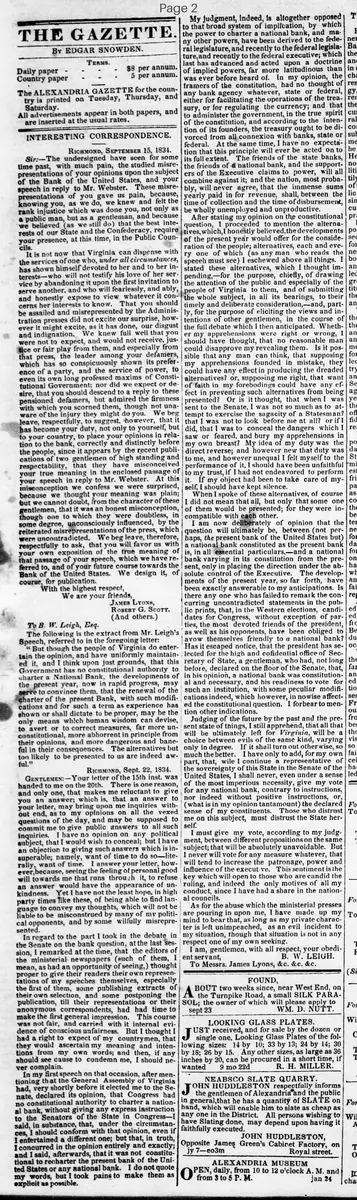
RICHMOND, SEPTEMBER 15, 1834.
Sir:—The undersigned have seen for some time past, with much pain, the studied misrepresentations of your opinions upon the subject of the Bank of the United States, and your speech in reply to Mr. Webster. These misrepresentations of you gave us pain, because, knowing you, as we do, we knew and felt the rank injustice which was done you, not only as a public man, but as a gentleman, and because your presence, at this time, in the Public Councils of our State and the Confederacy, requires that you should be assailed and misrepresented by the Administration presses did not excite our surprise.however it might excite, as it has done, our disgust and indignation. We knew full well that you were not to expect, and would not receive, justice or fair play from them, and especially from that press, the leader among your defamers which has so conspicuously shown its preference of a party, and the service of power. to even its own long professed maxims of Constitutional Government; nor did we expect or desire, that you should descend to a reply to these pensioned defamers, but admired the firmness with which you scorned them, though not unaware of the injury they might do you. We beg leave, respectfully, to suggest, however, that it has become your duty, not only to yourself, but to your country, to place your opinions in relation to the bank, correctly and distinctly before the people, since it appears by the recent publications of two gentlemen of high standing and respectability, that they have misconceived your true meaning in the enclosed passage of your speech in reply to Mr. Webster. At this misconception we confess we were surprised, because we thought your meaning was plain; but we cannot doubt, from the character of these gentlemen, that it was an honest misconception, though one to which they were doubtless, in some degree, unconsciously influenced, by the reiterated misrepresentations of the press, which were uncontradicted. We beg leave, therefore, respectfully to ask, that you will favor us with your own exposition of the true meaning of that passage of your speech, which we have referred to, and of your future course towards the Bank of the United States. We design it, of course, for publication.
With the highest respect,
We are your friends,
James Lyons,
Robert G. Scott.
(And others.)
To B. W. Leigh, Esq.
The following is the extract from Mr. Leigh's Speech, referred to in the foregoing letter:
"But though the people of Virginia do entertain the opinion, and have uniformly maintained it, and I think upon just grounds, that this Government has no constitutional authority to charter a National Bank, the developments of the present year, now in rapid progress, may serve to convince them, that the renewal of the charter of the present Bank, with such modifications and for such a term as experience has shown or shall dictate to be proper, may be the only means which human wisdom can devise, to avert or to correct measures, far more unconstitutional, more abhorrent in principle from their opinions, and more dangerous and baneful in their consequences. The alternatives but too likely to be presented to us are indeed awful."
RICHMOND, Sept. 22. 1834.
Gentlemen:—Your letter of the 15th inst. was handed to me on the 20th. There is one reason, and only one, that makes me reluctant to give you an answer; which is. that an answer to your letter, may bring upon me inquiries without end, as to my opinions on all the vexed questions of the day, and may be supposed to commit me to give public answers to all such inquiries. I have no opinion on any political subject, that I would wish to conceal; but I have an objection to giving such answers which is insuperable; namely, want of time to do so—literally, want of time. I answer your letter, however, because, seeing the feeling of personal good will towards me that runs through it, to refuse an answer would have the appearance of unkindness. Yet I have not the least hope. in high party times like these, of being able to find language to convey my thoughts, which will not be liable to be misconstrued by many of my political opponents, and by some wilfully misrepresented.
In regard to the part I took in the debate in the Senate on the bank question, at the last session, I remarked at the time, that the editors of the ministerial newspapers (such of them, I mean, as had an opportunity of seeing,) thought proper to give their readers their own representations of my speeches themselves, especially the first of them, some publishing extracts of their own selection, and some postponing the publication, till their representations or their anonymous correspondents, had had time to make the first general impression. This course was not fair, and carried with it internal evidence of conscious unfairness. But I thought I had a right to expect of my countrymen, that they would ascertain my meaning and intentions from my own words; and then, if any should see cause to condemn me, I should never complain.
In my first speech on that occasion, after mentioning that the General Assembly of Virginia had, very shortly before it elected me to the Senate, declared its opinion, that Congress had no constitutional authority to charter a national bank, without giving any express instruction to the Senators of the State in Congress—I said, in substance, that, under the circumstances, I should conform with that opinion, even if I entertained a different one; but that, in truth, I concurred in the opinion entirely and exactly; and I said, afterwards, that it was not constitutional to recharter the present bank of the United States or any national bank. I do not quote my words, but I took pains to make them as explicit as possible.
My judgment, indeed, is altogether opposed to that broad system of implication, by which the power to charter a national bank, and many other powers, have been derived to the federal legislature, and recently to the federal executive; which last has advanced and acted upon a doctrine of implied powers, far more latitudinous than was ever before heard of. In my opinion, the framers of the constitution, had no thought of any bank agency whatever, state or federal, either for facilitating the operations of the treasury, or for regulating the currency; and that to administer the government, in the true spirit of the constitution, and according to the intention of its founders, the treasury ought to be divorced from all connexion with banks, state or federal. At the same time, I have no expectation that this principle will ever be acted on to its full extent. The friends of the state banks, the friends of a national bank, and the supporters of the Executive claims to power, will all combine against it; and the nation, most probably, will never agree, that the immense sums yearly paid in—for revenue. shall, between the time of collection and the time of disbursement. be wholly unemployed and unproductive.
After stating my opinion on the constitutional question, I proceeded to mention the alternatives, which, I honestly believed, the developments of the present year would offer for the consideration of the people; alternatives, each and every one of which (as any man who reads the speech must see) I eschewed above all things. I stated these alternatives, which I thought impending,—for the purpose, chiefly, of drawing the attention of the public and especially of the people of Virginia to them, and of submitting the whole subject, in all its bearings, to their timely and deliberate consideration,—and, partly, for the purpose of eliciting the views and intentions of other gentlemen, in the course of the full debate which I then anticipated. Whether my apprehensions were right or wrong, I should have thought, that no reasonable man could disapprove my revealing them. Is it possible that any man can think, that supposing my apprehensions founded in mistake, they could have any effect in producing the dreaded alternatives? or, supposing me right, that want of faith in my forebodings could have any effect in preventing such alternatives from being presented? Or is it thought, that when I was sent to the Senate, I was not so much as to attempt to exercise the sagacity of a Statesman? that I was not to look before me at all? or if I did, that I was to conceal the dangers which I saw or feared, and bury my apprehensions in my own breast? My idea of my duty was the direct reverse; and however new that duty was to me, and however unequal I felt myself to the performance of it, I should have been unfaithful to my trust, if I had not endeavored to perform it. if my object had been to take care of myself, I should have kept silence.
When I spoke of these alternatives, of course I did not mean that all, but only that some one of them would be presented: for they were incompatible with each other.
I am now deliberately of opinion that the question will ultimately be, between (not perhaps, the present bank of the United States but) a national bank constituted as the present bank is, in all essential particulars,—and a national bank varying in its constitution from the present, only in placing the direction under the absolute control of the Executive. The developments of the present year, so far forth, have been exactly answerable to my anticipations. Is there any one who has failed to remark the concurring uncontradicted statements in the public prints, that, in the Western elections. candidates for Congress, without exception of parties, the most devoted friends of the president, as well as his opponents, have been obliged to avow themselves friendly to a national bank? Has it escaped notice, that the president has selected for the high and confidential office of Secretary of State. a gentleman. who had not long before, declared on the floor of the Senate, that, in his opinion, a national bank was constitutional and necessary, and his readiness to vote for such an institution, with some peculiar modifications indeed, which however. in nowise affected the constitutional question. I forbear to mention other indications.
Judging of the future by the past and the present state of things, I still apprehend, that all that will be ultimately left for Virginia, will be a choice between evils of the same kind, varying only in degree. If it shall turn out otherwise, so much the better. I have only to add, for my own part, that, while I continue a representative of the sovereignty of this State in the Senate of the United States. I shall never, even under a sense of the most imperious necessity, give my vote for any national bank, contrary to instructions. nor indeed without positive instructions, or. (what is in my opinion tantamount) the declared sense of my constituents. Those who distrust me on this subject, must distrust the State herself.
I must give my vote, according to my judgment, between different propositions on the same subject; that will be absolutely unavoidable. But I never will vote for any measure whatever, that will tend to increase the patronage, power and influence of the executive. This sentiment is the key which will open to those who are candid the ruling, and indeed the only motives of all my conduct, since I have had a share in the national councils.
As for the abuse which the ministerial presses are pouring in upon me, I have made up my mind to bear that, as long as my private character is left unimpeached, as an evil incident to my situation, though that situation is not in any respect one of my own seeking.
I am, gentlemen, with all respect, your obedient servant,
B. W. LEIGH.
To Messrs. James Lyons, &c. &c. &c.
What sub-type of article is it?
What themes does it cover?
What keywords are associated?
What entities or persons were involved?
Where did it happen?
Story Details
Key Persons
Location
Richmond, Virginia
Event Date
September 15, 1834; September 22, 1834
Story Details
Supporters of Senator B.W. Leigh write from Richmond urging him to publicly clarify his Senate speech on the Bank of the United States due to press misrepresentations and misconceptions by respected figures. Leigh responds, explaining his firm opposition to the constitutional authority for a national bank, his reluctance to engage but duty to warn of impending alternatives like executive-controlled banking, and his commitment to vote only per state instructions against increasing executive power.