Thank you for visiting SNEWPapers!
Sign up free
Emmons County Record
Linton, Williamsport, Emmons County, North Dakota
What is this article about?
Biographical sketch of William Lowndes, South Carolina's understated leader in Congress during the War of 1812 era (1812-1822), admired for unselfishness, fairness, and knowledge despite frail demeanor; nominated for President in 1822, died at 42.
Clipping
OCR Quality
Full Text
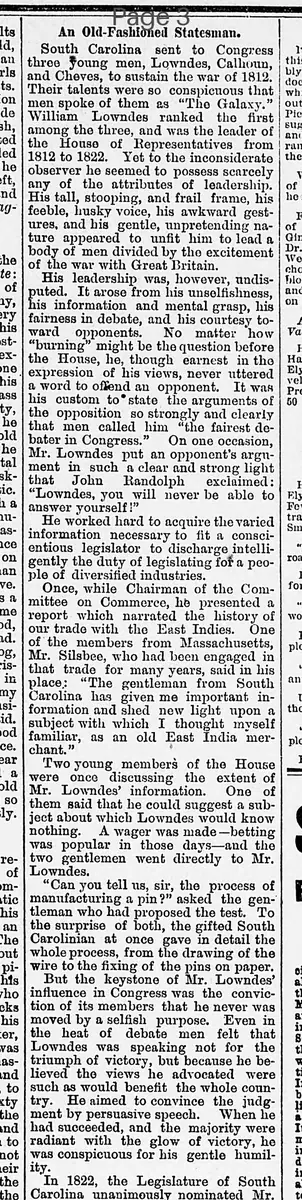
South Carolina sent to Congress three young men, Lowndes, Calhoun, and Cheves, to sustain the war of 1812. Their talents were so conspicuous that men spoke of them as 'The Galaxy.' William Lowndes ranked the first among the three, and was the leader of the House of Representatives from 1812 to 1822. Yet to the inconsiderate observer he seemed to possess scarcely any of the attributes of leadership. His tall, stooping, and frail frame, his feeble, husky voice, his awkward gestures, and his gentle, unpretending nature appeared to unfit him to lead a body of men divided by the excitement of the war with Great Britain. His leadership was, however, undisputed. It arose from his unselfishness, his information and mental grasp, his fairness in debate, and his courtesy toward opponents. No matter how 'burning' might be the question before the House, he, though earnest in the expression of his views, never uttered a word to offend an opponent. It was his custom to state the arguments of the opposition so strongly and clearly that men called him 'the fairest debater in Congress.' On one occasion, Mr. Lowndes put an opponent's argument in such a clear and strong light that John Randolph exclaimed: 'Lowndes, you will never be able to answer yourself!' He worked hard to acquire the varied information necessary to fit a conscientious legislator to discharge intelligently the duty of legislating for a people of diversified industries. Once, while Chairman of the Committee on Commerce, he presented a report which narrated the history of our trade with the East Indies. One of the members from Massachusetts, Mr. Silsbee, who had been engaged in that trade for many years, said in his place: 'The gentleman from South Carolina has given me important information and shed new light upon a subject with which I thought myself familiar, as an old East India merchant.' Two young members of the House were once discussing the extent of Mr. Lowndes' information. One of them said that he could suggest a subject about which Lowndes would know nothing. A wager was made—betting was popular in those days—and the two gentlemen went directly to Mr. Lowndes. 'Can you tell us, sir, the process of manufacturing a pin?' asked the gentleman who had proposed the test. To the surprise of both, the gifted South Carolinian at once gave in detail the whole process, from the drawing of the wire to the fixing of the pins on paper. But the keystone of Mr. Lowndes' influence in Congress was the conviction of its members that he never was moved by a selfish purpose. Even in the heat of debate men felt that Lowndes was speaking not for the triumph of victory, but because he believed the views he advocated were such as would benefit the whole country. He aimed to convince the judgment by persuasive speech. When he had succeeded, and the majority were radiant with the glow of victory, he was conspicuous for his gentle humility. In 1822, the Legislature of South Carolina unanimously nominated Mr. Lowndes as a candidate for the Presidency. He made no response to this nomination. A friend wrote him a letter, chiding him for his reticent attitude toward such a high compliment. In Mr. Lowndes' reply he stated that he had not taken and would never take a step to attract the public eye to himself. Then he uttered a sentiment which no one doubted to be the expression of one who aspired to merit rather than aimed to gain the honors of high office: 'The Presidency of the United States is not an office to be either solicited or declined.' When he died, at the early age of 42, even his political adversaries mourned the loss of a personal friend. One of the most active of them said: 'The best hopes of the country looked to William Lowndes for their fulfilment.' We have recalled this modest, retiring, unambitious statesman that our readers may muse over the achievements of one who was no orator, yet whose persuasive power and pure life made him a leader among men.
What sub-type of article is it?
What themes does it cover?
What keywords are associated?
What entities or persons were involved?
Where did it happen?
Story Details
Key Persons
Location
South Carolina, Congress, House Of Representatives
Event Date
1812 1822
Story Details
William Lowndes, a modest and unassuming South Carolinian, led the House of Representatives from 1812 to 1822 through unselfishness, extensive knowledge, fairness in debate, and courtesy, despite his frail appearance and weak voice. Known as the fairest debater, he was nominated for President in 1822 but declined to solicit the office. He died at age 42, mourned even by adversaries.