Thank you for visiting SNEWPapers!
Sign up free
The Pennsylvania Ledger, Or, The Virginia, Maryland, Pennsylvania, & New Jersey Weekly Advertiser
Philadelphia, Philadelphia County, Pennsylvania
What is this article about?
In the House of Lords, Lord Temple expresses caution in debating American policy due to transatlantic implications, supports British sovereignty and coercive measures against the colonies, and opposes a motion. Lord Townshend affirms Britain's right to control America, advocates vigorous war prosecution for quick submission, and dismisses fears of Irish unrest or foreign invasion.
Clipping
OCR Quality
Full Text
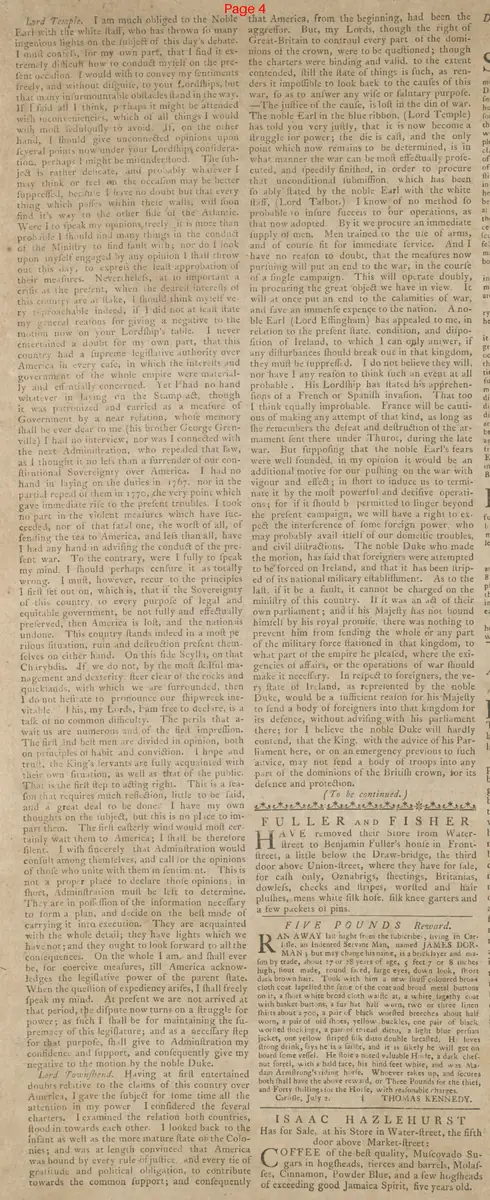
Lord Townshend. Having at first entertained doubts relative to the claims of this country over America, I gave the subject for some time all the attention in my power. I considered the several charters. I examined the relation both countries stood in towards each other. I looked back to the infant as well as the more mature state of the Colonies; and was at length convinced that America was bound by every rule of justice, and every tie of gratitude and political obligation, to contribute towards the common support; and consequently that America, from the beginning, had been the aggressor. But, my Lords, though the right of Great-Britain to controul every part of the dominions of the crown, were to be questioned; though the charters were binding and valid, to the extent contended, still the state of things is such, as renders it impossible to look back to the causes of this war, so as to answer any wise or salutary purpose. —The justice of the cause, is lost in the din of war. The noble Earl in the blue ribbon, (Lord Temple) has told you very justly, that it is now become a struggle for power; the die is cast, and the only point which now remains to be determined, is in what manner the war can be most effectually prosecuted, and speedily finished, in order to procure that unconditional submission, which has been so ably stated by the noble Earl with the white staff, (Lord Talbot.) I know of no method so probable to insure success to our operations, as that now adopted. By it we procure an immediate supply of men. Men trained to the use of arms, and of course fit for immediate service. And I have no reason to doubt, that the measures now pursuing will put an end to the war, in the course of a single campaign. This will operate doubly, in procuring the great object we have in view. It will at once put an end to the calamities of war, and save an immense expence to the nation. A noble Earl (Lord Effingham) has appealed to me, in relation to the present state, condition, and disposition of Ireland, to which I can only answer, if any disturbances should break out in that kingdom, they must be suppressed. I do not believe they will, nor have I any reason to think such an event at all probable. His Lordship has stated his apprehensions of a French or Spanish invasion. That too I think equally improbable. France will be cautious of making any attempt of that kind, as long as she remembers the defeat and destruction of the armament sent there under Thurot, during the late war. But supposing that the noble Earl's fears were well founded, in my opinion it would be an additional motive for our pushing on the war with vigour and effect; in short to induce us to terminate it by the most powerful and decisive operations; for if it should be permitted to linger beyond the present campaign, we will have a right to expect the interference of some foreign power, who may probably avail itself of our domestic troubles, and civil distractions. The noble Duke who made the motion, has said that foreigners were attempted to be forced on Ireland, and that it has been stripped of its national military establishment. As to the last, if it be a fault, it cannot be charged on the ministry of this country. If it was an act of their own parliament; and if his Majesty has not bound himself by his royal promise, there was nothing to prevent him from sending the whole or any part of the military force stationed in that kingdom, to what part of the empire he pleased, where the exigencies of affairs, or the operations of war should make it necessary. In respect to foreigners, the very state of Ireland, as represented by the noble Duke, would be a sufficient reason for his Majesty to send a body of foreigners into that kingdom for its defence, without advising with his parliament there; for I believe the noble Duke will hardly contend, that the King, with the advice of his Parliament here, or on an emergency previous to such advice, may not send a body of troops into any part of the dominions of the British crown, for its defence and protection.
(To be continued.)
What sub-type of article is it?
What keywords are associated?
What entities or persons were involved?
Where did it happen?
Foreign News Details
Primary Location
America
Key Persons
Outcome
support for coercive measures and negative vote on the motion to maintain british legislative supremacy over america; expectation of war ending in one campaign with unconditional submission.
Event Details
Lord Temple cautions against open criticism of Ministry's American policy due to potential transatlantic leaks, affirms British sovereignty, criticizes past measures like Stamp Act and tea shipment but supports coercive actions in current power struggle, and opposes the motion. Lord Townshend, convinced of Britain's rights over colonies, argues focus should be on prosecuting the war effectively for quick victory and submission, dismisses Irish disturbance or foreign invasion risks, and justifies military deployments to Ireland.