Thank you for visiting SNEWPapers!
Sign up free
Literary
November 18, 1880
Louisiana Capitolian
Baton Rouge, East Baton Rouge County, Louisiana
What is this article about?
In 1779, Captain Seawall commands the Tyrannicide, a Salem privateer schooner, as it sets sail from harbor. Encountering British vessels, including a sloop-of-war escorting merchants, the crew prepares for battle, ambushes the sloop with drags to slow down, delivers devastating broadsides, and causes its magazine to explode, destroying it without survivors.
Clipping
OCR Quality
92%
Excellent
Full Text
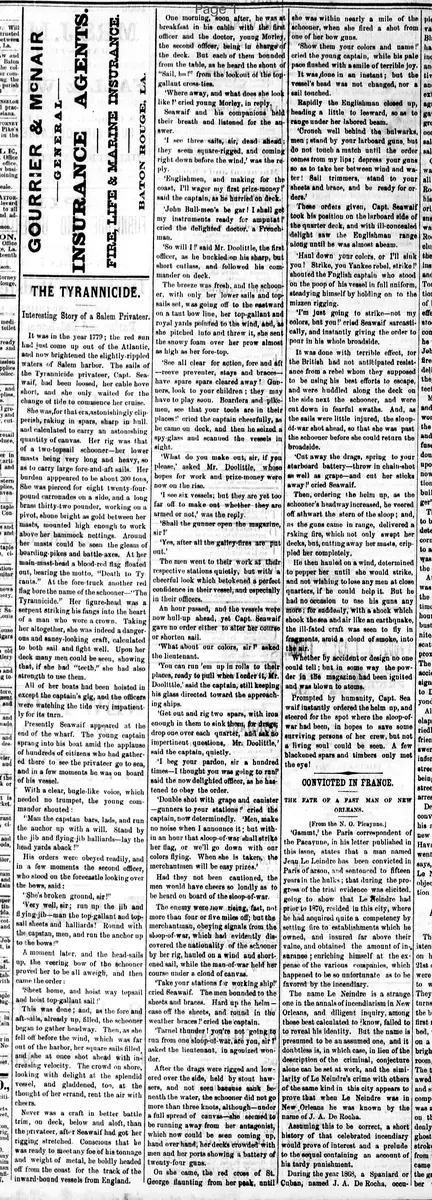
THE TYRANNICIDE.
Interesting Story of a Salem Privateer
It was in the year 1779; the red sun had just come up out of the Atlantic, and now brightened the slightly-rippled waters of Salem harbor. The sails of the Tyrannicide privateer, Capt. Seawall, had been loosed. Her cable hove short, and she only waited for the change of tide to commence her cruise.
She was, for that era, astonishingly clipperish, raking in spars, sharp in hull, and calculated to carry an astonishing quantity of canvas. Her rig was that of a two-topsail schooner--her lower masts being very long and heavy, so as to carry large fore-and-aft sails. Her burden appeared to be about 300 tons.
She was pierced for eight twenty-four-pound carronades on a side, and a long brass thirty-two pounder, working on a pivot, shone bright as gold between her masts, mounted high enough to work above her hammock nettings. Around her masts could be seen the gleam of boarding-pikes and battle-axes. At her main-mast-head a blood-red flag floated out, bearing the motto, "Death to Tyrants." At the fore-truck another red flag bore the name of the schooner—"The Tyrannicide." Her figure-head was a serpent striking his fangs into the heart of a man who wore a crown. Taking her altogether, she was indeed a dangerous and saucy-looking craft, calculated to both sail and fight well. Upon her deck many men could be seen, showing that, if she had "teeth," she had also strength to use them.
All of her boats had been hoisted in except the captain's gig, and the officers were watching the tide very impatiently for its turn.
Presently Seawall appeared at the end of the wharf. The young captain sprang into his boat amid the applause of hundreds of citizens who had gathered there to see the privateer go to sea, and in a few moments he was on board of his vessel.
With a clear, bugle-like voice, which needed no trumpet, the young commander shouted:
"Man the capstan bars, lads, and run the anchor up with a will. Stand by the jib and flying-jib halliards--lay the head yards aback!"
His orders were obeyed readily, and in a few moments the second officer, who stood on the forecastle looking over the bows, said:
"She's broken ground, sir!"
"Very well, sir; run up the jib and flying-jib--man the top-gallant and top-sail sheets and halliards! Round with the capstan, men, and run the anchor up to the bow!"
A moment later, and the head-sails up, the veering bow of the schooner proved her to be all a weigh, and then came the order:
"Sheet home, and hoist away topsail and hoist top-gallant sail!"
This was done; and, as the fore and aft-sails, already up, filled, the schooner began to gather headway. Then, as she fell off before the wind, which was fair out of the harbor, her square sails filled and she at once shot ahead with increasing velocity. The crowd on shore, looking with delight at the splendid vessel, and gladdened, too, at the thought of her errand, rent the air with cheers.
Never was a craft in better battle trim, on deck, below and aloft, than the privateer, after Seawall had got her rigging stretched. Conscious that he was ready to meet any foe of his tonnage and weight of metal, he boldly headed off from the coast for the track of the inward-bound vessels from England.
One morning, soon after, he was at breakfast in his cabin with the first officer and the doctor, young Morley, the second officer, being in charge of the deck. But each of them bounded from the table, as he heard the shout of "Sail, ho!" from the lookout of the top-gallant cross-trees.
"Where away, and what does she look like?" cried young Morley, in reply.
Seawall and his companions held their breath and listened for the answer.
"I see three sails, sir, dead ahead; they seem square-rigged, and coming right down before the wind," was the reply.
"Englishmen, and making for the coast, I'll wager my first prize-money!" said the captain, as he hurried on deck.
"John Bull-men's be gar! I shall get my instruments ready for amputations!" cried the delighted doctor, a Frenchman.
"So will I!" said Mr. Doolittle, the first officer, as he buckled on his sharp, but short cutlass, and followed his commander on deck.
The breeze was fresh, and the schooner, with only her lower sails and top-sails set, was going off to the eastward on a taut bow line, her top-gallant and royal yards pointed to the wind, and, as she pitched into and threw it, she sent the snowy foam over her prow almost as high as her fore-top.
"See all clear for action, fore and aft--rove preventer stays and braces--have spare spars cleared away! Gunner, look to your children; they may have to play soon. Boarders and pike men, see that your tools are in their places!" cried the captain cheerfully, as he came on deck, and then he seized a spy-glass and scanned the vessels in sight.
"What do you make out, sir, if you please," asked Mr. Doolittle, whose hopes for work and prize-money were now on the rise.
"I see six vessels; but they are yet too far off to make out whether they are armed or not," was the reply.
"Shall the gunner open the magazine, sir?"
"Yes, after all the galley-fires are put out."
The men went to their work at their respective stations quietly, but with a cheerful look which betokened a perfect confidence in their vessel, and especially in their officers.
An hour passed, and the vessels were now hull-up ahead, yet Capt. Seawall gave no order either to alter her course or shorten sail.
"What about our colors, sir!" asked the lieutenant.
"You can run 'em up in rolls to the places, ready to pull whoh I order it, Mr. Doolittle," said the captain, still keeping his glass directed toward the approaching ships.
"Got out and rig two spars, with iron enough in them to sink them, for drags: drop one over each quarter," and ask no impertinent questions, Mr. Doolittle," said the captain, quietly.
"I beg your pardon, sir a hundred times--I thought you was going to run!" said the now delighted officer, as he hastened to obey the order.
"Double shot with grape and canister--gunners to your stations!" cried the captain, now determinedly. "Men, make no noise when I announce it; but within an hour that sloop-of-war shall strike her flag, or we'll go down with our colors flying. When she is taken, the merchantmen will be easy prizes."
Had they not been cautioned, the men would have cheered so loudly as to be heard on board of the sloop-of-war.
The enemy were now rising fast, not more than four or five miles off; but the merchantmen, obeying signals from the sloop-of-war, which had evidently discovered the nationality of the schooner by her rig, hauled on a wind and shortened sail, while the man-of-war held her course under a cloud of canvas.
"Take your stations for working ship!" cried Seawall. The men bounded to the sheets and braces. "Hard up the helm--ease off the sheets, and round in the weather braces!" cried the captain.
"Tarnel thunder! You're not going to run from one sloop-of-war, are you, sir?" asked the lieutenant, in agonized wonder.
After the drags were rigged and lowered over the side, held by stout hawsers, and not seen because sank beneath the water, the schooner did not go more than three knots, although under a full spread of canvas she seemed to be running away from her antagonist which now could be seen coming up hand over hand, her decks crowded with men and her ports showing a battery of twenty-four guns.
On she came, the red cross of St. George flaunting from her peak, until she was within nearly a mile of the schooner, when she fired a shot from one of her bow guns.
"Show them your colors and name!" cried the young captain, while his pale face flushed with a smile of terrible joy.
It was done in an instant; but the vessel's head was not changed, nor a sail touched.
Rapidly the Englishman closed up, heading a little to leeward, so as to range under her larboard beam.
"Crouch well behind the bulwarks, men; stand by your larboard guns, but do not touch a match until the order comes from my lips; depress your guns so as to take her between wind and water! Sail trimmers, stand to your sheets and brace, and be ready for order."
These orders given, Capt. Seawall took his position on the larboard side of the quarter deck, and with ill-concealed delight saw the Englishman range along until he was almost abeam.
"Haul down your colors, or I'll sink you! Strike, you Yankee rebel, strike!" shouted the English captain who stood on the poop of his vessel in full uniform, steadying himself by holding on to the mizzen rigging.
"I'm just going to strike--not my colors, but you!" cried Seawall sarcastically, and instantly giving the order to pour in his whole broadside.
It was done with terrible effect, for the British had not anticipated resistance from a rebel whom they supposed to be using his best efforts to escape and were huddled along the deck on the side next the schooner, and were cut down in fearful swaths. And, as the sails were little injured, the sloop-of-war shot ahead, so that she was past the schooner before she could return the broadside.
"Cut away the drags, spring to your starboard battery--throw in chain-shot as well as grape and cut her sticks away!" cried Seawall.
Then, ordering the helm up, as the schooner's headway increased, he veered off athwart the stern of the sloop; and, as the guns came in range, delivered a raking fire, which not only swept her decks, but, cutting away her masts, crippled her completely.
He then hauled on a wind, determined to pepper her until she would strike, and not wishing to lose any men at close quarters, if he could help it. But he had no occasion to use his guns any more: for suddenly, with a shock which shook the sea and air like an earthquake, the ill-fated craft was seen to fly in fragments, amid a cloud of smoke, into the air.
Whether by accident or design no one could tell; but in some way the powder in the magazine had been ignited and was blown to atoms.
Prompted by humanity, Capt. Seawall instantly ordered the helm up, and steered for the spot where the sloop-of-war had been, in hopes to save some surviving persons of her crew, but not a living soul could be seen. A few blackened spars and timbers only met the eye!
Interesting Story of a Salem Privateer
It was in the year 1779; the red sun had just come up out of the Atlantic, and now brightened the slightly-rippled waters of Salem harbor. The sails of the Tyrannicide privateer, Capt. Seawall, had been loosed. Her cable hove short, and she only waited for the change of tide to commence her cruise.
She was, for that era, astonishingly clipperish, raking in spars, sharp in hull, and calculated to carry an astonishing quantity of canvas. Her rig was that of a two-topsail schooner--her lower masts being very long and heavy, so as to carry large fore-and-aft sails. Her burden appeared to be about 300 tons.
She was pierced for eight twenty-four-pound carronades on a side, and a long brass thirty-two pounder, working on a pivot, shone bright as gold between her masts, mounted high enough to work above her hammock nettings. Around her masts could be seen the gleam of boarding-pikes and battle-axes. At her main-mast-head a blood-red flag floated out, bearing the motto, "Death to Tyrants." At the fore-truck another red flag bore the name of the schooner—"The Tyrannicide." Her figure-head was a serpent striking his fangs into the heart of a man who wore a crown. Taking her altogether, she was indeed a dangerous and saucy-looking craft, calculated to both sail and fight well. Upon her deck many men could be seen, showing that, if she had "teeth," she had also strength to use them.
All of her boats had been hoisted in except the captain's gig, and the officers were watching the tide very impatiently for its turn.
Presently Seawall appeared at the end of the wharf. The young captain sprang into his boat amid the applause of hundreds of citizens who had gathered there to see the privateer go to sea, and in a few moments he was on board of his vessel.
With a clear, bugle-like voice, which needed no trumpet, the young commander shouted:
"Man the capstan bars, lads, and run the anchor up with a will. Stand by the jib and flying-jib halliards--lay the head yards aback!"
His orders were obeyed readily, and in a few moments the second officer, who stood on the forecastle looking over the bows, said:
"She's broken ground, sir!"
"Very well, sir; run up the jib and flying-jib--man the top-gallant and top-sail sheets and halliards! Round with the capstan, men, and run the anchor up to the bow!"
A moment later, and the head-sails up, the veering bow of the schooner proved her to be all a weigh, and then came the order:
"Sheet home, and hoist away topsail and hoist top-gallant sail!"
This was done; and, as the fore and aft-sails, already up, filled, the schooner began to gather headway. Then, as she fell off before the wind, which was fair out of the harbor, her square sails filled and she at once shot ahead with increasing velocity. The crowd on shore, looking with delight at the splendid vessel, and gladdened, too, at the thought of her errand, rent the air with cheers.
Never was a craft in better battle trim, on deck, below and aloft, than the privateer, after Seawall had got her rigging stretched. Conscious that he was ready to meet any foe of his tonnage and weight of metal, he boldly headed off from the coast for the track of the inward-bound vessels from England.
One morning, soon after, he was at breakfast in his cabin with the first officer and the doctor, young Morley, the second officer, being in charge of the deck. But each of them bounded from the table, as he heard the shout of "Sail, ho!" from the lookout of the top-gallant cross-trees.
"Where away, and what does she look like?" cried young Morley, in reply.
Seawall and his companions held their breath and listened for the answer.
"I see three sails, sir, dead ahead; they seem square-rigged, and coming right down before the wind," was the reply.
"Englishmen, and making for the coast, I'll wager my first prize-money!" said the captain, as he hurried on deck.
"John Bull-men's be gar! I shall get my instruments ready for amputations!" cried the delighted doctor, a Frenchman.
"So will I!" said Mr. Doolittle, the first officer, as he buckled on his sharp, but short cutlass, and followed his commander on deck.
The breeze was fresh, and the schooner, with only her lower sails and top-sails set, was going off to the eastward on a taut bow line, her top-gallant and royal yards pointed to the wind, and, as she pitched into and threw it, she sent the snowy foam over her prow almost as high as her fore-top.
"See all clear for action, fore and aft--rove preventer stays and braces--have spare spars cleared away! Gunner, look to your children; they may have to play soon. Boarders and pike men, see that your tools are in their places!" cried the captain cheerfully, as he came on deck, and then he seized a spy-glass and scanned the vessels in sight.
"What do you make out, sir, if you please," asked Mr. Doolittle, whose hopes for work and prize-money were now on the rise.
"I see six vessels; but they are yet too far off to make out whether they are armed or not," was the reply.
"Shall the gunner open the magazine, sir?"
"Yes, after all the galley-fires are put out."
The men went to their work at their respective stations quietly, but with a cheerful look which betokened a perfect confidence in their vessel, and especially in their officers.
An hour passed, and the vessels were now hull-up ahead, yet Capt. Seawall gave no order either to alter her course or shorten sail.
"What about our colors, sir!" asked the lieutenant.
"You can run 'em up in rolls to the places, ready to pull whoh I order it, Mr. Doolittle," said the captain, still keeping his glass directed toward the approaching ships.
"Got out and rig two spars, with iron enough in them to sink them, for drags: drop one over each quarter," and ask no impertinent questions, Mr. Doolittle," said the captain, quietly.
"I beg your pardon, sir a hundred times--I thought you was going to run!" said the now delighted officer, as he hastened to obey the order.
"Double shot with grape and canister--gunners to your stations!" cried the captain, now determinedly. "Men, make no noise when I announce it; but within an hour that sloop-of-war shall strike her flag, or we'll go down with our colors flying. When she is taken, the merchantmen will be easy prizes."
Had they not been cautioned, the men would have cheered so loudly as to be heard on board of the sloop-of-war.
The enemy were now rising fast, not more than four or five miles off; but the merchantmen, obeying signals from the sloop-of-war, which had evidently discovered the nationality of the schooner by her rig, hauled on a wind and shortened sail, while the man-of-war held her course under a cloud of canvas.
"Take your stations for working ship!" cried Seawall. The men bounded to the sheets and braces. "Hard up the helm--ease off the sheets, and round in the weather braces!" cried the captain.
"Tarnel thunder! You're not going to run from one sloop-of-war, are you, sir?" asked the lieutenant, in agonized wonder.
After the drags were rigged and lowered over the side, held by stout hawsers, and not seen because sank beneath the water, the schooner did not go more than three knots, although under a full spread of canvas she seemed to be running away from her antagonist which now could be seen coming up hand over hand, her decks crowded with men and her ports showing a battery of twenty-four guns.
On she came, the red cross of St. George flaunting from her peak, until she was within nearly a mile of the schooner, when she fired a shot from one of her bow guns.
"Show them your colors and name!" cried the young captain, while his pale face flushed with a smile of terrible joy.
It was done in an instant; but the vessel's head was not changed, nor a sail touched.
Rapidly the Englishman closed up, heading a little to leeward, so as to range under her larboard beam.
"Crouch well behind the bulwarks, men; stand by your larboard guns, but do not touch a match until the order comes from my lips; depress your guns so as to take her between wind and water! Sail trimmers, stand to your sheets and brace, and be ready for order."
These orders given, Capt. Seawall took his position on the larboard side of the quarter deck, and with ill-concealed delight saw the Englishman range along until he was almost abeam.
"Haul down your colors, or I'll sink you! Strike, you Yankee rebel, strike!" shouted the English captain who stood on the poop of his vessel in full uniform, steadying himself by holding on to the mizzen rigging.
"I'm just going to strike--not my colors, but you!" cried Seawall sarcastically, and instantly giving the order to pour in his whole broadside.
It was done with terrible effect, for the British had not anticipated resistance from a rebel whom they supposed to be using his best efforts to escape and were huddled along the deck on the side next the schooner, and were cut down in fearful swaths. And, as the sails were little injured, the sloop-of-war shot ahead, so that she was past the schooner before she could return the broadside.
"Cut away the drags, spring to your starboard battery--throw in chain-shot as well as grape and cut her sticks away!" cried Seawall.
Then, ordering the helm up, as the schooner's headway increased, he veered off athwart the stern of the sloop; and, as the guns came in range, delivered a raking fire, which not only swept her decks, but, cutting away her masts, crippled her completely.
He then hauled on a wind, determined to pepper her until she would strike, and not wishing to lose any men at close quarters, if he could help it. But he had no occasion to use his guns any more: for suddenly, with a shock which shook the sea and air like an earthquake, the ill-fated craft was seen to fly in fragments, amid a cloud of smoke, into the air.
Whether by accident or design no one could tell; but in some way the powder in the magazine had been ignited and was blown to atoms.
Prompted by humanity, Capt. Seawall instantly ordered the helm up, and steered for the spot where the sloop-of-war had been, in hopes to save some surviving persons of her crew, but not a living soul could be seen. A few blackened spars and timbers only met the eye!
What sub-type of article is it?
Prose Fiction
What themes does it cover?
Liberty Freedom
Patriotism
War Peace
What keywords are associated?
Privateer
Tyrannicide
Salem
Revolutionary War
Naval Battle
Seawall
British Sloop
Literary Details
Title
The Tyrannicide.
Subject
Interesting Story Of A Salem Privateer
Key Lines
At Her Main Mast Head A Blood Red Flag Floated Out, Bearing The Motto, "Death To Tyrants."
"Man The Capstan Bars, Lads, And Run The Anchor Up With A Will. Stand By The Jib And Flying Jib Halliards Lay The Head Yards Aback!"
"I'm Just Going To Strike Not My Colors, But You!" Cried Seawall Sarcastically, And Instantly Giving The Order To Pour In His Whole Broadside.
Whether By Accident Or Design No One Could Tell; But In Some Way The Powder In The Magazine Had Been Ignited And Was Blown To Atoms.