Thank you for visiting SNEWPapers!
Sign up free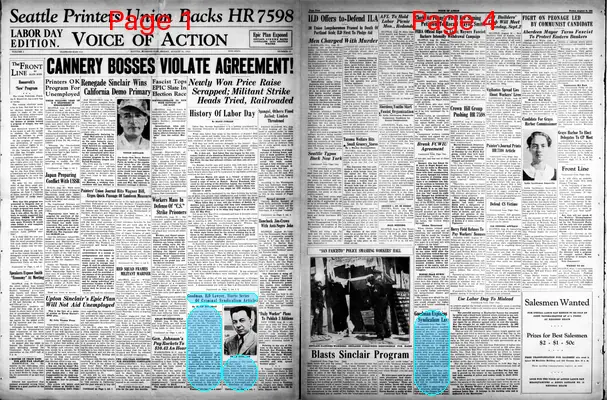
Voice Of Action
Seattle, King County, Washington
What is this article about?
Irvin Goodman, an ILD lawyer, begins a series of articles in the Voice of Action critiquing criminal syndicalism laws in Washington, Oregon, and California. These laws jail workers for exercising free speech, assembly, and political affiliation, with historical conviction data provided. Washington's law text is quoted, highlighting its broad scope against social protests.
Merged-components note: Merging continuation across pages based on explicit 'Continued on Page 4, col. 4' indicator and matching text content; relabeling to editorial as it is a signed explanatory series on syndicalism laws.
Clippings
1 of 2
OCR Quality
Full Text
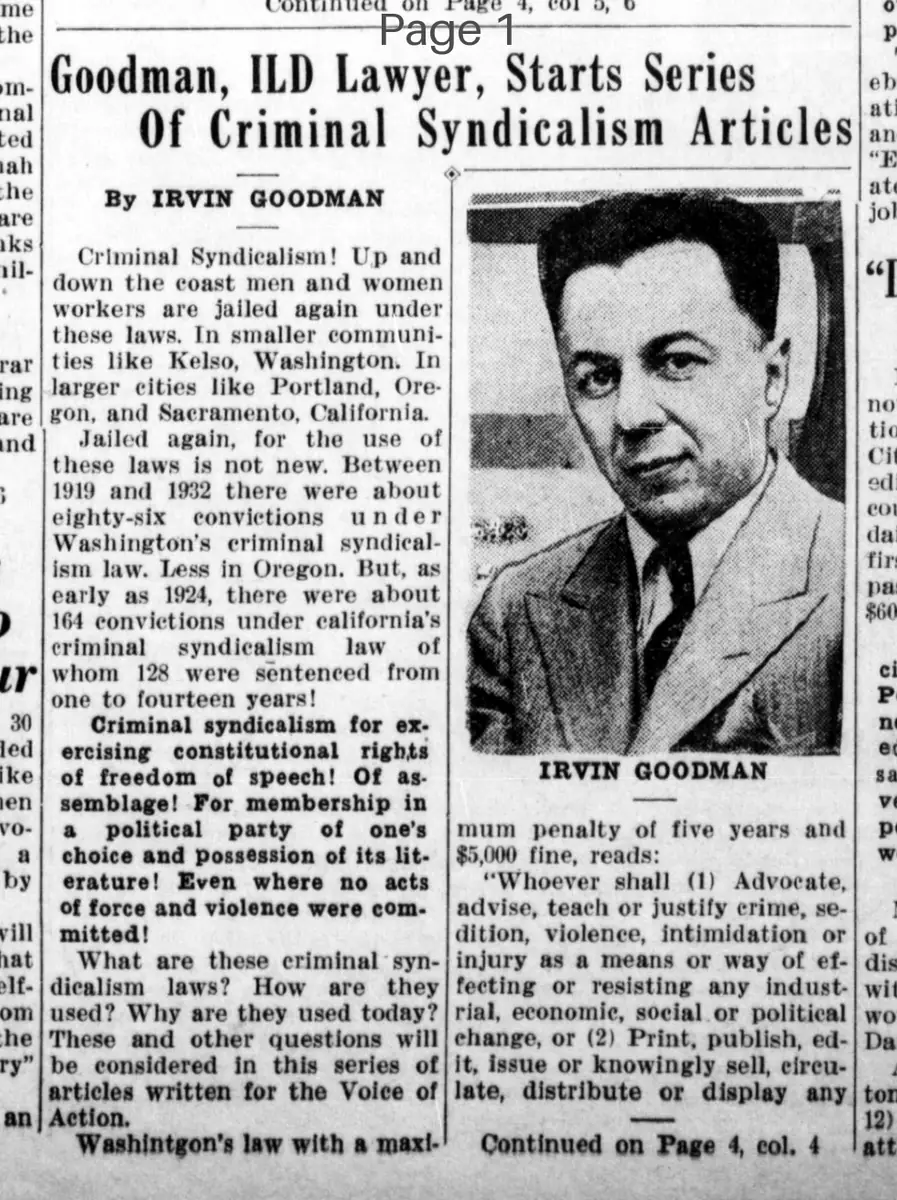
By IRVIN GOODMAN
Criminal Syndicalism! Up and down the coast men and women workers are jailed again under these laws. In smaller communities like Kelso, Washington. In larger cities like Portland, Oregon, and Sacramento, California.
Jailed again, for the use of these laws is not new. Between 1919 and 1932 there were about eighty-six convictions under Washington's criminal syndicalism law. Less in Oregon. But, as early as 1924, there were about 164 convictions under California's criminal syndicalism law, of whom 128 were sentenced from one to fourteen years!
Criminal syndicalism for exercising constitutional rights of freedom of speech! Of assemblage! For membership in a political party of one's choice and possession of its literature! Even where no acts of force and violence were committed!
What are these criminal syndicalism laws? How are they used? Why are they used today?
These and other questions will be considered in this series of articles written for the Voice of Action.
Washington's law with a maximum penalty of five years and $5,000 fine, reads:
"Whoever shall (1) Advocate, advise, teach or justify crime, sedition, violence, intimidation or injury as a means or way of effecting or resisting any industrial, economic, social or political change, or (2) Print, publish, edit, issue or knowingly sell, circulate, distribute or display any
Continued on Page 4, col. 4
Goodman Explains Syndicalism Law
Continued from Page One
book, pamphlet, paper, handbill document, or written or printed matter of any form, advocating, advising, teaching or justifying crime, sedition, violence, intimidation or injury as a means or way of effecting or resisting any industrial, economic, social or political change, or (3) Organize or help to organize, give aid to be a member of or voluntarily assemble with any group of persons formed to advocate, advise or teach crime, sedition, violence intimidation or injury as a means or way of effecting or resisting any industrial, economic, social or political change, Shall be guilty of a felony."
It is apparent that these criminal syndicalism laws are sufficiently broad to include nearly every protest against the existing social order. How they are used will be considered in the next article.
Note: Lack of space unfortunately prevents printing quotations from the Oregon Law. They will appear with the next article.
What sub-type of article is it?
What keywords are associated?
What entities or persons were involved?
Editorial Details
Primary Topic
Criminal Syndicalism Laws Restricting Free Speech And Assembly
Stance / Tone
Critical Of Syndicalism Laws As Violations Of Constitutional Rights
Key Figures
Key Arguments