Thank you for visiting SNEWPapers!
Sign up free
Editorial
December 14, 1883
Semi Weekly Interior Journal
Stanford, Lincoln County, Kentucky
What is this article about?
This editorial argues against the public display of mourning through clothing, veils, and stationery, deeming it in poor taste and a violation of the privacy of grief, which should remain personal rather than paraded conventionally.
Clipping
OCR Quality
98%
Excellent
Full Text
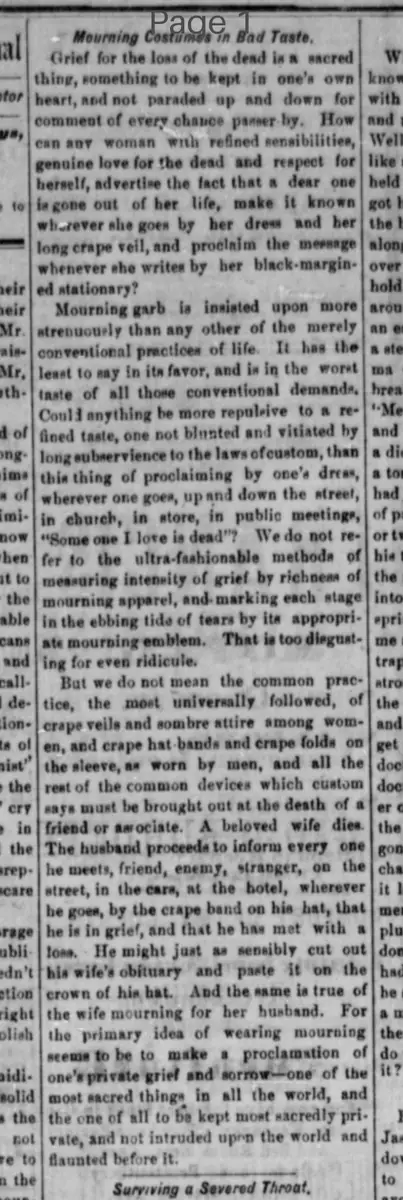
Mourning Costumes in Bad Taste,
Grief for the loss of the dead is a sacred thing, something to be kept in one's own heart, and not paraded up and down for comment of every chance passer by. How can any woman with refined sensibilities, genuine love for the dead and respect for herself, advertise the fact that a dear one is gone out of her life, make it known wherever she goes by her dress and her long crape veil, and proclaim the message whenever she writes by her black-edged stationery?
Mourning garb is insisted upon more strenuously than any other of the merely conventional practices of life. It has the least to say in its favor, and is in the worst taste of all those conventional demands.
Could anything be more repulsive to a refined taste, one not blunted and vitiated by long subservience to the laws of custom, than this thing of proclaiming by one's dress, wherever one goes, up and down the street, in church, in store, in public meetings, "Some one I love is dead"? We do not refer to the ultra-fashionable methods of measuring intensity of grief by richness of mourning apparel, and marking each stage in the ebbing tide of tears by its appropriate mourning emblem. That is too disgusting for even ridicule.
But we do not mean the common practice, the most universally followed, of crape veils and sombre attire among women, and crape hat-bands and crape folds on the sleeve, as worn by men, and all the rest of the common devices which custom says must be brought out at the death of a friend or associate. A beloved wife dies. The husband proceeds to inform every one he meets, friend, enemy, stranger, on the street, in the car, at the hotel, wherever he goes, by the crape band on his hat, that he is in grief, and that he has met with a loss. He might just as sensibly cut out his wife's obituary and paste it on the crown of his hat. And the same is true of the wife mourning for her husband. For the primary idea of wearing mourning seems to be to make a proclamation of one's private grief and sorrow one of the most sacred things in all the world, and the one of all to be kept most sacredly private, and not intruded upon the world and flaunted before it.
Grief for the loss of the dead is a sacred thing, something to be kept in one's own heart, and not paraded up and down for comment of every chance passer by. How can any woman with refined sensibilities, genuine love for the dead and respect for herself, advertise the fact that a dear one is gone out of her life, make it known wherever she goes by her dress and her long crape veil, and proclaim the message whenever she writes by her black-edged stationery?
Mourning garb is insisted upon more strenuously than any other of the merely conventional practices of life. It has the least to say in its favor, and is in the worst taste of all those conventional demands.
Could anything be more repulsive to a refined taste, one not blunted and vitiated by long subservience to the laws of custom, than this thing of proclaiming by one's dress, wherever one goes, up and down the street, in church, in store, in public meetings, "Some one I love is dead"? We do not refer to the ultra-fashionable methods of measuring intensity of grief by richness of mourning apparel, and marking each stage in the ebbing tide of tears by its appropriate mourning emblem. That is too disgusting for even ridicule.
But we do not mean the common practice, the most universally followed, of crape veils and sombre attire among women, and crape hat-bands and crape folds on the sleeve, as worn by men, and all the rest of the common devices which custom says must be brought out at the death of a friend or associate. A beloved wife dies. The husband proceeds to inform every one he meets, friend, enemy, stranger, on the street, in the car, at the hotel, wherever he goes, by the crape band on his hat, that he is in grief, and that he has met with a loss. He might just as sensibly cut out his wife's obituary and paste it on the crown of his hat. And the same is true of the wife mourning for her husband. For the primary idea of wearing mourning seems to be to make a proclamation of one's private grief and sorrow one of the most sacred things in all the world, and the one of all to be kept most sacredly private, and not intruded upon the world and flaunted before it.
What sub-type of article is it?
Social Reform
What keywords are associated?
Mourning Customs
Grief Privacy
Social Conventions
Bad Taste
Crape Veils
Editorial Details
Primary Topic
Critique Of Public Mourning Attire
Stance / Tone
Critical Of Conventional Mourning Practices
Key Arguments
Grief Is Sacred And Should Remain Private In One's Heart
Public Mourning Attire Advertises Personal Loss To Strangers
Mourning Garb Is A Conventional Demand In Worst Taste
Proclaiming Grief Via Dress Is Repulsive To Refined Sensibilities
Common Practices Like Crape Veils And Hat Bands Intrude Sacred Sorrow On The Public