Thank you for visiting SNEWPapers!
Sign up free
The Massachusetts Spy
Worcester, Worcester County, Massachusetts
What is this article about?
The South Carolina Convention's address to other states declares the 1828 and 1832 tariff acts unconstitutional and void within the state, invoking states' rights to nullify them. It criticizes the protective tariff system as oppressive, akin to colonial vassalage, and proposes alternative taxation while warning of potential union dissolution if coercion occurs.
Clipping
OCR Quality
Full Text
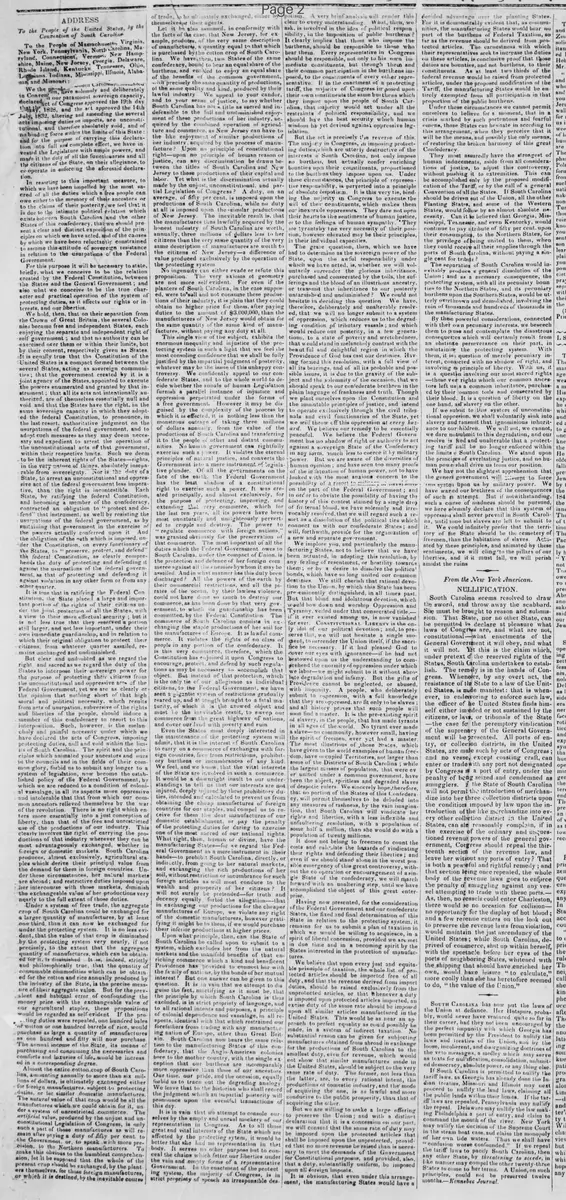
To the People of the United States, by the
Convention of South Carolina.
To the People of Massachusetts, Virginia, New York, Pennsylvania, North Carolina, Maryland, Connecticut, Vermont, New Hampshire, Rhode Island, Kentucky, Tennessee, Ohio, Louisiana, Indiana, Mississippi, Illinois, Alabama and Missouri:
We the people of South Carolina, in convention solemnly and deliberately assembled in sovereign capacity, have declared that the tariff act of 1828, and the act approved the 14th July, 1832, altering and amending the several acts imposing duties on imports, are unconstitutional, and therefore absolutely void, and of no binding force within the limits of this State: and for the purpose of carrying this declaration into full and complete effect, we have invested the Legislature with ample powers, and made it the duty of all the functionaries and all the citizens of the State, on their allegiance, to cooperate in enforcing the aforesaid declaration.
In resorting to this important measure, to which we have been impelled by the most sacred of all the duties which a free people can owe either to the memory of their ancestors or to the claims of their posterity, we feel that it is due to the intimate political relation which exists between South Carolina and the other States of this confederacy, that we should present a clear and distinct exposition of the principles on which we have acted, and of the causes by which we have been reluctantly constrained to assume this attitude of sovereign resistance in relation to the usurpations of the Federal Government.
For this purpose it will be necessary to state, briefly, what we conceive to be the relation created by the Federal Constitution, between the States and the General Government; and also what we conceive to be the true character and practical operation of the system of protecting duties, as it affects our rights or interests, and our liberties.
We hold, then, that on their separation from the Crown of Great Britain, the several Colonies became free and independent States, each enjoying the separate and independent right of self government; and that no authority can be exercised over them or within their limits, but by their consent, respectively given as States.
It is equally true that the Constitution of the United States is a compact formed between the several States, acting as sovereign communities; that the government created by it is a joint agency of the States, appointed to execute the powers enumerated and granted by that instrument; that all its acts not intentionally authorized, are of themselves essentially null and void and that the States have the right, in the same sovereign capacity in which they adopted the federal Constitution, to pronounce, in the last resort, authoritative judgment on the usurpations of the federal government, and to adopt such measures as they may deem necessary and expedient to arrest the operation of the unconstitutional acts of that government, within their respective limits. Such we deem to be the inherent rights of the States—rights, in the very nature of things, absolutely inseparable from sovereignty. Nor is the duty of a State, to arrest an unconstitutional and oppressive act of the federal government less imperative, than the right is incontestable. Each State, by ratifying the federal Constitution, and becoming a member of the confederacy contracted an obligation to "protect and defend" that instrument, as well by resisting the usurpations of the federal government, as by sustaining that government in the exercise of the powers actually conferred upon it. And the obligation of the oath which is imposed, under the Constitution, on every functionary of the States, to "preserve, protect, and defend" the federal Constitution, as clearly comprehends the duty of protecting and defending it against the usurpations of the federal government, as that of protecting and defending it against violation in any other form or from any other quarter.
It is true that in ratifying the Federal Constitution, the State placed a large and important portion of the rights of their citizens under the joint protection of all the States, with a view to their more effectual security; but it is not less true that they reserved a portion still larger, and not less important, under their own immediate guardianship, and in relation to which their original obligation to protect their citizens, from whatever quarter assailed, remains unchanged and undiminished.
But clear and undoubted as we regard the right and sacred as we regard the duty of the States to interpose their sovereign power for the purpose of protecting their citizens from the unconstitutional and oppressive acts of the Federal Government, yet we are as clearly of the opinion that nothing short of that high moral and political necessity, which results from acts of usurpation, subversive of the rights and liberties of the people, should induce a member of this confederacy to resort to this interposition. Such, however, is the melancholy and painful necessity under which we have declared the acts of Congress, imposing protecting duties, null and void within the limits of South Carolina. The spirit and the principles which animated your ancestors and ours in the councils and in the fields of their common glory, forbid us to submit any longer to a system of legislation, now become the established policy of the Federal Government, by which we are reduced to a condition of colonial vassalage, in all its aspects more oppressive and intolerable than that from which our common ancestors relieved themselves by the war of the revolution. There is no right which enters more essentially into a just conception of liberty, than that of the free and unrestricted use of the productions of our industry. This clearly involves the right of carrying the productions of that industry wherever they can be most advantageously exchanged, whether in foreign or domestic markets. South Carolina produces, almost exclusively, agricultural staples which derive their principal value from the demand for them in foreign countries. Under these circumstances, her natural markets are abroad; and restrictive duties imposed upon her intercourse with those markets, diminish the exchangeable value of her productions very nearly to the full extent of those duties.
Under a system of free trade, the aggregate crop of South Carolina could be exchanged for a larger quantity of manufactures, by at least one third, than it can now be exchanged for under the protecting system. It is no less evident, that the value of that crop is diminished by the protecting system very nearly, if not precisely, to the extent that the aggregate quantity of manufactures, which can be obtained for it, is diminished. It is, indeed, strictly and philosophically true, that the quantity of consumable commodities which can be obtained for the cotton and rice annually produced by the industry of the State, is the precise measure of their aggregate value. But for the prevalent and habitual error of confounding the money price with the exchangeable value of our agricultural staples, these propositions would be regarded as self evident. If the protecting duties were repealed, one hundred bales of cotton or one hundred barrels of rice, would purchase as large a quantity of manufactures as one hundred and fifty will now purchase. The annual income of the State, its means of purchasing and consuming the necessaries and comforts and luxuries of life, would be increased in a corresponding degree.
Almost the entire cotton crop of South Carolina, amounting annually to more than six millions of dollars, is ultimately exchanged either for foreign manufactures, subject to protecting duties, or for similar domestic manufactures. The natural value of that crop would be all the manufactures which we could obtain for it, under a system of unrestricted commerce. The artificial value, produced by the unjust and unconstitutional Legislation of Congress, is only such a part of those manufactures as will remain after paying a duty of fifty per cent. to the Government, or, to speak with more precision, to the Northern manufacturers. To make this obvious to the humblest comprehension, let it be supposed that the whole of the present crop should be exchanged, by the planters themselves, for those foreign manufactures, for which it is destined, by the inevitable course of trade, to be ultimately exchanged, either by themselves or their agents.
Let it be also assumed, in conformity with the facts of the case, that New Jersey, for example, produces, of the very same description of manufactures, a quantity equal to that which is purchased by the cotton crop of South Carolina. We have then, two States of the same confederacy, bound to bear an equal share of the burthens, and entitled to enjoy an equal share of the benefits of the common government, with precisely the same quantity of productions, of the same quality and kind, produced by their lawful industry. We appeal to your candor, and to your sense of justice, to say whether South Carolina has not a title as sacred and indefeasible to the full and undiminished enjoyment of these productions of her industry, acquired by the combined operation of agriculture and commerce, as New Jersey can have to the like enjoyment of similar productions of her industry, acquired by the process of manufacture? Upon no principle of constitutional right—upon no principle of human reason or justice, can any discrimination be drawn between the titles of South Carolina and New Jersey to those productions of their capital and labor. Yet what is the discrimination actually made by the unjust, unconstitutional, and partial Legislation of Congress? A duty, on an average, of fifty per cent. is imposed upon the productions of South Carolina, while no duty at all is imposed upon the similar productions of New Jersey. The inevitable result is, that the manufactures thus lawfully acquired by the honest industry of South Carolina are worth, annually, three millions of dollars less to her citizens than the very same quantity of the very same description of manufactures are worth to the citizens of New Jersey—a difference of value produced exclusively by the operation of the protecting system.
No ingenuity can either evade or refute this proposition. The very axioms of geometry are not more self evident. For even if the planters of South Carolina, in the case supposed, were to sell and not consume these productions of their industry, it is plain that they could obtain no higher price for them, after paying duties to the amount of $3,000,000, than the manufacturers of New Jersey would obtain for the same quantity of the same kind of manufactures, without paying any duty at all.
This single view of the subject, exhibits the enormous inequality and injustice of the protecting system in such a light that we feel the most consoling confidence that we shall be fully justified by the impartial judgment of posterity, whatever may be the issue of this unhappy controversy. We confidently appeal to our confederate States, and to the whole world to decide whether the annals of human Legislation furnish a parallel instance of injustice and oppression perpetrated under the forms of a free government. However it may be disguised by the complexity of the process by which it is effected, it is nothing less than the monstrous outrage of taking three millions of dollars annually, from the value of the productions of South Carolina and transferring it to the people of other and distant communities. No human government can rightfully exercise such a power. It violates the eternal principles of natural justice, and converts the Government into a mere instrument of legislative plunder. Of all the governments on the face of the earth, the Federal Government has the least shadow of a constitutional right to exercise such a power. It was created principally, and almost exclusively, for the purpose of protecting, improving, and extending her very commerce, which for the last ten years, all its powers have been most unnaturally and unrighteously perverted to cripple and destroy. The power to "regulate commerce with foreign nations," was granted obviously for the preservation of that commerce. The most important of all the duties which the Federal Government owes to South Carolina, under the compact of Union, is the protection and defence of her foreign commerce against all the enemies by whom it may be assailed. And in what manner has this duty been discharged? All the powers of the earth by their commercial restrictions, and all the pirates of the ocean, by their lawless violence, could not have done so much to destroy our commerce, as has been done by that very government, to which its guardianship has been committed, by the Federal Constitution. The commerce of South Carolina consists in exchanging the staple productions of her soil for the manufactures of Europe. It is lawful commerce. It violates the rights of no class of people in any portion of the confederacy. It is this very commerce, therefore, which the Constitution has enjoined it upon Congress to encourage, protect, and defend by such regulations as may be necessary to accomplish that object. But instead of that protection, which is the only tie of our allegiance as individual citizens, to the Federal Government, we have seen a gigantic system of restrictions gradually reared up, and at length brought to a fatal maturity, of which it is the avowed object and must be the inevitable result, to sweep our commerce from the great highway of nations, and cover our land with poverty and ruin.
Even the States most deeply interested in the maintenance of the protecting system will admit, that it is the interest of South Carolina to carry on a commerce of exchanges with foreign countries, free from restrictions, prohibitory burthens or incumbrances of any kind. We feel, and we know, that the vital interests of the State are involved in such a commerce. It would be a downright insult to our understandings to tell us that our interests are not injured, deeply injured by these prohibitory duties, intended and calculated to prevent us from obtaining the cheap manufactures of foreign countries for our staples, and compel us to receive for them the dear manufactures of our domestic establishment, or pay the penalty of the protecting duties for daring to exercise one of the most sacred of our national rights.
What right, then, human or divine, have the manufacturing States—for we regard the Federal Government as a mere instrument in their hands—to prohibit South Carolina, directly, or indirectly, from going to her natural markets, and exchanging the rich productions of her soil, without restriction or incumbrance for such foreign articles as will most conduce to the wealth and prosperity of her citizens? It will not surely be pretended—for truth and decency equally forbid the allegation—that in exchanging our productions for the cheaper manufactures of Europe, we violate any right of the domestic manufacturer, however gratifying it might be to them, if we would purchase their inferior productions at higher prices.
Upon what principle, then, can the State of South Carolina be called upon to submit to a system, which excludes her from the natural markets and the manifold benefits of that enriching commerce which a kind and beneficent Providence has provided to connect her with the family of nations, by the bonds of her mutual interest? But one answer can be given to this question. It is in vain that we attempt to disguise the fact, mortifying as it must be, that the principle by which South Carolina is thus excluded, is in strict propriety of language, and to all rational intents and purposes, a principle of colonial dependence and vassalage, in all respects, identical with that which restrained our forefathers from trading with any manufacturing nation of Europe, other than Great Britain. South Carolina now bears the same relation to the manufacturing States of this confederacy, that the Anglo-American colonies bore to the mother country, with the single exception that our burthens are incomparably more oppressive than those of our ancestors. Our time, our pride, and the occasion, equally forbid us to trace out the degrading analogy. We leave that to the historian who shall record the judgment which an impartial posterity will pronounce upon the eventful transactions of this day.
It is in vain that we attempt to console ourselves by the empty and unreal mockery of our representation in Congress. As to all those great and vital interests of the State which are affected by the protecting system, it would be better that she had no representation in that body. It serves no other purpose but to conceal the chains which fetter our liberties under the vain and empty forms of a representative Government. In the enactment of the protecting system, the majority of Congress, is in strict propriety of speech an irresponsible despotism with respect to the people of South Carolina. What, then, we ask, is involved in the idea of political responsibility, in the imposition of public burthens? It clearly implies that those who impose the burthens, should be responsible to those who bear them. Every representative in Congress should be responsible, not only to his own immediate constituents, but through them and their common participation in the burthens imposed, to the constituents of every other representative. If in the enactment of a protecting tariff, the majority of Congress imposed upon their own constituents the same burthens which they impose upon the people of South Carolina, that majority would act under all the restraints of political responsibility, and we should have the best security which human wisdom has yet devised against oppressive legislation.
But the act is precisely the reverse of this. The majority in Congress, in imposing protecting duties, which are utterly destructive of the interests of South Carolina, not only impose no burthens, but actually confer enriching bounties upon their constituents, proportioned to the burthens they impose upon us. Under these circumstances, the principle of representative responsibility, is perverted into a principle of absolute despotism. It is this very tie, binding the majority in Congress to execute the will of their constituents, which makes them our inexorable oppressors. They dare not open their hearts to the sentiments of human justice, or to the feelings of human sympathy. They are tyrants by the very necessity of their position, however elevated may be their principles, in their individual capacities.
The grave question, then, which we have had to determine as the sovereign power of the State, upon the awful responsibility under which we have acted, is, whether we will voluntarily surrender the glorious inheritance, purchased and consecrated by the toils, the sufferings and the blood of an illustrious ancestry, or transmit that inheritance to our posterity untarnished and undiminished. We could not hesitate in deciding this question. We have, therefore, deliberately and unalterably resolved, that we will no longer submit to a system of oppression, which reduces us to the degrading condition of tributary vassals; and which would reduce our posterity, in a few generations, to a state of poverty and wretchedness, that would stand in melancholy contrast with the beautiful and delightful region in which the Providence of God has cast our destinies. In forming this resolution, with a full view of all its bearings, and of all its probable and possible issues, it is due to the gravity of the subject and the solemnity of the occasion, that we should speak to our confederate brethren in the plain language of frankness and truth. Though we plant ourselves upon the Constitution and the immutable principles of justice, and intend to operate exclusively through the civil tribunals and civil functionaries of the State, yet we will throw off this oppression at every hazard. We believe our remedy to be essentially peaceful. We believe the Federal Government has no shadow of right or authority to act against a sovereign State of the Confederacy in any form, much less to coerce it by military power. But we are aware of the diversities of human opinion: and have seen too many proofs of the infatuation of human power, not to have looked with the most anxious concern to the possibility of a resort to military or naval force on the part of the Federal Government; and in order to obviate the possibility of having the history of this contest stained by a single drop of fraternal blood, we have solemnly and irrevocably resolved, that we will regard such a resort as a dissolution of the political ties which connect us with our confederate States; and will, forthwith, provide for the organization of a new and separate government. We implore you, and particularly the manufacturing States, not to believe that we have been actuated, in adopting this resolution, by any feeling of resentment, or hostility towards them; or by a desire to dissolve the political bonds, which have so long united our common destinies. We still cherish that rational devotion to the Union, by which this State has been pre-eminently distinguished, in all times past. But that blind and idolatrous devotion, which would bow down and worship Oppression and Tyranny, veiled under that consecrated title,—if it ever existed among us, is now vanished forever. CONSTITUTIONAL LIBERTY is the only idol of our political devotion; and, to preserve that, we will not hesitate a single moment, to surrender the Union itself, if the sacrifice be necessary. If it had pleased God to cover our eyes with ignorance—if he had not bestowed upon us the understanding to comprehend the enormity of oppression under which we labor—we might submit to it without absolute degradation and infamy. But the gifts of Providence cannot be neglected, or abused, with impunity. A people, who deliberately submit to oppression, with a full knowledge that they are oppressed, are fit only to be slaves; and all history proves that such people will soon find a master. It is the pre-existing spirit of slavery, in the people, that has made tyrants in all ages of the world. No tyrant ever made a slave—no community, however small, having the spirit of freemen, ever yet had a master. The most illustrious of those States, which have given to the world examples of human freedom, have occupied Territories, not larger than some of the Districts of South Carolina; while the largest masses of population, that were ever united under a common government, have been the abject, spiritless and degraded slaves of despotic rulers. We sincerely hope, therefore, that no portion of the States of this Confederacy, will permit themselves to be deluded into any measures of rashness, by the vain imagination, that South Carolina will vindicate her rights and liberties, with a less inflexible and unfaltering resolution, with a population of some half a million, than she would do with a population of twenty millions.
It does not belong to freemen to count the costs and calculate the hazards of vindicating their rights and defending their liberties; and even if we should stand alone in the worst possible emergency of this great controversy, without the co-operation or encouragement of a single State of the confederacy, we will march forward with an unaltering step, until we have accomplished the object of this great enterprise.
Having now presented, for the consideration of the Federal Government and our confederate States, the fixed and final determination of this State in relation to the protecting system, it remains for us to submit a plan of taxation in which we would be willing to acquiesce, in a spirit of liberal concession, provided we are met in due time and in a becoming spirit by the States interested in the protection of manufactures.
We believe that upon every just and equitable principle of taxation, the whole list of protected articles should be imported free of all duty, and that the revenue derived from import duties, should be raised exclusively from the unprotected articles, or that whenever a duty is imposed upon protected articles imported, an excise duty of the same rate should be imposed upon all similar articles manufactured in the United States. This would be as near an approach to perfect equality as could possibly be made, in a system of indirect taxation. No substantial reason can be given for subjecting manufactures obtained from abroad in exchange for the productions of South Carolina to the smallest duty, even for revenue, which would not show that similar manufactures made in the United States, should be subject to the very same rate of duty. The former, not less than the latter, are, to every rational intent, the productions of domestic industry, and the mode of acquiring the one, is as lawful and more conducive to the public prosperity, than that of acquiring the other.
But we are willing to make a large offering to preserve the Union; and with a distinct declaration that it is a concession on our part, we will consent that the same rate of duty may be imposed upon the protected articles that shall be imposed upon the unprotected, provided that no more revenue be raised than is necessary to meet the demands of the Government for Constitutional purposes, and provided, also, that a duty, substantially uniform, be imposed upon all foreign imports.
It is obvious, that even under this arrangement, the manufacturing States would have a decided advantage over the planting States. For it is demonstrably evident that, as communities, the manufacturing States would bear no part of the burthens of Federal Taxation, so far as the revenue should be derived from protected articles. The earnestness with which their representatives seek to increase the duties on these articles, is conclusive proof that those duties are bounties, and not burthens, to their constituents. As at least two thirds of the federal revenue would be raised from protected articles, under the proposed modification of the Tariff, the manufacturing States would be entirely exempted from all participation in that proportion of the public burthens.
Under these circumstances we cannot permit ourselves to believe for a moment, that in a crisis marked by such portentous and fearful omens, those States can hesitate in acceding to this arrangement, when they perceive that it will be the means, and possibly the only means, of restoring the broken harmony of this great Confederacy.
They most assuredly have the strongest of human inducements, aside from all considerations of justice, to adjust this controversy without pushing it to extremities. This can be accomplished only by the proposed modification of the Tariff, or by the call of a general Convention of all the States. If South Carolina should be driven out of the Union, all the other Planting States, and some of the Western States, would follow by an almost absolute necessity. Can it be believed that Georgia, Mississippi, Tennessee, and even Kentucky, would continue to pay a tribute of fifty per cent. upon their consumption, to the Northern States, for the privilege of being united to them, when they could receive all their supplies through the ports of South Carolina, without paying a single cent for tribute?
The separation of South Carolina would inevitably produce a general dissolution of the Union; and as a necessary consequence, the protecting system, with all its pecuniary bounties to the Northern States, and its pecuniary burthens upon the Southern States, would be utterly overthrown and demolished, involving the ruin of thousands and hundreds of thousands in the manufacturing States.
By these powerful considerations, connected with their own pecuniary interests, we beseech them to pause and contemplate the disastrous consequences which will certainly result from an obstinate perseverance on their part, in maintaining the protecting system.
With them, it is a question of merely pecuniary interest, connected with no shadow of right, and involving no principle of liberty. With us, it is a question involving our most sacred rights—those very rights which our common ancestors left us as a common inheritance, purchased by their common toils and consecrated by their blood. It is a question of liberty on the one hand, and slavery on the other. If we submit to this system of unconstitutional oppression, we shall voluntarily sink into slavery and transmit that ignominious inheritance to our children. We will not, we cannot, we dare not submit to this degradation, and our resolve is fixed and unalterable that a protecting tariff shall be no longer enforced within the limits of South Carolina. We stand upon the principles of everlasting justice, and no human power shall drive us from our position.
We have not the slightest apprehension that the general government will attempt to force this system upon us by military power. We have warned our brethren of the consequences of such an attempt. But if notwithstanding such a course of madness should be pursued, we here solemnly declare that this system of oppression shall never prevail in South Carolina, until none but slaves are left to submit to it. We would infinitely prefer that the territory of the State should be the cemetery of freemen, than the habitation of slaves. Actuated by these principles, and animated by these sentiments, we will cling to the pillars of our liberties, and if it must fall, we will perish amidst the ruins.
What sub-type of article is it?
What keywords are associated?
Where did it happen?
Domestic News Details
Primary Location
South Carolina
Outcome
declaration of tariff acts as null and void within south carolina; investment of powers in legislature to enforce; proposal of alternative taxation plans; warning of potential dissolution of the union if federal coercion occurs.
Event Details
The Convention of South Carolina issues an address declaring the tariff acts of 1828 and July 14, 1832, unconstitutional and void in the state, based on states' rights and the compact theory of the Constitution. It argues the protective duties oppress Southern agriculture, favoring Northern manufacturers, and equates the system to colonial vassalage. The address calls for cooperation from state functionaries and citizens to resist enforcement, proposes equitable taxation alternatives, and resolves to resist federal coercion, even at the risk of secession.