Thank you for visiting SNEWPapers!
Sign up free
The Frontiersman
Wasilla, Palmer, Alaska
What is this article about?
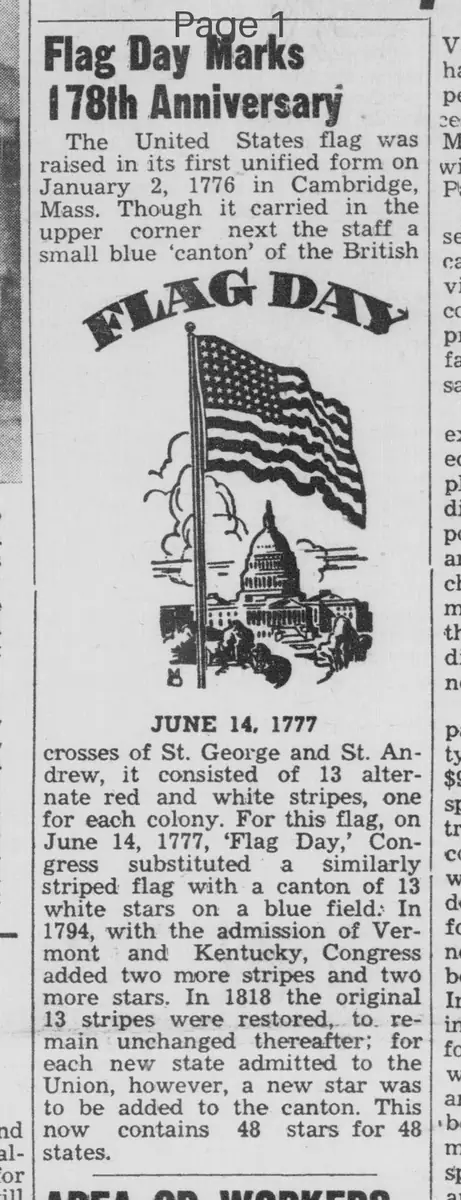
Flag Day marks the 178th anniversary of the adoption of the US flag on June 14, 1777. Details its evolution from 1776 with British elements and 13 stripes, to stars in 1777, additions in 1794, and 1818 changes to 13 stripes with stars per state, now 48.
Merged-components note: Merged image with the Flag Day story due to spatial overlap and thematic relevance.
Clipping
OCR Quality
Full Text
178th Anniversary
The United States flag was raised in its first unified form on January 2, 1776 in Cambridge, Mass. Though it carried in the upper corner next the staff a small blue 'canton' of the British crosses of St. George and St. Andrew, it consisted of 13 alternate red and white stripes, one for each colony. For this flag, on June 14, 1777, 'Flag Day,' Congress substituted a similarly striped flag with a canton of 13 white stars on a blue field. In 1794, with the admission of Vermont and Kentucky, Congress added two more stripes and two more stars. In 1818 the original 13 stripes were restored, to remain unchanged thereafter; for each new state admitted to the Union, however, a new star was to be added to the canton. This now contains 48 stars for 48 states.
What sub-type of article is it?
What keywords are associated?
Where did it happen?
Story Details
Location
Cambridge, Mass.
Event Date
January 2, 1776; June 14, 1777; 1794; 1818
Story Details
The United States flag was first raised in unified form on January 2, 1776, in Cambridge, Mass., with a British canton and 13 red and white stripes for the colonies. On June 14, 1777, Congress adopted a flag with 13 stars on blue field. In 1794, two stripes and stars added for Vermont and Kentucky. In 1818, original 13 stripes restored, with a new star added for each state thereafter, now 48 stars for 48 states.