Thank you for visiting SNEWPapers!
Sign up free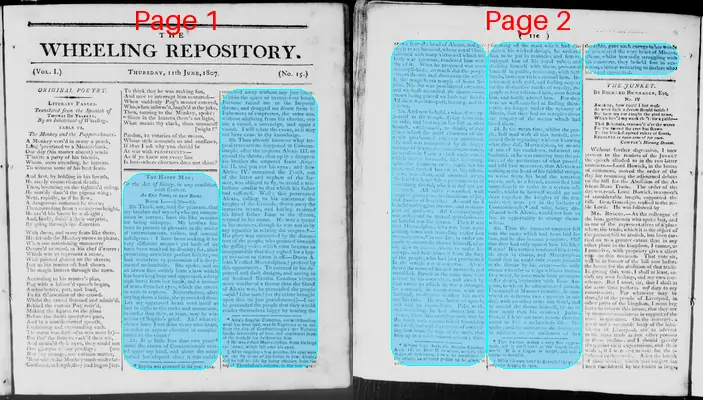
Literary
June 11, 1807
The Wheeling Repository
Wheeling, Ohio County, West Virginia
What is this article about?
In this excerpt from an epic poem, Princess Sophia laments her brief emperorship in Constantinople in 1204, describing how she and husband Nicolas Canabus were crowned amid rejoicing, only for treacherous Murtzuphus to dethrone and kill them and others, leaving her in deep melancholy.
Merged-components note: Continuation of the epic poem 'The Happy Man' across pages 1 and 2.
Clippings
1 of 2
OCR Quality
95%
Excellent
Full Text
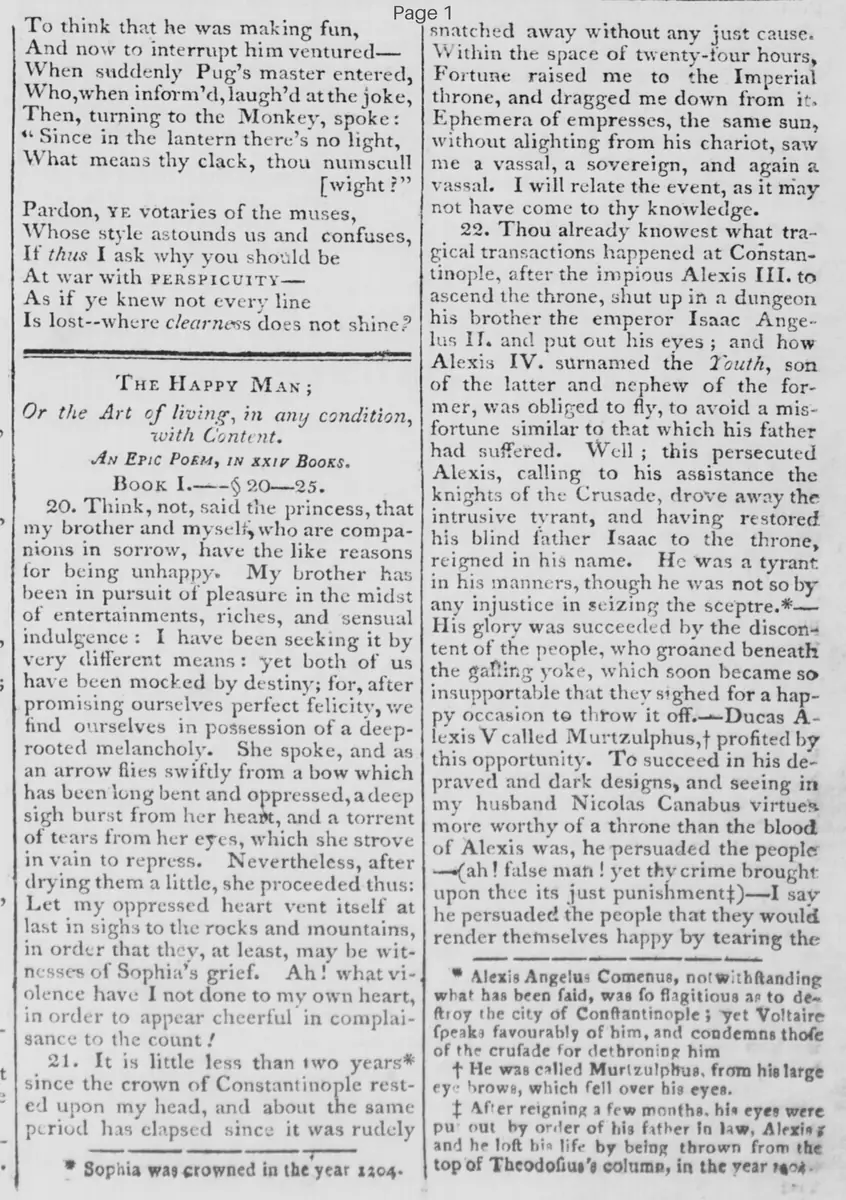
The Happy Man;
Or the Art of living, in any condition,
with Content.
An Epic Poem, In XXIV Books.
Book I.--620--25.
20. Think not, said the princess, that
my brother and myself, who are companions
in sorrow, have the like reasons
for being unhappy. My brother has
been in pursuit of pleasure in the midst
of entertainments, riches,
and sensual indulgence:
I have been seeking it by
very different means: yet both of us
have been mocked by destiny; for, after
promising ourselves perfect felicity, we
find ourselves in possession of a deep-
rooted melancholy. She spoke, and as
an arrow flies swiftly from a bow which
has been long bent and oppressed, a deep
sigh burst from her heart, and a torrent
of tears from her eyes, which she strove
in vain to repress. Nevertheless, after
drying them a little, she proceeded thus:
Let my oppressed heart vent itself
at last in sighs to the rocks and mountains,
in order that they, at least, may be witnesses
of Sophia's grief. Ah! what violence have
I not done to my own heart,
in order to appear cheerful in compliance
to the count!
21. It is little less than two years*
since the crown of Constantinople rested
upon my head, and about the same
period has elapsed since it was rudely
snatched away without any just cause.
Within the space of twenty-four hours,
Fortune raised me to the Imperial
throne, and dragged me down from it.
Ephemera of empresses, the same sun,
without alighting from his chariot, saw
me a vassal, a sovereign, and again a
vassal. I will relate the event, as it may
not have come to thy knowledge.
22. Thou already knowest what tragical
transactions happened at Constantinople, after the impious Alexis III. to
ascend the throne, shut up in a dungeon
his brother the emperor Isaac Angelus
II. and put out his eyes; and how
Alexis IV. surnamed the Youth, son
of the latter and nephew of the former, was obliged to fly, to avoid a misfortune similar to that which his father
had suffered. Well: this persecuted
Alexis, calling to his assistance the
knights of the Crusade, drove away the
intrusive tyrant, and having
restored his blind father
Isaac to the throne,
reigned in his name. He was a tyrant
in his manners, though he was not so by
any injustice in seizing the sceptre.*
His glory was succeeded by the discontent
of the people, who groaned beneath
the galling yoke, which soon became so
insupportable that they sighed for a happy
occasion to throw it off.--Ducas. Alexis V called Murtzulphus,† profited by
this opportunity. To succeed in his de-
praved and dark designs, and seeing in
my husband Nicolas Canabus virtues
more worthy of a throne than the
blood of Alexis was, he persuaded the people
—(ah! false man! yet thy crime brought
upon thee its just punishment)—I say
he persuaded the people that they would
render themselves happy by tearing the
crown from the head of the young prince, and placing it upon that of Nicolas.
*Sophia was crowned in the year 1204.
†Alexis Angelus Comnenus, notwithstanding what has been said, was so flagitious as to destroy the city of Constantinople; yet Voltaire speaks favourably of him, and condemns those of the crusade for dethroning him. He was called Murtzulphus, from his large eye brows, which fell over his eyes. After reigning a few months, his eyes were put out by order of his father in law, Alexius, and he lost his life by being thrown from the top of Theodisius's column, in the year 1205.
crown from the head of Alexis, and giving it to my husband, whose royal blood adorned with many virtues of which nobody was ignorant, rendered him worthy of it. What he proposed was soon accomplished; so much did the people esteem the one and abominate the other. In the magnificent temple of Saint Sophia, Nicolas was proclaimed emperor, and we both ascended the throne--one crown being placed on both our heads. All then was transport, feasting, and rejoicing.
23. And now behold, a white dove appeared in the temple, flying from side to side, and bearing in her bill an olive branch, emblematic, no doubt, of that peace which the mild character of the newly proclaimed emperor promised. My soul was transported by the happy presage of this mysterious circumstance. Immediately I saw a Black eagle enter, which darted furiously, like lightning, upon the innocent dove, made her his prey, and carried her off in his talons.
24. I saw, was silent, and swooned away. My faithful heart felt a presentiment of something direful, which it did not understand. All sides resounded with songs of panegyric, acclamations of joy, and dances of festivity. Around me I beheld nothing but incense, and testimonies of gladness. All Constantinople was enlivened by mutual gratulations-- so hateful was the tyrant.
Then it was that Murtzuphus, who was bent upon pulling down and trampling under foot two emperors, in one day, in order unjustly to mount the throne himself, nimbly flew to advise Alexis to make his escape, and hide himself from the fury of the people, who had just proclaimed in the temple a new emperor. Alexis heard the name of the new monarch, and trembled. Struck at the same time with horror by his own vices, and awed by that virtue to which he was a stranger, he ventured, in competition with my husband, to dispute neither his merit nor his title. He was bereft of speech, and had no counsellors. Pale, weak, and trembling, he had almost lost his senses, when Murtzuphus took him by the hand, with counterfeited friendship and zeal, and under pretence of concealing him from the rage of the mob, shut him up in a subterranean prison; then,
*History says here, viz. Nicolas Canabus, Alex. IV. and Isaac II. to whom, with the like design of destroying him as he manifested to the others, he ordered poison to be given, in 1203.
throwing off the mask which had disguised his wicked design, he ordered him to be put in manacles and fetters, stripped him of his royal robes, and decking himself with them, presented himself in public, scattering, with both hands, immense riches around him. Intoxicated with gold, and feeling respect for the distinctive marks of royalty, the people at first tolerated him, soon feared him, and finally adored him. For they were so well satisfied at finding themselves no longer under the tyranny of Alexis, that they had no scruples about the iniquity of the means which had freed them.
24. In the mean time, whilst the people, half mad with all this tumult, continued their rejoicings without knowing what they did, Murtzuphus, by means of one of his confidents, informed my husband, as he was entering into the palace, of the particulars of what passed; and told him moreover, that Alexis was coming at the head of his faithful troops, to wrest from his head the tottering crown, and, as a friend, counselled him immediately to retire to a certain safe castle, whilst he himself would go and draw together the knights of the crusade, that were yet in the harbour of Constantinople,* and who, being displeased with Alexis, would not lose so fair an opportunity to avenge themselves.
25. Thus the innocent emperor fell into the snare which had been laid for him, and he also became a captive. Oh! that they had only spared him his life! But no! His virtues rendered him terrible even in chains, and Murtzuphus found that he could only secure himself in the throne by his crimes-the only means whereby to reign without virtue. In a word, he soon made both prisoners suffer death, beginning with Isaac Angelus, to whom he administered poison. Unexampled Monster in malice, he contrived to dethrone two emperors in one day, with no other arms but fraud, and to ascend the throne himself, by no other merit than his crimes. Judge, then, if I have not more reason than the count to live a melancholy life. She spoke; and the animation she displayed, in addition to the nobleness of her
+This harbour makes a very fine appearance, and is considered as the largest in the world. It is a league in length, and half a league in breadth.
+With his own hand he strangled the young emperor Alexis, in 1204.
thoughts, gave such energy to her words as penetrated the very heart of Misano, whom, whilst inwardly struggling with his emotions, they beheld lost in suspense, without venturing to declare what his mind suggested.
Or the Art of living, in any condition,
with Content.
An Epic Poem, In XXIV Books.
Book I.--620--25.
20. Think not, said the princess, that
my brother and myself, who are companions
in sorrow, have the like reasons
for being unhappy. My brother has
been in pursuit of pleasure in the midst
of entertainments, riches,
and sensual indulgence:
I have been seeking it by
very different means: yet both of us
have been mocked by destiny; for, after
promising ourselves perfect felicity, we
find ourselves in possession of a deep-
rooted melancholy. She spoke, and as
an arrow flies swiftly from a bow which
has been long bent and oppressed, a deep
sigh burst from her heart, and a torrent
of tears from her eyes, which she strove
in vain to repress. Nevertheless, after
drying them a little, she proceeded thus:
Let my oppressed heart vent itself
at last in sighs to the rocks and mountains,
in order that they, at least, may be witnesses
of Sophia's grief. Ah! what violence have
I not done to my own heart,
in order to appear cheerful in compliance
to the count!
21. It is little less than two years*
since the crown of Constantinople rested
upon my head, and about the same
period has elapsed since it was rudely
snatched away without any just cause.
Within the space of twenty-four hours,
Fortune raised me to the Imperial
throne, and dragged me down from it.
Ephemera of empresses, the same sun,
without alighting from his chariot, saw
me a vassal, a sovereign, and again a
vassal. I will relate the event, as it may
not have come to thy knowledge.
22. Thou already knowest what tragical
transactions happened at Constantinople, after the impious Alexis III. to
ascend the throne, shut up in a dungeon
his brother the emperor Isaac Angelus
II. and put out his eyes; and how
Alexis IV. surnamed the Youth, son
of the latter and nephew of the former, was obliged to fly, to avoid a misfortune similar to that which his father
had suffered. Well: this persecuted
Alexis, calling to his assistance the
knights of the Crusade, drove away the
intrusive tyrant, and having
restored his blind father
Isaac to the throne,
reigned in his name. He was a tyrant
in his manners, though he was not so by
any injustice in seizing the sceptre.*
His glory was succeeded by the discontent
of the people, who groaned beneath
the galling yoke, which soon became so
insupportable that they sighed for a happy
occasion to throw it off.--Ducas. Alexis V called Murtzulphus,† profited by
this opportunity. To succeed in his de-
praved and dark designs, and seeing in
my husband Nicolas Canabus virtues
more worthy of a throne than the
blood of Alexis was, he persuaded the people
—(ah! false man! yet thy crime brought
upon thee its just punishment)—I say
he persuaded the people that they would
render themselves happy by tearing the
crown from the head of the young prince, and placing it upon that of Nicolas.
*Sophia was crowned in the year 1204.
†Alexis Angelus Comnenus, notwithstanding what has been said, was so flagitious as to destroy the city of Constantinople; yet Voltaire speaks favourably of him, and condemns those of the crusade for dethroning him. He was called Murtzulphus, from his large eye brows, which fell over his eyes. After reigning a few months, his eyes were put out by order of his father in law, Alexius, and he lost his life by being thrown from the top of Theodisius's column, in the year 1205.
crown from the head of Alexis, and giving it to my husband, whose royal blood adorned with many virtues of which nobody was ignorant, rendered him worthy of it. What he proposed was soon accomplished; so much did the people esteem the one and abominate the other. In the magnificent temple of Saint Sophia, Nicolas was proclaimed emperor, and we both ascended the throne--one crown being placed on both our heads. All then was transport, feasting, and rejoicing.
23. And now behold, a white dove appeared in the temple, flying from side to side, and bearing in her bill an olive branch, emblematic, no doubt, of that peace which the mild character of the newly proclaimed emperor promised. My soul was transported by the happy presage of this mysterious circumstance. Immediately I saw a Black eagle enter, which darted furiously, like lightning, upon the innocent dove, made her his prey, and carried her off in his talons.
24. I saw, was silent, and swooned away. My faithful heart felt a presentiment of something direful, which it did not understand. All sides resounded with songs of panegyric, acclamations of joy, and dances of festivity. Around me I beheld nothing but incense, and testimonies of gladness. All Constantinople was enlivened by mutual gratulations-- so hateful was the tyrant.
Then it was that Murtzuphus, who was bent upon pulling down and trampling under foot two emperors, in one day, in order unjustly to mount the throne himself, nimbly flew to advise Alexis to make his escape, and hide himself from the fury of the people, who had just proclaimed in the temple a new emperor. Alexis heard the name of the new monarch, and trembled. Struck at the same time with horror by his own vices, and awed by that virtue to which he was a stranger, he ventured, in competition with my husband, to dispute neither his merit nor his title. He was bereft of speech, and had no counsellors. Pale, weak, and trembling, he had almost lost his senses, when Murtzuphus took him by the hand, with counterfeited friendship and zeal, and under pretence of concealing him from the rage of the mob, shut him up in a subterranean prison; then,
*History says here, viz. Nicolas Canabus, Alex. IV. and Isaac II. to whom, with the like design of destroying him as he manifested to the others, he ordered poison to be given, in 1203.
throwing off the mask which had disguised his wicked design, he ordered him to be put in manacles and fetters, stripped him of his royal robes, and decking himself with them, presented himself in public, scattering, with both hands, immense riches around him. Intoxicated with gold, and feeling respect for the distinctive marks of royalty, the people at first tolerated him, soon feared him, and finally adored him. For they were so well satisfied at finding themselves no longer under the tyranny of Alexis, that they had no scruples about the iniquity of the means which had freed them.
24. In the mean time, whilst the people, half mad with all this tumult, continued their rejoicings without knowing what they did, Murtzuphus, by means of one of his confidents, informed my husband, as he was entering into the palace, of the particulars of what passed; and told him moreover, that Alexis was coming at the head of his faithful troops, to wrest from his head the tottering crown, and, as a friend, counselled him immediately to retire to a certain safe castle, whilst he himself would go and draw together the knights of the crusade, that were yet in the harbour of Constantinople,* and who, being displeased with Alexis, would not lose so fair an opportunity to avenge themselves.
25. Thus the innocent emperor fell into the snare which had been laid for him, and he also became a captive. Oh! that they had only spared him his life! But no! His virtues rendered him terrible even in chains, and Murtzuphus found that he could only secure himself in the throne by his crimes-the only means whereby to reign without virtue. In a word, he soon made both prisoners suffer death, beginning with Isaac Angelus, to whom he administered poison. Unexampled Monster in malice, he contrived to dethrone two emperors in one day, with no other arms but fraud, and to ascend the throne himself, by no other merit than his crimes. Judge, then, if I have not more reason than the count to live a melancholy life. She spoke; and the animation she displayed, in addition to the nobleness of her
+This harbour makes a very fine appearance, and is considered as the largest in the world. It is a league in length, and half a league in breadth.
+With his own hand he strangled the young emperor Alexis, in 1204.
thoughts, gave such energy to her words as penetrated the very heart of Misano, whom, whilst inwardly struggling with his emotions, they beheld lost in suspense, without venturing to declare what his mind suggested.
What sub-type of article is it?
Poem
Dialogue
What themes does it cover?
Political
What keywords are associated?
Epic Poem
Constantinople
Dethronement
Tyranny
Byzantine Empire
Sophia
Murtzuphus
Nicolas Canabus
Literary Details
Title
The Happy Man; Or The Art Of Living, In Any Condition, With Content. An Epic Poem, In Xxiv Books. Book I. 620 25.
Subject
Sophia's Recounting Of Her Brief Reign And Dethronement In Constantinople In 1204
Key Lines
Think Not, Said The Princess, That My Brother And Myself, Who Are Companions In Sorrow, Have The Like Reasons For Being Unhappy.
It Is Little Less Than Two Years* Since The Crown Of Constantinople Rested Upon My Head, And About The Same Period Has Elapsed Since It Was Rudely Snatched Away Without Any Just Cause.
And Now Behold, A White Dove Appeared In The Temple, Flying From Side To Side, And Bearing In Her Bill An Olive Branch, Emblematic, No Doubt, Of That Peace Which The Mild Character Of The Newly Proclaimed Emperor Promised.
Unexampled Monster In Malice, He Contrived To Dethrone Two Emperors In One Day, With No Other Arms But Fraud, And To Ascend The Throne Himself, By No Other Merit Than His Crimes.