Thank you for visiting SNEWPapers!
Sign up free
Editorial
September 23, 1842
The Illinois Free Trader And Lasalle County Commercial Advertiser
Ottawa, La Salle County County, Illinois
What is this article about?
Editorial defends the executive proclamation by Illinois governor, auditor, and treasurer prohibiting State bank paper for tax payments against widespread press criticism. Attributes opposition to disdain for the 'Springfield clique' and refutes claims of selfish motives, citing the Circular's vindication for the state's benefit.
Clipping
OCR Quality
98%
Excellent
Full Text
The Executive Proclamation—The Circular.
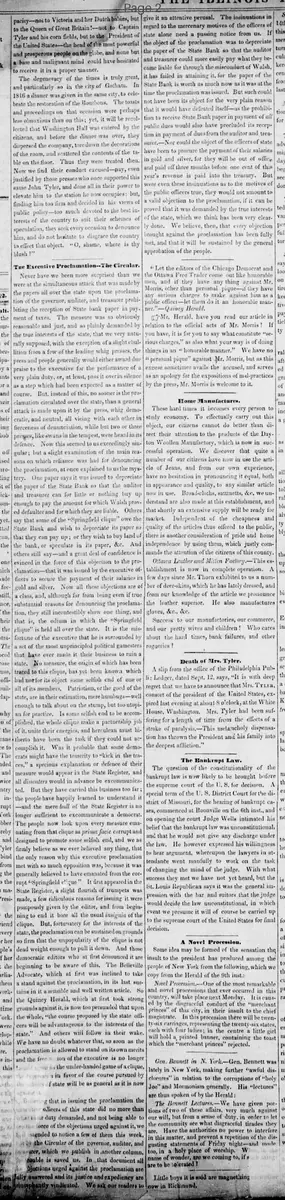
Never have we been more surprised than we were at the simultaneous attack that was made by the papers all over the state upon the proclamation of the governor, auditor, and treasurer prohibiting the reception of State bank paper in payment of taxes. The measure was so obviously reasonable and just, and so plainly demanded by the true interests of the state, that we very naturally supposed, with the exception of a slight ebullition from a few of the leading whig presses, the press and people generally would either award due praise to the executive for the performance of a very plain duty, or, at least, pass it over in silence as a step which had been expected as a matter of course. But, instead of this, no sooner is the proclamation circulated over the state, than a general attack is made upon it by the press, whig democratic, and neutral, all vieing with each other in fierceness of denunciation, while but two or three presses, like swans in the tempest, were heard in its defence. Now this seemed to us exceedingly singular; but a slight examination of the main reasons on which reliance was had for denouncing the proclamation, at once explained to us the mystery. One paper says it was issued to depreciate the paper of the State Bank so that the auditor and treasurer can for little or nothing buy up enough to pay the amount for which Walsh proved defaulter and for which they are liable. Others say that some of the "Springfield clique" owe the State Bank and wish to depreciate its paper so that they can pay up; or they wish to buy land of the bank, or speculate in its paper, &c. And others still say—and a great deal of confidence is evinced in the force of this objection to the proclamation—that it was issued by the executive officers to secure the payment of their salaries in gold and silver. Now all these objections are of a class, and, although far from being even if true substantial reasons for denouncing the proclamation, they still incontestibly show one thing, and that is, the odium in which the "Springfield clique" is held all over the state. It is the misfortune of the executive that he is surrounded by a set of the most unprincipled political gamesters that have ever made it their business to ruin a state. No measure, the origin of which has been traced to this clique, has yet been known which had not for its object some selfish end of one or all of its members, Patriotism, or the good of the state, are in their estimation, mere humbugs—well enough to talk about on the stump, but too utopian for practice. Is some selfish end to be accomplished, the whole clique make a partnership job of it, unite their energies, and herculean must hitherto have been the task if they could not accomplish it. Was it probable that some democrats might have the temerity to "kick in the traces," a specious explanation or defence of their measure would appear in the State Register, and all dissenters would in advance be excommunicated. But they have carried this business too far; the people have happily learned to understand it—and the mere bull of the State Register is no longer sufficient to excommunicate a democrat The people now look upon every measure emanating from that clique as prima facie corrupt and designed to promote some selfish end, and we as firmly believe as we ever believed any thing, that the only reason why this executive proclamation met with so much opposition was, because it was generally believed to have emanated from the corrupt "Springfield clique" It first appeared in the State Register, a slight flourish of trumpets was made, a few ridiculous reasons for issuing it were pompously given by the editor, and from beginning to end it bore all the usual insignia of the clique. But, fortunately for the interests of the state, the proclamation can be sustained on grounds so firm that the unpopularity of the clique is not dead weight enough to pull it down. And those democratic editors who at first denounced it are beginning to be aware of this. The Belleville Advocate, which at first was inclined to take a stand against the proclamation, in its last sustains it in a sensible and well written article. So the Quincy Herald, which at first took strong grounds against it, is now too persuaded that upon the whole, "the course proposed by the state officers will be advantageous to the interests of the state." And others will follow in their wake.
We have no doubt whatever that, so soon as the proclamation is allowed to stand on its own merits and the free action of the executive is no longer 'op a, the under-handed game of a clique, the sentiment in favor of the course pursued by the officers of state will be as general as it is now believing that in issuing the proclamation the executive officers of this state did no more than their duty demanded, and not being able to see the force of the objections urged against it, we intended to notice a few of them this week, but by the Circular of the governor, auditor, and treasurer, which we publish in another column, trouble is saved us. In that document all objections urged against the proclamation are fully answered and its justice and expediency are triumphantly vindicated. We ask our readers to give it an attentive perusal. The insinuations in regard to the mercenary motives of the officers of state alone need a passing notice from us. If the object of the proclamation was to depreciate the paper of the State Bank so that the auditor and treasurer could more easily pay what they became liable for through the misconduct of Walsh, it has failed in attaining it, for the paper of the State Bank is worth as much now as it was at the time the proclamation was issued. But such could not have been its object for the very plain reason that it would have defeated itself—as the prohibition to receive State Bank paper in payment of all public dues would also have precluded its reception in payment of dues from the auditor and treasurer.—Nor could the object of the officers of state have been to procure the payment of their salaries in gold and silver, for they will be out of office, and paid off three months before one cent of this year's revenue is paid into the treasury. But were even these insinuations as to the motives of the public officers true, they would not amount to a valid objection to the proclamation, if it can be proved that it was demanded by the true interests of the state, which we think has been very clearly done. We believe, then, that every objection brought against the proclamation has been fully met, and that it will be sustained by the general approbation of the people.
Never have we been more surprised than we were at the simultaneous attack that was made by the papers all over the state upon the proclamation of the governor, auditor, and treasurer prohibiting the reception of State bank paper in payment of taxes. The measure was so obviously reasonable and just, and so plainly demanded by the true interests of the state, that we very naturally supposed, with the exception of a slight ebullition from a few of the leading whig presses, the press and people generally would either award due praise to the executive for the performance of a very plain duty, or, at least, pass it over in silence as a step which had been expected as a matter of course. But, instead of this, no sooner is the proclamation circulated over the state, than a general attack is made upon it by the press, whig democratic, and neutral, all vieing with each other in fierceness of denunciation, while but two or three presses, like swans in the tempest, were heard in its defence. Now this seemed to us exceedingly singular; but a slight examination of the main reasons on which reliance was had for denouncing the proclamation, at once explained to us the mystery. One paper says it was issued to depreciate the paper of the State Bank so that the auditor and treasurer can for little or nothing buy up enough to pay the amount for which Walsh proved defaulter and for which they are liable. Others say that some of the "Springfield clique" owe the State Bank and wish to depreciate its paper so that they can pay up; or they wish to buy land of the bank, or speculate in its paper, &c. And others still say—and a great deal of confidence is evinced in the force of this objection to the proclamation—that it was issued by the executive officers to secure the payment of their salaries in gold and silver. Now all these objections are of a class, and, although far from being even if true substantial reasons for denouncing the proclamation, they still incontestibly show one thing, and that is, the odium in which the "Springfield clique" is held all over the state. It is the misfortune of the executive that he is surrounded by a set of the most unprincipled political gamesters that have ever made it their business to ruin a state. No measure, the origin of which has been traced to this clique, has yet been known which had not for its object some selfish end of one or all of its members, Patriotism, or the good of the state, are in their estimation, mere humbugs—well enough to talk about on the stump, but too utopian for practice. Is some selfish end to be accomplished, the whole clique make a partnership job of it, unite their energies, and herculean must hitherto have been the task if they could not accomplish it. Was it probable that some democrats might have the temerity to "kick in the traces," a specious explanation or defence of their measure would appear in the State Register, and all dissenters would in advance be excommunicated. But they have carried this business too far; the people have happily learned to understand it—and the mere bull of the State Register is no longer sufficient to excommunicate a democrat The people now look upon every measure emanating from that clique as prima facie corrupt and designed to promote some selfish end, and we as firmly believe as we ever believed any thing, that the only reason why this executive proclamation met with so much opposition was, because it was generally believed to have emanated from the corrupt "Springfield clique" It first appeared in the State Register, a slight flourish of trumpets was made, a few ridiculous reasons for issuing it were pompously given by the editor, and from beginning to end it bore all the usual insignia of the clique. But, fortunately for the interests of the state, the proclamation can be sustained on grounds so firm that the unpopularity of the clique is not dead weight enough to pull it down. And those democratic editors who at first denounced it are beginning to be aware of this. The Belleville Advocate, which at first was inclined to take a stand against the proclamation, in its last sustains it in a sensible and well written article. So the Quincy Herald, which at first took strong grounds against it, is now too persuaded that upon the whole, "the course proposed by the state officers will be advantageous to the interests of the state." And others will follow in their wake.
We have no doubt whatever that, so soon as the proclamation is allowed to stand on its own merits and the free action of the executive is no longer 'op a, the under-handed game of a clique, the sentiment in favor of the course pursued by the officers of state will be as general as it is now believing that in issuing the proclamation the executive officers of this state did no more than their duty demanded, and not being able to see the force of the objections urged against it, we intended to notice a few of them this week, but by the Circular of the governor, auditor, and treasurer, which we publish in another column, trouble is saved us. In that document all objections urged against the proclamation are fully answered and its justice and expediency are triumphantly vindicated. We ask our readers to give it an attentive perusal. The insinuations in regard to the mercenary motives of the officers of state alone need a passing notice from us. If the object of the proclamation was to depreciate the paper of the State Bank so that the auditor and treasurer could more easily pay what they became liable for through the misconduct of Walsh, it has failed in attaining it, for the paper of the State Bank is worth as much now as it was at the time the proclamation was issued. But such could not have been its object for the very plain reason that it would have defeated itself—as the prohibition to receive State Bank paper in payment of all public dues would also have precluded its reception in payment of dues from the auditor and treasurer.—Nor could the object of the officers of state have been to procure the payment of their salaries in gold and silver, for they will be out of office, and paid off three months before one cent of this year's revenue is paid into the treasury. But were even these insinuations as to the motives of the public officers true, they would not amount to a valid objection to the proclamation, if it can be proved that it was demanded by the true interests of the state, which we think has been very clearly done. We believe, then, that every objection brought against the proclamation has been fully met, and that it will be sustained by the general approbation of the people.
What sub-type of article is it?
Economic Policy
Partisan Politics
Taxation
What keywords are associated?
Executive Proclamation
State Bank Paper
Springfield Clique
Tax Payments
Political Opposition
Circular Defense
State Interests
What entities or persons were involved?
Governor
Auditor
Treasurer
Springfield Clique
State Bank
Walsh
State Register
Belleville Advocate
Quincy Herald
Editorial Details
Primary Topic
Defense Of Executive Proclamation Prohibiting State Bank Paper For Taxes
Stance / Tone
Strongly Supportive Of Proclamation, Critical Of Springfield Clique And Opposition
Key Figures
Governor
Auditor
Treasurer
Springfield Clique
State Bank
Walsh
State Register
Belleville Advocate
Quincy Herald
Key Arguments
Proclamation Is Reasonable, Just, And Demanded By State Interests
Opposition Stems From Odium Toward Corrupt Springfield Clique
Objections Alleging Depreciation Of Bank Paper To Cover Defaults Are Baseless And Self Defeating
Proclamation Does Not Secure Gold/Silver Salaries As Officers Leave Office Before Revenue Collection
Circular Fully Answers Objections And Vindicates Justice And Expediency
Even If Motives Were Selfish, State's Interests Justify The Measure
Press Initially Attacked But Some Democratic Papers Now Support It